When Congress passed that truncated, industry-forgiving Health Care Bill recently, Progressives and Liberals couldn't decide whether to spit or bet all the pot. President Obama had demonstrated that he just isn't an activist like FDR, or a Congress-wrangler like LBJ; the gap between his mild-mannered desire for "bipartisanship" and the Right Wing's refusal to cooperate in any way just seems insurmountable and... sad.
As the so-called Recession rolls on, jobs and housing go nowhere; and Wall Street parallels to the Great Depression keep haunting us too, except that it's ordinary people committing suicide this time rather than the obscenely wealthy banksters and CEOs.

The March 2010 issue of
The Atlantic includes a brief remembrance of one of the significant books that emerged during those hard years (and still irks surviving members of the featured sharecropper family):
Let Us Now Praise Famous Men, by over-heated writer James Agee (photo at right) and sharp-eyed photographer Walker Evans. Produced on assignment for
Fortune Magazine, this lengthy feature piece was then shelved instead,

which gave Agee time to turn it into an epic, oddly poetic account of Southern poverty in the Thirties.
Let Us Now... appeared in 1941 but proved to be a confusing misstep, panned by the critics as romantic and excessive.
But it has endured. And the "Grim Regression" we are trapped in now--that's what I call it anyway--has revived interest in Agee's book and in other cultural artifacts

from that bleak decade in the U.S. They were hard times, yes, experienced nearly everywhere in America, but also a time when folks pulled together to help each other survive and when the federal government acted swiftly and repeatedly to keep the country alive if not well.
 (Let's pause for a moment. I consider the Great Depression to have been the initial decade of our most heroic years, America's too-brief peak as a nation, lasting from approximately 1930 to 1973. And simplifying shamelessly, I'd offer these high points:
The Depression hitting everyone ("paupers and peasants and princes and kings," as Dylan put it), eventually forcing folks to work together.  Roosevelt's government dedicated to creating jobs and rebuilding infrastructure and arts alike, followed by a World War that seemed just and drove our economy into full action mode. Post-War prosperity lasting through the Fifties (plus the rise of rock 'n roll), allowing our young people and disenfranchised groups to gather strength and momentum
 for what became the great movements of the Sixties--Civil Rights, Women's rights, sexual revolution, freed spirits and hippies and rock music ruling all.
Then the forces of repression came roaring back, all the grim events that heralded the resulting 40-year collapse of America: King and the Kennedys assassinated, race riots across the country, the Vietnam War sapping the public will, plus the Watergate investigation and Nixon's fall suggesting that maybe the people would take charge again, but... but that's another, more depressing story.)
Resuming the earlier discussion, as other evidence I'd cite two exceptional books published in late 2009,
Dancing in the Dark: A Cultural History of the Great Depression by Morris Dickstein (from Norton)

and
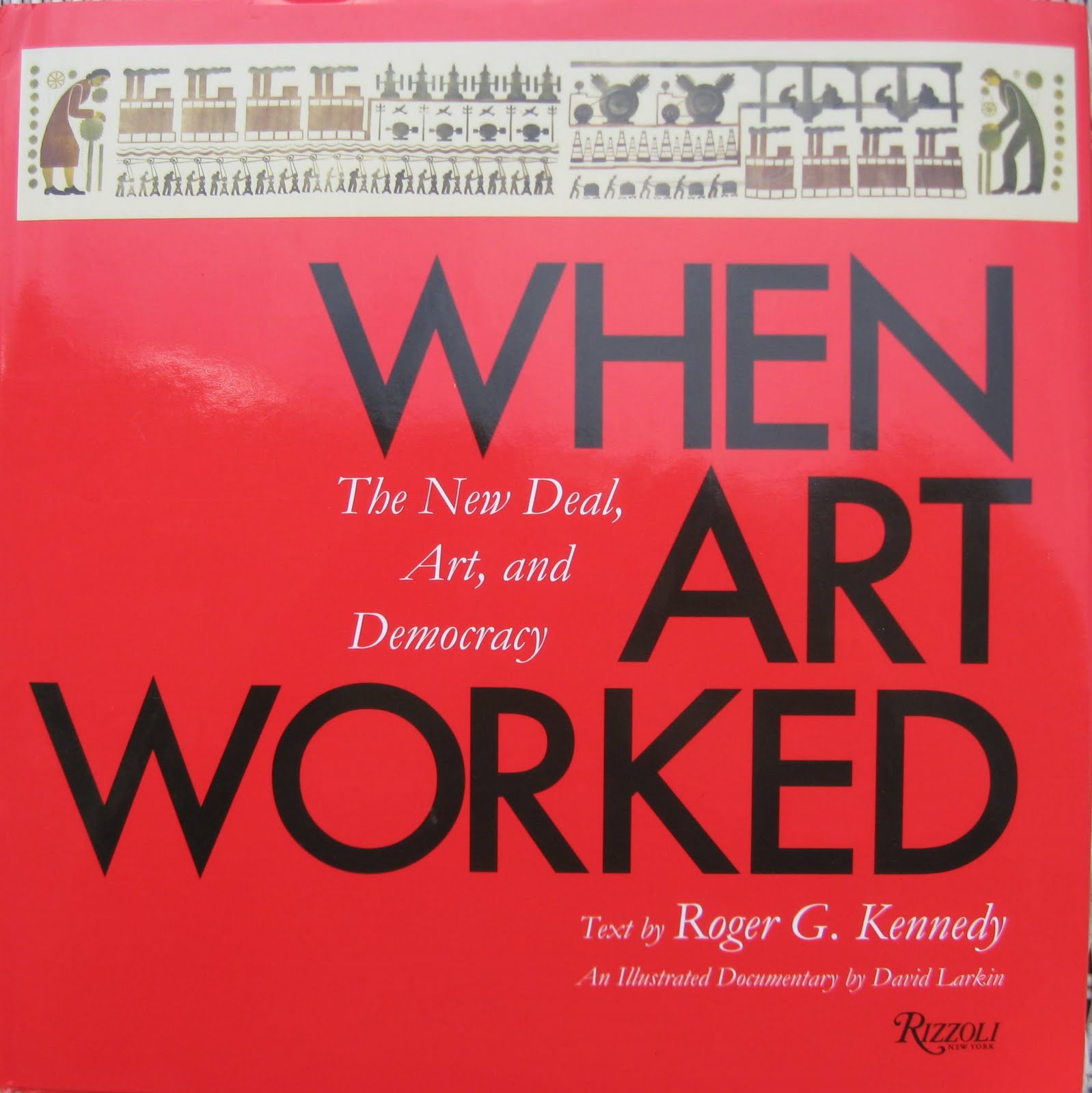
When Art Worked: The New Deal, Art, and Democracy by Roger G. Kennedy and David Larkin (from Rizzoli).
The two complement each other perfectly, with Dickstein writing at length on fiction, film, and social history, and with a brief look at Art Deco--covering the lively arts, one might say--

while the coffee table book provides a splendid sampling of the government-sponsored
public arts of the Depression (sculpture and painting, posters and photography, architecture and public works), created by and for the WPA, CCC, TVA, FAP, and Roosevelt's other "alphabet soup" organizations.

With deft yet erudite critical acumen, Dickstein analyzes in fascinating, enriching detail (and at 550-page length) an astonishing array of cultural touchstones: Steinbeck's beloved
Grapes of Wrath and Roth's fitfully remembered
Call It Sleep; Wright's violent
Native Son and Hurston's rediscovered
Their Eyes Were Watching God; the once-scorned novels of Nathaniel West and the misinterpreted films of Busby Berkeley; Left-sympathizing fiction

(and non-, including Agee's fever-dream text) compared to the hard-reality photos of WPA regulars Ben Shahn, Walker Evans, and Dorothea Lange; Odets and Blitzstein and the Federal Theater Project shut down while Pare Lorenz's documentaries triumphed; challenged conservative poets like Frost and Stevens versus the freeform sophistication of Hollywood's "screwball" comedies; Welles'
Kane following on the heels of Capra's
Mr. Smith;

Thirties Populist music ranging from Gershwin to Woody Guthrie, from Copland to the Duke; and so on, ad glorium.
Basically, if it happened, if an artist registered on the public consciousness at all, then s/he's here.

But Dickstein's critiques extend as well to historical moments and sociological matters. I won't try to summarize or synthesize all the brilliance on display, but I will cite just two of the hundreds of secondary references and quotations he draws on. First, President Roosevelt himself, taken from the Second Inaugural Address:
I see millions of families trying to live on incomes so meager that the pall of family disaster hangs over them day by day.
 I see millions whose daily lives in city and on farm continue under conditions labeled indecent by a so-called polite society half a century ago.
I see millions denied education,  recreation, and the opportunity to better their lot and the lot of their children.
I see millions lacking the means to buy the products of farm and factory and by their poverty denying work and productiveness to many other millions.
I see one-third of a nation ill-housed, ill-clad, ill-nourished.(And today FDR would see many millions more, with two-thirds of the farms and factories taken over and sold off, and the manufac-turing and service economy jobs outsourced overseas by stock-worshipping true-believers and bottomline bottom-feeders.)

For a more personal depiction, Dickstein quotes from T.H. Watkins' fairly recent, instant-classic text
The Great Depression: America in the 1930s--written in the early Nineties, but now sounding prescient, tragically apt again:
Fear was the great leveller of the Great Depression. It haunted the dreams of the African-American sharecropper in the South who held a fistful  of barren dust in his hand and wondered what the system would do now to cheat him and his family of life. It stalked the middle-class white merchant in Idaho who had seen decades of work destroyed when his once-friendly banker coldly forced him into bankruptcy. It whispered terror
  into the ear of the Mexican-American foundry worker in Detroit who had put his future in the hands of the
 coyote
who brought him north from Mexico into this strange cold place and who now found his job had vanished. Fear shattered all the fine Anglo-Saxon certitudes of the Great Plains farm wife who watched black  clouds of dust roll up on the edge of the horizon and knew that her dreams would soon be sucked up into that boiling mass.
(Whew. Factual writing
that elegant, no matter how emotional, in itself justifies the study of history!)
The text of
When Art Worked, on the other hand, is somewhat less compelling,

more dryly factual, full of obscure details about the Roosevelt administration and all the capital-letter works divisions and arts czars (Morgenthau, Hopkins, Ickes, and others) vying for influence. Skim it to get the political gist, I'd say, and focus instead on the artist personalities and the embarrassment of visual riches, most pieces never seen outside the Library of Congress or other government storehouses.

(Except for Walker Evans' shot of his friend Agee, all the visuals I've chosen as pictorial support come from the Rizzoli book.)
Courtesy of writer Kennedy and designer Larkin, not only do we enjoy posters and paintings and photographs both famous and unknown, but we also experience major road works, bridge repairs, construction of buildings and monuments, rural electrification projects, farmlands regenerated, neglected National Parks revitalized; plus the remarkable (and readable) series of state and regional guidebooks created

by then-struggling writers like Steinbeck and Nelson Algren, Ralph Ellison and Jim Thompson; plus wallsful of murals both interior and ex-, music events "for the People," and not-so-radical Populist theater, heroic attempts to document the whole spectrum of peoples and sub-cultures across America... and, dare I say, more?


FDR promised a New Deal for economically devastated America. In varying degrees he delivered, thanks to the hard work of willing-to-believe millions (and a World War to rev our economic engines). He also said something else pertinent

to these two books: "One hundred years from now my administration will be known for its art, not for its relief."
Will our current President accomplish even half as much? He talks a good fight, but so far only the wealthy and powerful are enjoying any tangible benefits.

Where are the jobs and economic assistance for workers and the hurting middle class? Where are the CCCs and WPAs for
this Grim Regression?

 to freedom finally gained 12 years before America's Civil War.
  The veranda'ed condo with its multiple ceiling fans was spacious and handsomely appointed, perched atop a slope of the Carambola Golf Resort; landlocked but still not far from the sea. And we did the tourist thing merrily--many fire-heat hours of driving, mapping, gawking, snapping, shopping, dining and, above all, consuming iced beverages.
  Plus hanging out at the beach for wades, dips, swims and--chosen by some--snorkelling's surface skims too.
  (This in serious contrast to 40 years ago when I tried to bring back a case of Ol' Oak dark rum from Trinidad/Tobago, only to be smacked with a huge tariff fee when we passed through trade-protected Puerto Rico.)
  Folks are 40-proof faithful to the servers of booze.