Sunday, May 30, 2010

Jazzed, Every One of Us


Consider this brief piece from poet Michael S. Harper:

Alone

A friend told me
He'd risen above jazz.
I leave him there.


Harper's poem could well be a 21st century way of reiterating Duke Ellington's message from the Thirties (and every day since):

It don't mean a thing
If it ain't got that swing.


But how does a writer get that swing? A few poems about Jazz or Jazz musicians have become literary benchmarks, notably some loosely "jazzy" pieces by Langston Hughes and Gwendolyn Brooks. Here's the end of Hughes' "Trumpet Player":

The Negro
With the trumpet at his lips
Whose jacket
Has a
fine one-button roll,
Does not know
Upon what riff the music slips
Its hypodermic needle
To his soul--

But softly
As the tune comes from his throat
Trouble
Mellows to a golden note.


By contrast, fifty years later the poets were Black ("Negro" no more) and angry, and considerably more prolix, as in "AM/TRAK" by Amiri Baraka (once known as Beat poet Leroi Jones) or "Don't Cry, Scream" by Haki Mahubuti (aka Don Lee), Baraka's supposed rival--both poems long and complex rants on John Coltrane's fate in a white world. At similar length, but more relaxed and reasoned is Sterling A. Brown's look at less-famous musicians--his great "Cabaret (1927, Black & Tan Chicago)" blending club images, bits of solos verbalised, wry commentary, and lyrics from the song "Down on the Delta." Also memorable, and from a more mellow Beat poet, is Ted Joans' compact tribute to sax man Lester Young (the tenor giant's name is the title):

He was our president as well as the minister
of soul stirring Jazz, he knew what he
blew, and he did what a prez should do,
wail, wail, wail, There were many of
them to follow him and most of them were
fair--but they never spoke so eloquently
in so a far out funky air
Our prez done died, he know'd this would come.
but death has only booked him, alongside
Bird, Art Tatum, and other heavenly wailers.
Angels of Jazz--they don't die--they live
they live--in hipsters like you and I


That word "fair" is a wry poke at the white sax guys, Allen Eager to Stan Getz, Brew Moore to Zoot Sims, who borrowed heavily but so kept Lester "alive." And further proof of Joans' final wishful thinking might be the literary fame of Frank O'Hara's poem "The Day Lady Died," putting the death of Billie Holiday into the context of a busy day in New York City, the poet stunned and resisting, focussing in on the precisely named details of existence to stave off his grief, at least until the end:

and I am sweating a lot by now and thinking of
leaning on the john door in the Five Spot
while she whispered a song along the keyboard
to Mal Waldron and everyone and I stopped breathing


Like any other art at its best, certain pieces about Jazz can make you "stop breathing" for a moment, reflecting emotion... thought... admiration... wonder. You'll find a great many of these, whatever your taste in literature or kind of blue notes, in the compact, 240-page Everyman's Library Pocket Poets volume titled, simply, Jazz Poems (issued back in 2006), which I've been dipping into now and again since buying a copy a few months ago. The range is astonishing, with worthy pieces from poets black and white; both vaunted elders and young turks, the famous and the little-known alike--made equal by their fascination for the music and their semi-improvisational verbal riffs.

There are multiple poems here for Satch and Duke (also Billy Strayhorn's sophisticated lyrics to "Lush Life"), for Miles and Charlie Parker, for John Coltrane and Thelonious Monk, and a smash solo spot for Chet Baker (the haunted, heartrending "Almost Blue" by Mark Doty). Some attempt to recreate a particular solo (Paul Blackburn's "Listening to Sonny Rollins at the Five Spot"), others play verbal games that just become irritating: Bob Kauffman's nonsensical "Crootey Songo," Harryette Mullens' babble of words to match "Music for Homemade Instruments," the repetitive, phrases-diminishing "Gyre's Galax" by N.H. Pritchard (you could stop anywhere in four pages and get that one).

Variety rules. Jazz poems can be as hip-hop physical as Quincy Troupe's "Snake-Back Solo," or as spaciously philosophical as Charles Wright's Asia-meets-African-America masterwork titled "Body and Soul II (For Coleman Hawkins)," or as quietly personal as "Mood Indigo" by Ntozake Shange:

it hasnt always been this way
ellington was not a street
robeson no mere memory
du bois walked up my father's stairs
hummed some tune over me
sleeping in the company of men
who changed the world

it wasnt always like this
why ray barretto used to be a side-man
& dizzy's hair was not always grey
i remember i was there
i listened in the company of men
politics as necessary as collards
music even in our dreams...


Quoting from this wonderful book is a easy as playing the scales on a piano--speaking of which, there are fine elegies here for Monk and Bud Powell, plus a splendid Cecil Taylor session that I'm also skipping--but I'll take my cue from the arrange-ment of the contents and finish with a couple more pictures of Billie. (She used words--grist for the poets!) From the opening of--get this--"Poem in Which I Make the Mistake of Comparing Billie Holiday to a Cosmic Washerwoman":

We were driving back from the record store at the mall
when Terrance told me that Billie Holiday
was not a symbol for the black soul.

He said, The night is not African American either, for
your information,

it is just goddamn dark,
and in the background

she was singing a song I never heard before,
moving her voice like water moving
along the shore of a lake,
reaching gently into the crevices, touching the pebbles
and sand...


Tony Hoagland wrote that one, and Rita Dove this contrasting gem:

Canary
(for Michael S. Harper)

Billie Holiday's burned voice
had as many shadows as lights,
a mournful candelabra against a sleek piano,
the gardenia her signature under that ruined face.

(Now you're cooking, drummer to bass,
magic spoon, magic needle.
Take all day if you have to
with your mirror and your bracelet of song.)

Fact is, the invention of women under siege
has been to sharpen love in the service of myth.

If you can't be free, be a mystery.


Close to perfect, I'd say... but here's a postscript of sorts, a bit piece not in the anthology, but good evidence that the attraction of Jazz for poets goes on:

Day Goes

Riffs of fire
course the molten skies,
pulsing through layers,
running the changes,
charring to black.

Night's new arrangements
cool and slowly
harden. Streetlights come on
to anyone. Now
the moon blows sax,

a Prez-redential solo
floating butter-cream
over the greys; cat
can play. Lady whispers
her dream chorus--

sixteen bars of gone
reds, bone whites,
silent black-and-blue
notes. We are jazzed,
every one of us.

Sunday, May 23, 2010

Have You Met Mr. Jones?


When the wonderful pianist Hank Jones died a week ago, Jazz writer Doug Ramsey used a striking four-word phrase--"The parade outward continues"--to introduce his in-pieces tribute (starting here). Hank's passing in fact unleashed a print and Internet blizzard of comments, tributes, essays, remembrances, and remarks. While Doug's curious phrase was compelling in itself, its implication of too many elder Jazzmen exiting this life became both eloquent and ineffably sad.
I too loved the deft and lingeringly lovely touch of Hank at the keyboard. I've owned scores of albums he graced, from the studio dates with Charlie Parker that helped solidify his early rep as casually excellent Bop Era pianist, through the leaner years when Jazz was struggling and Jones left adrift, but which soon led to the several "Great Jazz Trio" albums he recorded in Japan (sometimes with brother Elvin); and then to his masterful mid-life duets (on disc and in concert) with John Lewis and Tommy Flanagan, and his spiffy turn as Fats Waller reincarnate (for the stage musical Ain't Misbehavin'), to his later years as quietly charming, still agile and brilliant elder statesman--who stubbornly kept working every day to "improve" his playing!

Fortunately I did get to see him in person a couple of times over the decades. But I don't have any personal anecdotes or unique insights that might enhance the heartfelt messages of the many who have preceded me. This notice, then, is as brief as Hank's 91 years were long--the equivalent of one keyboard run by the genial Mr. Jones. Remember the great and grand Hank by listening to his hundreds, maybe thousands of recordings, including his composition "Hank You Thank."

Hank's for the memories.

Monday, May 17, 2010

The Man with the Blue Guitar


How many modern Bluesmen can you name who play with elegance and panache, making six strings ring like a metallic 12; who write non-12 bar songs that often chime internally like Tin Pan Alley tunes, yet are still audibly "Blue"; and who sing in three distinct voices (or maybe three variants of the same whiskey-gargling baritone)--general mushmouthed Southerner; nimbly drawlin' "N' Wawlins" native; and old man half-talking the words, sounding like his false teeth are loose! And maybe I should mention that he's white?

Well, the only right answer would be Chris Smither, whose recording career amazingly was launched going-on 50 years ago (which makes him nearly old enough to qualify as a "Blues Rediscovery"!). Back then he still sounded like a young whippersnapper, but one who snapped those guitar strings like a whip, influenced by both laconic Lightnin' Hopkins and the sly "Candy Man," Mississippi John Hurt. He cut two albums for Tomato Records, plus an unreleased third, then dropped into a hole of booze and drugs that pretty much held him down and out for a dozen years. Fortunately, before that he had met both Eric von Schmidt and Bonnie Raitt (he was living in Boston then), and they either recorded his tunes or talked him up to friends. So when Chris resurfaced in the early '80s, he was remembered as the writer of "Love You Like a Man" and "I Feel the Same" (Raitt recorded both), but now playing better, patting--often stomping--his foot on the floorboards like John Lee Hooker, and sounding a whole lot wittier and wiser.

His own songs of the last couple of decades in fact combine humor, philosophy, droll remarks, and sneaky puns; rather than telling stories, they usually explore life circumstances. He claims to write only to have songs to perform live, the setting he prefers; and his spontaneous performances do regularly trump the more-polished studio takes. Smither and his striking blue six-string don't really need any back-up, so every ten years or so he releases a live album that designates the previous decade's best songs (or moments), even by collecting performances from a variety of venues if necessary. (Latch onto the Hightone CDs titled Another Way to Find You and Live As I'll Ever Be for Smither on stage. Among his studio albums, watch for Happier Blue, Small Revelations, Leave the Light On, and Train Home--but choosing these is really a matter of favoring near perfection over mere excellence!)

Though Chris seems content to issue a new album just every two or three years, his songwriting has become so brilliant and his musicianship so assured that fans like me wish for more frequent hearings. In signature songs now he'll mumble and grumble and try to adjust to having his car stolen ("Let It Go"), or search pathetically and comically for that mean heartbreaker "Lola," or transform himself, metaphorically at least, from cave man to liar to dreamer to old man ("Cave Man"), or work to invoke/become his own "Homunculus" (a song he values so much that his music company bears its name). But Chris admires others' creations too, so he's just as likely to rear back and tear "Statesboro Blues" and "Dust My Broom" to Smithereens; trip out on favorites by Chuck Berry or Little Feat; take a few moments to nail the stunningly lovely Rolly Sally song "Killin' the Blues"; and then casually toss off waltz-time takes on "Kind Woman" and "Visions of Johanna." (Dylan has become a favored source over the last decade, and Chris gives the Bobster a run for his money on several numbers; in fact, I'm convinced the guitarman now "owns" "Desolation Row." Who knew there was so much beauty hidden in that surreal circus of strange?)

But best we examine the words of a few key Smither songs. No matter where mic'ed, his guitar skills and rhythmic feet are a given, tending to business while his lyrics hone in on certain "Small Revelations":

Simple to see where we come from,
Harder is where we go...
Passion is feeling in motion,
Compassion is standing still,
This isn't justification,
Hearing is letting it happen,
To listen's a work of will,
Beware of cheap imitations,
Thankful for small revelations,
Thankful for small revelations...


Or maybe you're hurting from a failed romance? Think of his "Winsome Smile":

It's hard to believe, but I'm tellin' you, your heart will soon recover,
But you don't want it to, you love this achin' agony,
It's noble and it's true, you won't forsake this pain for other lovers,
I think happiness would fill your mind with misery,
But time will wound all heels, and it ain't pretty,
With any luck at all she'll find some dope that you can pity,
Your loss is measured in illusions, your gain is all in bittersweet intelligence,
And your winsome smile will lose some of its innocence...


Even the Big Easy street vendor selling vegetables (in "No Love Today") feels your pain:

I got ba-na-na, watermelon, peaches by the pound,
Sweet corn, mirleton, mo' better than in town,
I got okra, enough to choke ya,
Beans of every kind,
If hungry is what's eatin' you
I'll sell you peace of mind,
But this ain't what you came to hear me say,
And I hate to disappoint you,
But I got no love today,
I got no love today...


Occasionally he grapples with political matters--Darwin, DNA and intelligent design in "Origin of Species," Iraq and the blasted oil men of "Diplomacy," after-Wall-Street madness wreaking havoc on ordinary lives ("Surprise, Surprise")--but mostly Chris masks his displeasure, musing philosophically, as in "Outside In":

Did you ever stop to notice, it's when you feel a little low,
That the entire spinning universe descends to say hello
With heavy-handed cheerfulness and a calculated smile
And says, "Carry me awhile."
But you don't have to carry much of anything at all.
The biggest thoughts of bigger things are really pretty small.
The major thoughts that occupy the minor state of mind
Are what we leave behind,
Just a minor thought that we can leave behind...


There are scores more songs worth citing on Smither's dozen available albums, but I'll let his bitter-angst, easily witty "Confirmation" put paid to this rummaging and ruminating:

I need confirmation of my duties,
Help me get my poor life back in line.
If I tell you what the hell I'm up to,
Maybe you can tell what's on my mind.

Cuz I don't pick no cotton, I never pick my nose,
I couldn't pick a pocket in a pile of dirty clothes,
But I pick 'em, I choose 'em,
I pick the locks that used to keep me in.
I pick 'em up, I put 'em down,
That's how I get around, but it's wearin' thin.

I don't drive no bargains, I never drive a car,
Couldn't drive a wagon if you hitched it to a star,
But I'll drive you crazy,
Make you wonder who you are,
Drive nails in your coffin,
But I don't often let it get that far.

Help me get these pieces back together,
Make it so the seams don't seem to show.
I had it patched with bits of glue and leather,
How it fell apart I'll never know.

Cuz I don't look for trouble, but it finds me all the same.
If you hear me shout, just lookout, cuz it's callin' me by name.
It's lookin' still, it always will,
If looks could kill I'd be six feet underground.
I never was good lookin',
But now I'm too old to let that get me down.
Yes, I never was good lookin',
But now I'm too old to let that get me down...


Speaks right to the core of me, folks.

Tuesday, May 11, 2010

Of Marty Gras and Martynis


Have Paich-ence, please; don't shoot the messenger or declare Martyal law. I'm just reviving a few puns used for mid-Fifties tune titles recorded by composer-arranger Marty Paich--who would soon become better known for his work with the Dek-Tette (his slightly later redo of Gerry Mulligan's Tentet) assembled for several Mel Torme sessions on Bethlehem and Verve and other labels later.

But before Mel there was Marty's West Coast... er, Martyrdom... toiling in the vineyards with, and for, Shorty Rogers and the All-Stars like Art Pepper, Jimmy Giuffre, and Shelly Manne. Of course, other arrangers lacked Marty's perfect Paich. (Okay, okay, no more egregious puns... only gregious ones, like his album titled Revel Without Pause!)

Marc Myers' long interview with saxman Herb Geller (find it here) introduced a couple of Paich LP jackets I had neither seen nor heard before, so I sent off for copies toot sweet. And what sweet tooting then arrived in the mail... Candidly speaking, you can dig the disc jacket's hipster hype (shades of Ken Nordine!): "Paich is the Picasso of Big-Band Jazz," says Archie. On the Coast, Paich is most. His music makes murals grow in your mind. Paper and pencil are his canvas and brush. Listen: hear colors rush. Archie did. And recorded the engaging arranging Marty Paich.

("Who's this Archie?" you may ask. No album credit namechecks any such person for Paich's release. Well, the trick is this: rather than critic Nat Hentoff's short-lived Candid label--which gets logo credit on the CD--the LP was instead originally issued on Archie Bleyer's Cadence Records.)

Meanwhile the fun was just beginning, because two days later I found a used copy of Nat Pierce's "Ballad of Jazz Street" sessions. These tracks were originally cut in 1961, but only issued 17 years later (and still later reissued on a Hep Jazz CD), waxed by Nat's rehearsal band with Paul Gonsalves, Paul Quinichette, Clark Terry, Eddie Bert, Dick Meldonian, and others. (That temporary group can be seen as the decades-back precursor to Eighties marvel the Capp-Pierce Juggernaut.)

... Big little bands both, these circa-'60 ensembles, but while Pierce then stuck to his guns for decades--filling in at the piano for Count Basie, composing for Basie, Kenton, Herman, and other bands (he had acquired clout by having arranged landmark TV show The Sound of Jazz), doing his part to keep Mainstream Swing vibrant and alive--Paich gradually drifted into arranging for Pop vocalists like Dinah Shore and Peggy Lee, Ray Charles and even Kenny Loggins, as well as conducting the strings whenever Sarah Vaughan went Classical. Paich got the credits and publicity, and the bread, while Pierce gained the cred and private acclaim, and the scuffling.

But back to the two albums. Was Paich truly a Picasso? For the volume and variety of Pablo wouldn't that be, say, Ellington instead? (Or was Duke more accurately the Impressionist among Jazz composers--Monet maybe?) Marty seems more a master of miniatures, quick and clever and controled, maybe more like Degas. By this artfully silly analogy, Pierce (shown at right) would then be Renoir, beefy and colorful and slightly old-fashioned.

I fully expected to find the Paich album superficial and the Pierce one to be more substantial... which should teach me to eschew preconceptions. Because Paich's pieces slink and soar, all but one tune his own originals, while Pierce's program mixes reworkings and his own tunes about equally (and more stolidly). There's a casual lope and lightheartedness to most of Marty, with even the titles straightforwardly simple: "Nice and Easy," "New Soft Shoe," "Tommy's Toon," "Easy Listenin'." He gets the best from his West's best too (Bob Enevoldsen, Pete Candoli, Buddy Childers, Bill Perkins, Herb Geller, Bob Cooper, Jack Sheldon, et al), crack players making for crack sections and solos.

Vince De Rosa's French horn and Enevoldsen's clarinet create a woodwind mournfulness for the ballad "Black Rose"; and Joe Mondragon goes for a bassman's lazy ramble on the bluesy "Walkin' On Home." Drummer Mel Lewis gets his licks in on "Tommy's Toon" (well, everywhere really, and subtly, like pianist Paich); while the only standard, however little-known back then, "What's New," is muted and beautiful, lyrically led by Sheldon's trumpet. As for the punning I mentioned up top, you can check out "Martyni Time," just over three minutes long and as chilled and tasty as that first sip of the evening. (Omit the Desmond "dry.")

So you have Marty's West Coast leanings (arrangements with interacting sections, call-and-response counterpoint, solos cushioned by others, a general lightness and openness) vs. Nat's happy Swing, reaching from Boston to Kansas City, featuring fewer players but "heavier" arrangements and a "thicker" sound. Vague terms, these, and possibly irrelevant distinctions, but one can readily hear the overall difference--Pierce's powerful pre-Bop excitement vs. Paich's cheery post-Bop energy, both approaches lifting the listener and generating movement.

With Basie his mentor, Pierce always went for a hip riffing sound, usually reminiscent of the Count's great comeback band of the early/mid Fifties. And the first two tracks here ("Pretty Little Girl"--purely perfect--and the less-welcome "Melan-choly Baby") sound like those 16 men swinging. But after that, it's a slow slide downhill, from "Black Jack" with Paul Gonsalves doing his patented frenetic blowing, through misguided and misshapen arrangements of Horace Silver tunes "Soulville" and "Sister Sadie"--a great fellow, well-liked by all, Nat still weren't no funky white boy!--right to the original LP's three-section, sidelong title track.

For "Jazz Street" Pierce shucks his Basie boat cap and dons a rakish, Dukish fedora. Nat's piano becomes decidedly stride-like here and there, and his melodies meander quizzically, discovering strange venues along that hipster Street. The presence of both Gonsalves and Clark Terry helps lend the Ellington touch, as do Nat's section writing and non-Ducal soloists Dick Meldonian and Eddie Bert.

All holds well for the first two sections, but everything goes to wrack and ruin in Part Three, which sounds like Basie meets Godzilla, I mean Duke meets Paul Quinichette, and everyone loses--direction, sense, melody, you name it. The "Ballad" ends badly, reduced to sign-off chaos.

So Pierce's resurrected rehearsals sadly don't have a Paich on Marty's arty party. (Now I exit hurriedly, no noose being better than the hemp demanded by irate Mainstream fans everywhere.)

Saturday, May 8, 2010

Well Seasoned


Yes, Spring is here;
Cold Winter's fell...
Too slow I fear.
But wait a spell
And then you'll hear
Me show-and-tell,
Ring loud and clear
Old Smither's bell!


Too much bologna lately, and not enough blog-onya. But I'm workin' on it--in fact, I'm in the middle of penning two different music posts, one on Chris (folk/bluesman named above) and the other a Fifties Jazz thing. Which will arrive first? Stay tuned...

Monday, April 26, 2010

The Cruzan Snorkel


...Sounds like a Robert Ludlum thriller, with an underwater missile crisis maybe. Or a crypto-Christian tome by yet another Dan Brown clone (the Rosy Cruzan assassins!). But actually it's why tropics lovers head for St. Croix in the U.S. Virgin Islands--to find some of the best snorkelling in the Caribbean, on a friendly, commercially prosperous island, well-served by its big distilleries cooking the most excellent local rum (branded Cruzan also), and conglomerate Captain Morgan rum too, as well as a giant oil refinery employing over a thousand local people. Any apparent poverty on St. Croix looks to be more a matter of "soon come" indifference than actual suffering poor.

But my impressions could be wrong, of course--casual observations from a quick week in muggy paradise--considering St. Croix's complex history... From Columbus coming ashore in 1493, to the later massacre of the Arawak Indians; from the flags of eight rival colonial powers waving fitfully for a century, to 200 years then of calm Danish rule; from thousands of slaves forcibly transported to work cane fields and cotton plantations, to freedom finally gained 12 years before America's Civil War.

And today, 160 years later, the island holds some 55,000 inhabitants spread over just 80 square miles... with air so steamy wet that one wakes up already damp and proceeds through the day thoroughly drenched, whether from sudden rain or hammering sun. No wonder the bays and beaches are well-attended, the rum drinks consumed in quantity, and the shade breezes sought by all. And thank God for air-conditioning!

Good friends were offered a luxury condo for a week's use, and Sandra and I were invited to join them. A red-eye flight connecting through Miami and San Juan delivered us ready for something tall and cool or hot and sandy, and preferably both. The veranda'ed condo with its multiple ceiling fans was spacious and handsomely appointed, perched atop a slope of the Carambola Golf Resort; landlocked but still not far from the sea. And we did the tourist thing merrily--many fire-heat hours of driving, mapping, gawking, snapping, shopping, dining and, above all, consuming iced beverages. Plus hanging out at the beach for wades, dips, swims and--chosen by some--snorkelling's surface skims too.

Thinking of grandkids, and their parents, and perhaps ourselves, we bought inexpensive items only: t-shirts, postcards and one colorful poster, V.I.-version reggae CDs, and Cruzan rum in bottles sized from 50 ml up to the slightly daunting full liter. Ironically, U.S.V.I. regulations allow as much as $1600 in goods and six large bottles of liquor to be brought back duty free, but we gathered in only a tiny fraction of that, determined to live large on a small budget. (This in serious contrast to 40 years ago when I tried to bring back a case of Ol' Oak dark rum from Trinidad/Tobago, only to be smacked with a huge tariff fee when we passed through trade-protected Puerto Rico.)

Anyway, blog snob that I am, I don't consider a sunburn-style vacation to hold much interest for others, so I will now exit, pursued by a bare... beach bunny (as if any chance) while chanting this silly bit of ditty to "nice up de dance" (as a reggae-mon might say):

From the Nord of the Danes to the South of the Seuss,
Folks are 40-proof faithful to the servers of booze.
If you're Cruzan for rum mixed with tropic fruit juice,
Crunch the sand of St. Croix in your snorkelling shoes;
Lose your travelers' blues, and just... bust... loose!


(with thanks to Ellen and Bob)

Friday, April 9, 2010

Was the Depression So Great?


When Congress passed that truncated, industry-forgiving Health Care Bill recently, Progressives and Liberals couldn't decide whether to spit or bet all the pot. President Obama had demonstrated that he just isn't an activist like FDR, or a Congress-wrangler like LBJ; the gap between his mild-mannered desire for "bipartisanship" and the Right Wing's refusal to cooperate in any way just seems insurmountable and... sad.

As the so-called Recession rolls on, jobs and housing go nowhere; and Wall Street parallels to the Great Depression keep haunting us too, except that it's ordinary people committing suicide this time rather than the obscenely wealthy banksters and CEOs.

The March 2010 issue of The Atlantic includes a brief remembrance of one of the significant books that emerged during those hard years (and still irks surviving members of the featured sharecropper family): Let Us Now Praise Famous Men, by over-heated writer James Agee (photo at right) and sharp-eyed photographer Walker Evans. Produced on assignment for Fortune Magazine, this lengthy feature piece was then shelved instead, which gave Agee time to turn it into an epic, oddly poetic account of Southern poverty in the Thirties. Let Us Now... appeared in 1941 but proved to be a confusing misstep, panned by the critics as romantic and excessive.

But it has endured. And the "Grim Regression" we are trapped in now--that's what I call it anyway--has revived interest in Agee's book and in other cultural artifacts from that bleak decade in the U.S. They were hard times, yes, experienced nearly everywhere in America, but also a time when folks pulled together to help each other survive and when the federal government acted swiftly and repeatedly to keep the country alive if not well.

(Let's pause for a moment. I consider the Great Depression to have been the initial decade of our most heroic years, America's too-brief peak as a nation, lasting from approximately 1930 to 1973. And simplifying shamelessly, I'd offer these high points:

The Depression hitting everyone ("paupers and peasants and princes and kings," as Dylan put it), eventually forcing folks to work together. Roosevelt's government dedicated to creating jobs and rebuilding infrastructure and arts alike, followed by a World War that seemed just and drove our economy into full action mode. Post-War prosperity lasting through the Fifties (plus the rise of rock 'n roll), allowing our young people and disenfranchised groups to gather strength and momentum for what became the great movements of the Sixties--Civil Rights, Women's rights, sexual revolution, freed spirits and hippies and rock music ruling all.

Then the forces of repression came roaring back, all the grim events that heralded the resulting 40-year collapse of America: King and the Kennedys assassinated, race riots across the country, the Vietnam War sapping the public will, plus the Watergate investigation and Nixon's fall suggesting that maybe the people would take charge again, but... but that's another, more depressing story.)


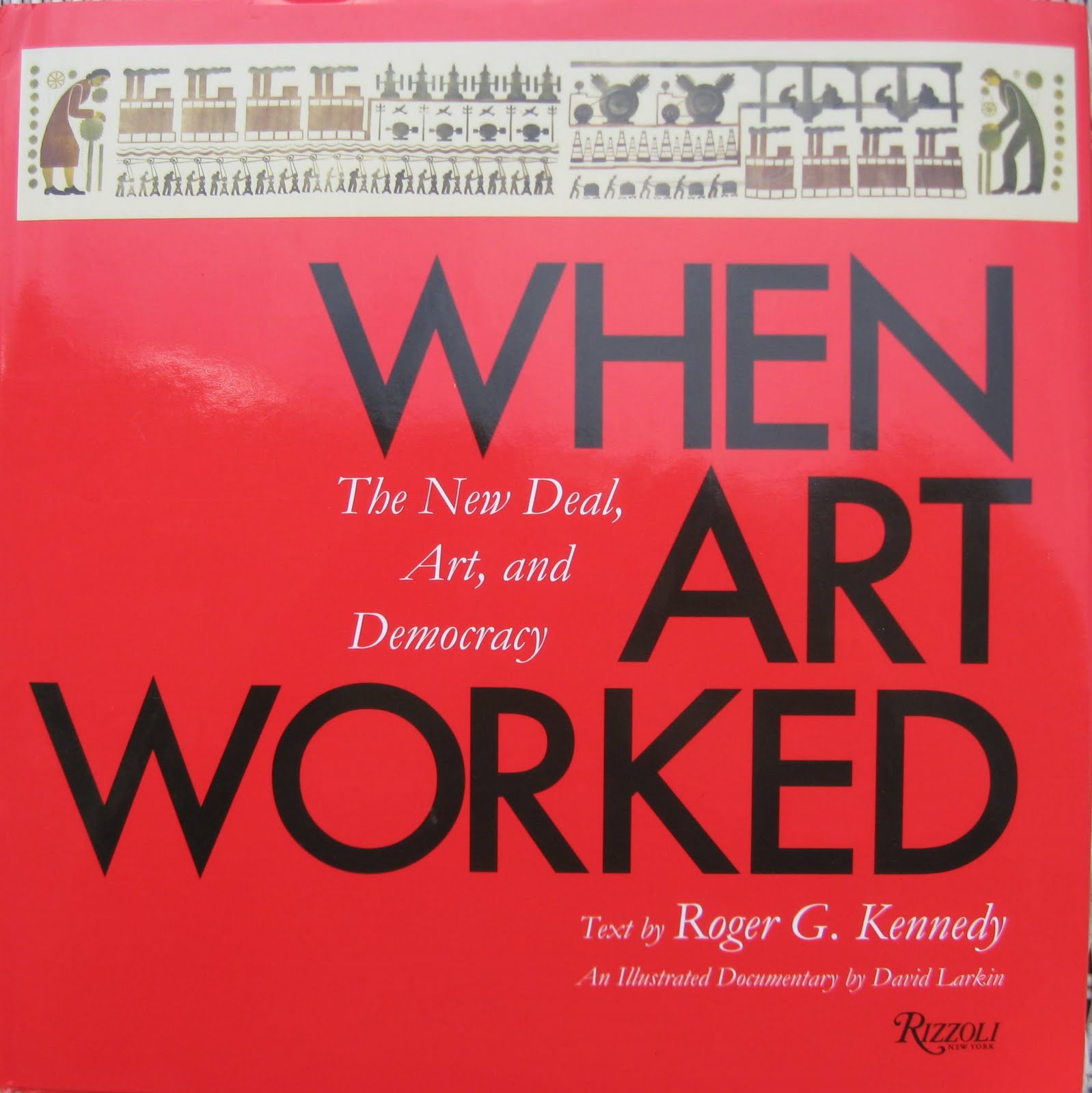
Resuming the earlier discussion, as other evidence I'd cite two exceptional books published in late 2009, Dancing in the Dark: A Cultural History of the Great Depression by Morris Dickstein (from Norton) and When Art Worked: The New Deal, Art, and Democracy by Roger G. Kennedy and David Larkin (from Rizzoli).

The two complement each other perfectly, with Dickstein writing at length on fiction, film, and social history, and with a brief look at Art Deco--covering the lively arts, one might say--while the coffee table book provides a splendid sampling of the government-sponsored public arts of the Depression (sculpture and painting, posters and photography, architecture and public works), created by and for the WPA, CCC, TVA, FAP, and Roosevelt's other "alphabet soup" organizations.

With deft yet erudite critical acumen, Dickstein analyzes in fascinating, enriching detail (and at 550-page length) an astonishing array of cultural touchstones: Steinbeck's beloved Grapes of Wrath and Roth's fitfully remembered Call It Sleep; Wright's violent Native Son and Hurston's rediscovered Their Eyes Were Watching God; the once-scorned novels of Nathaniel West and the misinterpreted films of Busby Berkeley; Left-sympathizing fiction (and non-, including Agee's fever-dream text) compared to the hard-reality photos of WPA regulars Ben Shahn, Walker Evans, and Dorothea Lange; Odets and Blitzstein and the Federal Theater Project shut down while Pare Lorenz's documentaries triumphed; challenged conservative poets like Frost and Stevens versus the freeform sophistication of Hollywood's "screwball" comedies; Welles' Kane following on the heels of Capra's Mr. Smith; Thirties Populist music ranging from Gershwin to Woody Guthrie, from Copland to the Duke; and so on, ad glorium.

Basically, if it happened, if an artist registered on the public consciousness at all, then s/he's here. But Dickstein's critiques extend as well to historical moments and sociological matters. I won't try to summarize or synthesize all the brilliance on display, but I will cite just two of the hundreds of secondary references and quotations he draws on. First, President Roosevelt himself, taken from the Second Inaugural Address:

I see millions of families trying to live on incomes so meager that the pall of family disaster hangs over them day by day.

I see millions whose daily lives in city and on farm continue under conditions labeled indecent by a so-called polite society half a century ago.

I see millions denied education, recreation, and the opportunity to better their lot and the lot of their children.

I see millions lacking the means to buy the products of farm and factory and by their poverty denying work and productiveness to many other millions.

I see one-third of a nation ill-housed, ill-clad, ill-nourished.


(And today FDR would see many millions more, with two-thirds of the farms and factories taken over and sold off, and the manufac-turing and service economy jobs outsourced overseas by stock-worshipping true-believers and bottomline bottom-feeders.)

For a more personal depiction, Dickstein quotes from T.H. Watkins' fairly recent, instant-classic text The Great Depression: America in the 1930s--written in the early Nineties, but now sounding prescient, tragically apt again:

Fear was the great leveller of the Great Depression. It haunted the dreams of the African-American sharecropper in the South who held a fistful of barren dust in his hand and wondered what the system would do now to cheat him and his family of life. It stalked the middle-class white merchant in Idaho who had seen decades of work destroyed when his once-friendly banker coldly forced him into bankruptcy. It whispered terror into the ear of the Mexican-American foundry worker in Detroit who had put his future in the hands of the coyote who brought him north from Mexico into this strange cold place and who now found his job had vanished. Fear shattered all the fine Anglo-Saxon certitudes of the Great Plains farm wife who watched black clouds of dust roll up on the edge of the horizon and knew that her dreams would soon be sucked up into that boiling mass.

(Whew. Factual writing that elegant, no matter how emotional, in itself justifies the study of history!)

The text of When Art Worked, on the other hand, is somewhat less compelling, more dryly factual, full of obscure details about the Roosevelt administration and all the capital-letter works divisions and arts czars (Morgenthau, Hopkins, Ickes, and others) vying for influence. Skim it to get the political gist, I'd say, and focus instead on the artist personalities and the embarrassment of visual riches, most pieces never seen outside the Library of Congress or other government storehouses. (Except for Walker Evans' shot of his friend Agee, all the visuals I've chosen as pictorial support come from the Rizzoli book.)

Courtesy of writer Kennedy and designer Larkin, not only do we enjoy posters and paintings and photographs both famous and unknown, but we also experience major road works, bridge repairs, construction of buildings and monuments, rural electrification projects, farmlands regenerated, neglected National Parks revitalized; plus the remarkable (and readable) series of state and regional guidebooks created by then-struggling writers like Steinbeck and Nelson Algren, Ralph Ellison and Jim Thompson; plus wallsful of murals both interior and ex-, music events "for the People," and not-so-radical Populist theater, heroic attempts to document the whole spectrum of peoples and sub-cultures across America... and, dare I say, more?

FDR promised a New Deal for economically devastated America. In varying degrees he delivered, thanks to the hard work of willing-to-believe millions (and a World War to rev our economic engines). He also said something else pertinent to these two books: "One hundred years from now my administration will be known for its art, not for its relief."

Will our current President accomplish even half as much? He talks a good fight, but so far only the wealthy and powerful are enjoying any tangible benefits.

Where are the jobs and economic assistance for workers and the hurting middle class? Where are the CCCs and WPAs for this Grim Regression?