Wednesday, October 26, 2011

Flash Gordon and Rocket Fresh Rainier

Rainier Beer celebrated its hundred-year anniversary in 1976... well, sort of "a hundred"; there was some discontinuity ignored, some no-beer years due to Prohibition and such.

My boss coined the word “Beercentennial” to mark the occasion verbally--America’s Bicentennial was still, er, Fresh in the minds of folks--and we dreamed up television ads that touched on the past, present, and (possible) future of the popular beer. (I was writer/producer for the firm that provided all creative work for the brewery.)

Rainier had a reputation for presenting strange and surprising, tongue-in-cheek and amusing, commercials back then--still a rarity back in those stolid Seventies. But the requisite seriousness of such a major benchmark for Rainier actually constrained our much-vaunted creativity. Blowing the frothy heads off a tray of poured beers was about as wild as we got... except for the "future" spot, which evolved gradually from a single sci-fi parody to a 30-second extravaganza that borrowed
from the “hot” films 2001 and Star Wars, joined by the outmoded glory of newspaper-strip and movie-serial hero Flash Gordon.

Our commercial ended up inside the bizarre Star Wars bar, where the camera discovers a big reunion in progress for the Flash Gordon characters—Dr. Zarkov, the lovely Dale, Ming the Merciless, and so on, plus (renamed for ad purposes) “Fresh” himself. But this reunion is occurring many years later, with the characters showing their post-retirement age.

Most of the parts were taken by local actors, but we actually hired the original movie Flash, Buster Crabbe (famous as a handsome, virile Tarzan too), still showing serious star power at age 72 (as I recall). Crabbe was serendipitously the main guest that year at a nicely timed Seattle science fiction convention, and we were happy to use his accessibility to our advantage.

In those days we also created several beer posters each year, usually related to the TV spots that were appearing. But the brewery balked at a "Fresh Gordon" poster; we couldn’t convince them of the sudden craze for science fiction that was sweeping the country. But I was so certain of its viability that I got permission from Rainier to print and market the poster myself.

So a comics shop owner and I did just that, printed 2000 or so, and over the next year-and-some sold all of them, to sci-fi fanatics and Rainier collectors and specialty poster shops. Now, skip ahead 35 years. Searching through stuff recently, before wife Sandra and I left on vacation, I found the copy of “our” poster that I’d kept as a sample/souvenir.

I decided to write a blog post around it, and that’s what you’ve been reading. (Used to caption the poster, that tiny print you can’t make out in the lower right-hand corner was meant to sound like pulp magazine copy.)

Retro rockets firing, Fresh Gordon jockeyed his MFR-80 spaceship down onto the arid, dusty surface of planet Bungo.

Then, aided by his thirsty companions of so many years, Fresh broke through the belligerent throng of alien vizki and d’jin, forging a path straight to the barren
world’s lone outpost of galactic civilization, the B’aarli Maltina. There the beerless company at last espied the liquid treasure for which they had quested so long--Mountain Fresh Rainier.

Even Bing the Brewless was overcome. “The Beer That Conquered the Galaxy” soon quenched five more parched throats.

Classy, huh? Oh yeah, I really thought I was hot stuff back in the day…

Monday, October 10, 2011

Roots, Right Hooks, and Hits

Remember the Who’s hardnose heyday and Roger Daltry raging, “Hope I die before I get old”? Never imagined I’d ever have to admit such a sea-change, but the older I get, the farther I drift from Rock and the nearer I draw to Folk (or, in current terminology, Roots/Americana). Only the Guthrie/Dylan/Springsteen-styled Populist mergers keep me hangin' on and around the Rock scene at all. (Happy to admit I haven’t looked at a Rolling Stone issue in years!)

So here are a half-dozen Folk/Roots (&Beyond) CD releases, both new and older,
that I’ve heard and enjoyed in recent weeks (and you can play spot-the-connections if you choose):

Purpose + Grace (Topic). Pride of place goes to our guest from across the Pond, Martin Simpson. Back in Old Blighty after several years’ residency in the U.S., Simpson plays a Blues-infused, Anglo-AND-American Folk now, his guitar work smooth and Root-solid, often surprising, occasionally sensational. His own vocals keep improving too, but for this eclectic set, he brought in some big guns: June Tabor, Dick Gaughan, Richard Thompson.
And the tunes are terrific, ranging from antique (“The Sheffield Apprentice” and “Barbry Allen”) to Americana (great expanded versions of “In the Pines” and “Little Liza Jane”), from updated (“Bad Girl’s Lament” and “Jamie Foyers”) to current (“Brothers Under the Bridge” and “Strange Affair”). Still, the disc’s apex is reached--and the album’s title secured--when Martin and “Geordie” Gaughan team up for Depression-anthem-come-‘round-again “Brother Can You Spare a Dime.” Anthemic and--think English slang now--brilliant.

Pull Up Some Dust and Sit Down (Nonesuch). Ry Cooder’s new album
channels Woody Guthrie to offer Ry’s trenchant musical response to the New Depression and never-ending political chicanery--played as only slide-master Cooder can so casually emulate—with angry laments against Wall Street, the wars abroad, old folks cheated, families splintered, returning veterans neglected, a modern Jesse James (Tex-Mex corrida style), and other on-going Populist complaints. It’s a wry Cooder keeper, blending Blues, Old Time Country, Gospel, Folk Ballads, and other Roots-in-Americana;
and his National steel guitar might rightly sport a sticker updating the well-known phrase on Guthrie’s: “This machine crushes banksters and warmongering profiteers.”

Note of Hope (429 Records). Opening salvo in the big build-up to the 2012 Guthrie centennial. Unfortunately there’s less meat and more aimless motion in this collection of unknown Woody texts nesting in new musical settings. The whole first half of the CD just limps along, but then Kurt Elling’s boogie and Ani DiFranco’s mechanized “Voice”
auger some better; Pete Seegar and Studs Terkel (the one prodded awake and the other resurrected via tape) rouse ‘n’ roll the bindle on down the line; and Chris Whitley (high and lonesome some weeks before he died) and Jackson Browne, rumblin’ and rattlin’ for a fanciful 14-minute “You Know the Night” (Woody busily courting his second wife)… well, de Gents and DiFrank Lady do just manage to take ‘er on home after all.

Wonder Wheel (Jewish Music Group). The Klezmatics had Guthrie Estate approval to adapt some of his Coney Island-era writings to klezmer music…
not a totally off-kilter stretch since the folk-poet’s second wife Marjorie (mother of Arlo and Nora plus two) was Jewish. But the result, while sung splendidly and played with an ear attuned to stately (rather than spirited) dance, seems to me a waste of Woody. The klezmer arrangements just overwhelm the Okie from Okemah, rendering his posthumous contributions surprisingly unraucous. Klezmatics fans should sample “Mermaid’s Avenue”
(the only Woody lyrics offering his usual evocative sense of place), “Gonna Get through This World,” “From Here On In,” and “Wheel of Life” (Rabbi Woody, would you believe?), while the goyisch Guthrie gang must settle for his less earthy, more spiritual writings: “Holy Ground,” “Orange Blossom Ring,” and “Heaven.”

World Musette (Paris Jazz Corner). Klezmer clarinets, saxes, and fiddles show up sometimes in the wonderful French music called musette—bluesy and triste (sad)
but somehow lightly so--which more commonly features accordion and guitar (and violin bien sur). The ever-changing ensemble known as Les Primitifs du Futur took a broader approach for this disc, incorporating xylophone, Hawaiian steel guitar, trumpet, oud, and whatever else might be needed to create a many-nations, World Music version of musette. Present too for many of the tracks, adding banjo, mandolin, and some vocals (plus artwork for the elaborate CD booklet, itself worth the price of the disc), is U.S. expatriate Robert Crumb,
better known as cartoonist R. Crumb, professional artist and amateur musician--as opposed to amateur artist and professional musician W. Guthrie, but both men shaped by the Depression (one way or another) and each eventually emblematic of his time. All that aside, this album is strangely effective, a potpourri of varied sounds and styles, China to America, that still links back to the Parisian clubs and Buenos Aires dives that musette evokes.

There’s More Pretty Girls Than One (Arhoolie). Both Crumb and fiddler Ian McCamy appeared on World Musette; now, a decade later, comes McCamy's
Melody Sheiks, a cheery quartet of expats residing in Provence and gleefully making Old Timey music together—tight and in tune, but no threat to the master pickers on either side of the Atlantic. And so what? With this repertoire, all the Sheiks need is a suit and a smile:
“Drunken Hiccups” and “Goodbye Booze,” “Ragtime Annie” and “Old Molly Hare,” both the “Dill Pickle” and “Pig Ankle” rags, the “Quebec Quickstep” and “Saint Jobe’s Waltz,”
“Take Me Back to Georgia” and “Home Sweet Home.” Hot times in the Old Country, thanks to Crumb’s great collection of Twenties 78s, and a hell of a ways from the "New Country" we know and leave, gladly, behind! So rise up, Billy, and walk along, John, and sail away, ladies, sail away...

Catch ya on the other side.

Wednesday, October 5, 2011

Re:Freshin' (and Rainier Beer)

After limping through the Weill marathon, my clumsy stumblings in pursuit of his Jazz connections exacerbated by a recalcitrant new computer that keeps refusing to follow orders, well, I’m just bone tired. I feel like the Incredible Shrinking Man’s cousin. Add-in real height loss resulting from Parkinson’s as well as collapsing vertebrae… and it’s no wonder I’ve been having this irritating Mad Men/Pan Am Fifties dream...

My wife and I are out for a walk, and we bump into somebody she knows from business.

“Hey, Jim,” she says to him, “I want you to meet the ‘little man.’
Don’t know what I’d do without him… gets me out the door in the morning and keeps me going. Keeps me on my toes too.”

Not really. These days Sandie can wear flats and still get above my paltry 5’8”. I’ve lost nearly four inches in height, which has all slid down to my waistline. That’s one definition of an “Adult,” of course… someone who’s stopped growing at both ends and started growing in the middle. (I qualify.)

At any rate, no more big essays for a while (a Weill?). In fact, we’ll be gone east to Pennsylvania, New York, and Montreal for part of October, so blogging will be minimal for a… no, won’t say it… for some weeks.

These bleary thoughts have reminded me that back when I wrote and produced Rainier Beer ads (usually working off the buzzword phrase “Mountain Fresh,” clinging to the real tall mountain’s coat-tails), somebody among us on the creative team came up with a two-word bumper snicker that I liked well enough to stick a sample on my own car:

“GONE FRESHIN’.”

This time it’s RE-freshin’ I need, because… as we might have said in some other Rainier ad (but didn’t), with the unused two-word text positioned below photo of an empty sixpack-bottles carton…

Right now I’m “FRESH OUT.”

* * * * *

Note: One more post coming in a few days, so there’ll be something to think about while we're gone.

Monday, September 26, 2011

4B: "Svengali" a Weill Later


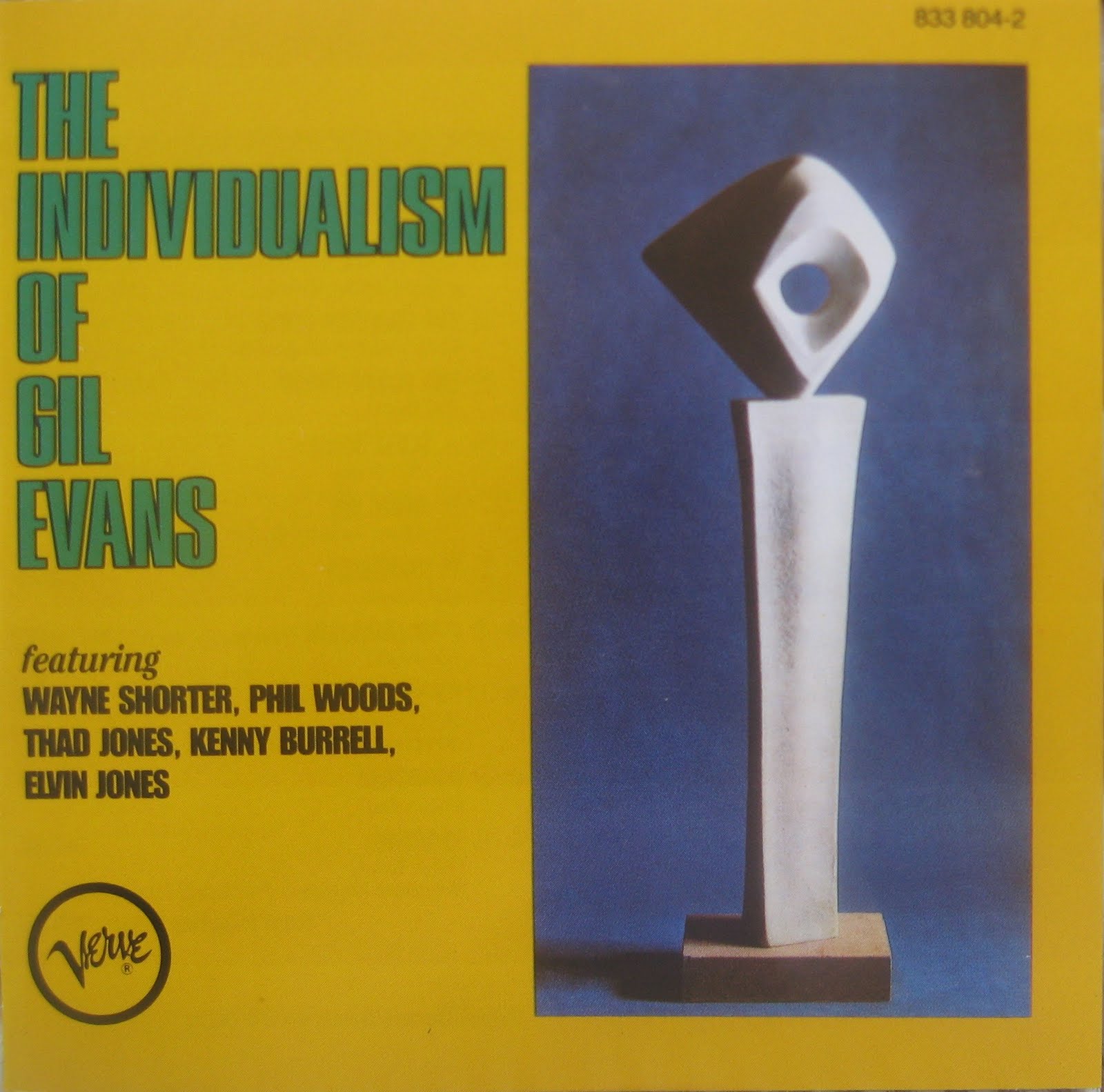
Much more Kurt Weill still lay ahead as Lotte Lenya’s publicizing efforts (see part 4A below this closing section) made things happen--long-play records, more performances by more curious musicians, scholars mulling things over. Nonet trombonist J.J. Johnson and pianist Andre Previn teamed up for a Weill record, and then Gil Evans proceeded to create two multi-varied albums of great genius, perhaps the best of his long career (and no Miles for miles!), titled Out of the Cool and The Individualism of Gil Evans.

Each LP featured, and to some extent was keyed on, a single piece by Weill. Retrieved from his German theatre works were “Bilbao Song”—in Gil’s hands a mix of dissonant proclamation, odd percussion, and plucked bass and guitar, somehow all of a piece with the Cool album’s other tunes—and,
more prominently, “The Barbara Song,” a stunning, perfect arrangement that hovers and shimmers and haunts, on first listen or fiftieth, a wealth of melody and modulations, mastery and mystery alike.

Evans’ assistant for several years in the Eighties was Maria Schneider, who learned much from Gil and applies those lessons herself as a multi-Grammy award-winning Jazz orchestra leader. Invited by Jazz.com to pick and analyze a dozen favorite Evans tracks from his long career, well, Ms. Schneider chose Weill’s “My Ship” and “The Barbara Song” as two of the twelve. Regarding the latter she wrote, in part:

“I thought of it as a ‘Gil piece,’ not an arrangement of something. One day it occurred to me to check out Kurt Weill’s original version. And there it was, the whole long and developed melodic contour that I was familiar with. Gil had simply laid it out, but he did it in such a way that made it feel improvised and continually evolving…. Through the melody, Gil heard profound depth, and spun his own universe out of it…. Gil’s lines are just Weill’s original melody, but wrung out at a slow, searing tempo.”

Musician, conductor, and scholar Ryan Truesdell has located and studied and prepared for recording a number of unknown Evans arrangements, with an album to be released next year. He too has declared “The Barbara Song” to be one of Gil’s best and most important creations.

In fact, Gil’s quiet influence—his colors and dissonant voicings, his composer shadows (Debussy, Stravinsky, de Falla… and Weill?), his unlikely but perfect orchestrations and “notes between notes”—eventually pervaded or at least provoked the thinking of arrangers and musicians alike, whoever worked with him or studied his works, for the next 40 years: among arrangers, Bob Brookmeyer and Hal Mooney, Pete Rugulo and Teddy Charles, across the decades to Bob Belden and Gil Goldstein, Maria Schneider and Laurent Cugny; and among the scores of players, John Lewis, Gerry Mulligan and Miles… Steve Lacy, Cannonball Adderley and Johnny Coles… Eric Dolphy, Kenny Burrell and Elvin Jones…
Wayne Shorter, Herb Bushler and Tony Studd… Howard Johnson, Billy Harper and David Sanborn… Lew Soloff, Hiram Bullock and Arthur Blythe… Masabumi Kikuchi, Hannibal Marvin Peterson and Tom Malone… Pete Levin, George Adams and Airto... on and on and on.

Without Gil Evans and Kurt Weill would the Doors ever have swung wide open--first, Kurt’s “Alabama Song” and then Gil’s “Jambangle,” reworked a bit to become, with lyrics added, “Light My Fire”? And that era-defining hit probably led inexorably to Gil’s late projects with both Robbie Robertson and Sting—while edgy rockers like Lou Reed, Marianne Faithful, Nick Cave, and Tom Waits
built their careers in part on the jagged sound of Weill.

Without Evans, would composer Carla Bley’s twists and turns and quirky jibes so readily have found a place in Jazz? Without Kurt’s Berlin days, could bassman Charlie Haden’s peripatetic orchestra ever have become so political, so “Musically Liberated,” and so admired?

If Gil hadn’t taken off the arranger gloves and punched-up his freeform bands of the Seventies and Eighties, embracing electricity and synthesizers, would Miles Davis have gone so far (and farther out) into fusion and funk? He continued to consult Gil at every turn, and one can easily imagine the two of them holed up with some medicinal weed,
chortling merrily at the next step each planned to take. (In fact, if old guard Gil hadn’t grinned and accepted the mantle of avant garde “Svengali,” would fusion music ever have succeeded so?)

But we need to resume our walk on the Weill side. George Avakian became the manager and producer for a John Lewis-Gunther Schuller “Third Stream” venture called Orchestra U.S.A.; and one mid-Sixties project was an album titled Mack the Knife and Other Berlin Theatre Songs of Kurt Weill, by two Orchestra sextets that included ex-Nonet members Mike Zwerin and Lewis. Zwerin’s arrangements took a much simpler approach to Weill,
with a varying core of five musicians playing Kurt’s tunes fairly straight while the freed-up sixth man became the overlaid improvising soloist... basic stuff, really, very dependent on each soloist’s inspiration. But the results were astonishing, because the primary soloist on three of the seven tracks was Eric Dolphy going ballistic and berserk on his bass clarinet, especially on “Alabama Song,” registering his response to the Civil Rights violence there. (Had Dolphy not died soon after the first session no doubt he would have crushed the other four tunes too.)

Nearly three decades later, when Avakian wrote typically brilliant liner notes for the CD reissue of yet another Weill/Jazz album (John Bunch playing solo piano versions, mostly “up” and Fats Wallerish),
George was still marveling at Dolphy’s performances and he told this anecdote: Lenya had heard Dolphy play at a gallery opening in 1962 and had enjoyed his inventive style. In ’64 George gave her a copy of the Sextet album, warning that she might be shocked by the ferocity of Eric’s playing, particularly on “Alabama Song.” Avakian commented, “I am convinced that it will never be surpassed as the wildest bass clarinet solo of all time.”

Lenya listened and then responded with her own tale of Kurt hearing a Jazz version of one of his tunes and not recognizing it at first. When he did, he quoted a Threepenny lyric, “It’s possible my way—but this is possible too.”
Then she added, “Tell Eric I’m not sure what Kurt would have said about him, but I think it’s great and now I really understand why [he] wanted to play…” (that is, for the artist back in ’62).

Gil Evans was dead by the time Avakian wrote about woodwinds-and-sax genius Dolphy—who had contributed as well to the great Individualism album. In the mid-Eighties Gil evidently had begun to rethink the anything-goes, un-arranged bands he had “led” (just barely) for two erratic decades. Some bits of evidence:

Maria Schneider found him at the piano one day, practically tearing his white hair out; he desperately wanted to recreate his classic re-composing of Weill’s “My Ship,”
but couldn’t remember what he’d done or how—and he had thrown the arrangement away many years earlier.

At the time of his death in 1988, he was considering a proposed commission from producer Hal Willner, innovative driving force behind the excellent Weill tribute album Lost in the Stars (released in 1985) and the varied and amazing September Songs CD sequel that would shake up the Jazz/Pop world in 1997. Willner wanted Gil to do a new version of Mahagonny! (The mind boggles at what might have been… the whole opera given the old Evans musical magic? The Songspiel only? Or even just the right song or two…)

Maybe Gil had finally heard the rumblings among fans and Jazz critics,
who were tiring of too many live albums by spur-of-the-moment, hit-or-miss, "Monday at Sweet Basil" bands. Columnist Francis Davis ended one essay, for example, with this suggestion:

“Evans belongs back in the studio, where greater focus is a prerequisite, and where arrangers are in their element… He deserves an opportunity to pick the soloists for an entire album of Mingus or Ellington or Billy Strayhorn or Kurt Weill, for whom he has long shown a special affinity…”

But none of that occurred. Instead Gil cut a disc of duets with Steve Lacy and a pair of fine, old-style-Evans orchestral CDs with Laurent Cugny’s Big Band Lumiere. Then he died.

Weill’s fans around the world celebrated his centennial in 2000, and lots of new albums appeared, and then the world just resumed turning. These days the Weill Foundation works with scholars doing related research, and it keeps tabs on Kurt’s music, Berlin to Broadway and beyond.

Gil’s assistants and musicians and fans continue to ponder his musical choices and mysterious innovations. The piano trio known as Tethered Moon issued a terrific CD of Weill songs in 1995; all three musicians (Masabumi Kikuchi, Gary Peacock and Paul Motian) in some manner had played or recorded with Gil.

In 1997 Charlie Haden produced an interesting “duet” on “Speak Low,” his deep-as-a-well double bass thudding alone over pianist Fred Hersch and then segueing into… Kurt Weill himself singing the familiar lyrics!

And in late August, a few weeks ago, Ryan Truesdell and his hand-picked orchestra of New York musicians cut a dozen previously unrecorded and/or unknown Evans arrangements ranging from the Forties up to the Sixties. The resulting album will be issued in 2012, Gil’s own centennial year.

Among the tunes recorded was a recently discovered alternate arrangement of “The Barbara Song,” this unknown version
for a larger and differently configured orchestra than Gil used back in 1964.

The Kurt Weill conduit continues.


* * * * *
My thanks to all who actually read all five parts in this diffuse saga. I tried to make it vaguely amusing, even surprising in a few spots, with a changing perspective on the people and music. Maybe I got in over my head, but the float vest worked... and here we are, finally ready to move on.

Saturday, September 24, 2011

Gil Evans: Here 4A Weill


(Lengthy Part 4 is now divided for readability, with second half in a day or two.)

There was something in the air. Or maybe it was the water. But from the Twenties to the late Sixties there was this spectrum--invisible, imaginary, whatever--of oddball anarchist music (well, quirky anyway) being created and released on record and film. Aural symptoms might include sound effects, irregular rhythms, changing tempos, tuneless tunes, uncommon instruments, eccentric, possibly amateurish playing, an alien musical conception withal.

Each artist would exhibit only certain of these traits. At one end of the spectrum you’d find, chronologically, the barnyard sounds and seemingly uneducated playing of the Original Dixieland Jass Band; the wild and woolly, wacky-woo-woo, musical bits and pieces strung together with split-second timing by composer Carl Stallings for Warner Bros.’ “Looney Tunes and Merry Melodies” cartoons; and the bizarre combinations of music and dialogue and sound effects good-humoredly smushed together on the records of Spike Jones. (The near-musical, carefully timed, rapid-fire routines of comics like the Marx Brothers and Abbott & Costello fit in there somewhere too.)

The opposite end of the spectrum is much more musical, though still strange-sounding when first sprung on a casual, unsuspecting listener. I hope there’s no need to belabor the point (racially or otherwise), but I’m thinking of the choppy, hammering, stride-piano playing and eccentric, brilliant-corners compositions of Thelonious Monk; the slightly west-of-caterwauling, hues-of-blues originals issuing from Ornette Coleman’s plastic sax (love the “ugly beauty”; still not ready for Prime Time); John Coltrane’s “sheets of sound” reflecting his unshakeable, inner-space determination to blow every possible note and combination of notes arrayed in the infinite field of any piece of music (and do so all at once!); and the antic hijinx--the combs, brooms, costumes, dreams and drums--the delirious music unleashed on a suspicious world by the world-is-our-playground-and-oyster, con-kniving knaves known as the Art Ensemble of Chicago.

One end “light”… one end “serious.” And most groups and Jazz bands somewhere along the line between. You can supply your own candidates and placement, or you can dismiss the whole fanciful thing as Hog-warts, but I ask that you just amble with me a ways further.

Edging toward the bizarre would be the Boyd Raeburn Orchestra mixing BeBop and Stravinsky, while the working groups and session bands organized by Gil Evans would be drawn more to the blues’n’boogie, Hard Bop portion of my diagram. And the odd balance of Jazz, opera, and Broadway pop would deposit Kurt Weill (his friend Gershwin not far off) right on the invisible midpoint, flanked by tubas and tangos!

Kurt died in 1950, with only his American show-tune hits of the Forties still having any currency. But two stubborn fans (maybe three) versed in his forgotten European works were having none of that. I wrote a bit last time about Lenya’s revived career and tireless publicizing of Kurt. Time now to introduce George Avakian: writer, producer, scholar, proselytizer, bon vivant, and great good friend of Jazz. The fact that he knew and loved Weill’s early masterworks was the cake under all that frosting.

Avakian and Lenya teamed up to create most of the famous Columbia Records LPs starring her and resurrecting Kurt’s songs and German theatrical works with and without Brecht—excellent if not quite perfectly definitive productions of Mahagonny, Threepenny, his German and American theater songs, Seven Deadly Sins… all but Happy End, which was a later addition after George had moved on from Columbia. (Avakian shows up time and again in this fable.)

Parallel to this were developments in the career of arranger/re-composer/conductor Gil Evans. Claude Thornhill’s bands of the early and later Forties, with beaucoup arrangements by Evans, occupy a special “Beautiful Music” spot on that spectrum chart. Gil fashioned a strange but lovely sound by blending high woodwinds, low brass, and Thornhill’s soft-as-snow-falling piano… which oddly worked on BeBop adaptations as well as ballads and semi-Classical numbers.

When the band was off the road, Evans stayed on in New York City, and his door’s-always-open bachelor pad became the philosophic bull-session center (circa 1948-1951) for a select group of musicians and fledgling arrangers: Evans, John Parisi, Gerry Mulligan, Lee Konitz, John Lewis, and several others including Gil’s new pal, Miles Davis. Fresh from his high-profile time with Charlie Parker, Miles soon became the frontman/leader, and Gil the central force behind the scenes, as the group gradually experimented with a stripped-down version of Thornhill, all the rich chords and strange harmonies vested in nine players only (including tuba and French horn)—just the sort of musical challenge Weill once thrived on.

So there they were, the Evans crew gradually rehearsing, road-testing audience response via a two-week gig at the Royal Roost, and slowly edging into the recording sessions that became known years later as “The Birth of the Cool”—and Kurt doing much the same: writing, orchestrating, rehearsing, moving on from Street Scene to shape new shows Love Life and Lost in the Stars. I’d love to believe that Gil and Kurt each had a chance to catch the other’s work; it’s just barely possible. Certainly Weill’s music became a source for Evans’ magpie curiosity and skillful re-composing a few years later, but Gil’s interest might have started in the Forties.

Here’s that chronology told simply:

Miles' (and Gil’s) Nonet recorded very slowly, with sessions in 1949-50. Among the changing roster of players, Konitz, Mulligan, Miles, and tuba whiz Bill Barber made all dates, joined variously (as available) by J.J. Johnson, Max Roach, John Lewis, Junior Collins, Al McKibbon, Gunther Schuller, and (in place of Johnson during the Roost gig) trombonist and writer Mike Zwerin.

Evans’ conception and maybe even his handiwork seem evident in several arrangements though he claimed only “Moon Dreams” (often cited as the perfect Nonet cut) and “Boplicity.” Some selections were released on 78s with minimal publicity and minimal response, but reissued c. 1954 and then 1957 on LPs with the “Cool” claim—light textures, subtle rhythms, disciplined arrangements; some of them including “Moon Dreams” aren’t too far from what Weill was composing and imaginatively orchestrating at (and on) all stages. (Tangos seemed one of Kurt’s special fortes. Intriguing then that Evans’ own best-loved original was “Las Vegas Tango.”)

Kurt died in 1950, the Nonet soon after. Players dispersed to become leaders elsewhere. Miles and Gil stayed in touch. Then in 1956 Columbia’s producer and a&r great George Avakian not only began issuing the Lenya-Weill albums, but also signed Miles to a major label contract. Gil came aboard to help with arrangements for the Davis Quintet’s ‘Round Midnight debut, which turned out so well that Avakian decided to put Gil and Miles together for an orchestral Jazz LP.

Which became the brilliant and famous album titled Miles Ahead, though not without a struggle: several three-hour recording sessions and countless hours of cut-and-splice tape editing by Avakian and overseer Gil. But the result… ah, the bountiful, beautiful result… “Springsville.” “New Rhumba.” “The Duke.” “The Maids of Cadiz.” “Blues for Pablo.” The title cut. And leading into that track, because the LP really is one big suite of linked, disparate tunes and themes, Kurt Weill’s song superb, fleet of foresail and fancy, “My Ship”… the track routinely discussed as one of Evans’ masterworks of melody and motion. (Yes, Kurt and Gil, together again for the first time, documented.)

And so onward, to Porgy and Bess and Sketches of Spain and more, as Davis and Evans went deep into the dark center of Catfish Row and the deepest song of flamenco--wailing Jazz soloist against richly textured orchestra, slipping closer to a kind of opera. And the reawakened Sephardic soul of Kurt lingered a Weill, smiling

Sunday, September 11, 2011

Owed to Autumn


Inspired by the gorgeous aerial shots of autumn foliage that bridge scenes in the new TV series Necessary Roughness, and by Doug Ramsey’s photos detailing the changing seasons as seen from his roving bicycle (posted at his Rifftides blog), yet equally dis-inspired by this dadblamed new computer still dissing me, and by my resulting failure to write "Kurt Weill Part 4," well… what can a poor boy do but to sing for a rock ‘n’ roll band, ‘cause in sleepy Vashon town there’s just no place that’s happening, so I’ve booked-in Little Johnny Keats as my stand-up replacement. Yes, he’s another short guy like Weill, but he’s tall on entertainment and believe thee me, folks, he knows how to turn a phrase!

Here are some excerpts from his ode to the busy female “Autumn”—but rather than New York or Vermont, this lovely gal’s a favorite in Sussex and Cumbria instead…


Season of mists and mellow fruitfulness,
Close bosom-friend of the maturing sun;
Conspiring with him how to load and bless
With fruit the vines that round the thatch-eves run;
To bend with apples the mossed cottage-trees,
And fill all fruit with ripeness to the core…


Who hath not seen thee oft amid thy store?
Sometimes whoever seeks abroad may find
Thee sitting careless on a granary floor,
Thy hair soft-lifted by the winnowing wind;
Or on a half-reaped furrow sound asleep,
Drowsed with the fume of poppies, while thy hook
Spares the next swath and all its twined flowers…


Where are the songs of Spring? Ay, where are they?
Think not of them, thou hast thy music too,--
While barred clouds bloom the soft-dying day,
And touch the stubble-plains with rosy hue…
Hedge-crickets sing, and now with treble soft
The red-breast whistles from a garden-croft;
And gathering swallows twitter in the skies.


* * * * *
That was Johnny… a pretty decent poet, and the clever lad predicted social networking too.