Friday, April 9, 2010

Was the Depression So Great?


When Congress passed that truncated, industry-forgiving Health Care Bill recently, Progressives and Liberals couldn't decide whether to spit or bet all the pot. President Obama had demonstrated that he just isn't an activist like FDR, or a Congress-wrangler like LBJ; the gap between his mild-mannered desire for "bipartisanship" and the Right Wing's refusal to cooperate in any way just seems insurmountable and... sad.

As the so-called Recession rolls on, jobs and housing go nowhere; and Wall Street parallels to the Great Depression keep haunting us too, except that it's ordinary people committing suicide this time rather than the obscenely wealthy banksters and CEOs.

The March 2010 issue of The Atlantic includes a brief remembrance of one of the significant books that emerged during those hard years (and still irks surviving members of the featured sharecropper family): Let Us Now Praise Famous Men, by over-heated writer James Agee (photo at right) and sharp-eyed photographer Walker Evans. Produced on assignment for Fortune Magazine, this lengthy feature piece was then shelved instead, which gave Agee time to turn it into an epic, oddly poetic account of Southern poverty in the Thirties. Let Us Now... appeared in 1941 but proved to be a confusing misstep, panned by the critics as romantic and excessive.

But it has endured. And the "Grim Regression" we are trapped in now--that's what I call it anyway--has revived interest in Agee's book and in other cultural artifacts from that bleak decade in the U.S. They were hard times, yes, experienced nearly everywhere in America, but also a time when folks pulled together to help each other survive and when the federal government acted swiftly and repeatedly to keep the country alive if not well.

(Let's pause for a moment. I consider the Great Depression to have been the initial decade of our most heroic years, America's too-brief peak as a nation, lasting from approximately 1930 to 1973. And simplifying shamelessly, I'd offer these high points:

The Depression hitting everyone ("paupers and peasants and princes and kings," as Dylan put it), eventually forcing folks to work together. Roosevelt's government dedicated to creating jobs and rebuilding infrastructure and arts alike, followed by a World War that seemed just and drove our economy into full action mode. Post-War prosperity lasting through the Fifties (plus the rise of rock 'n roll), allowing our young people and disenfranchised groups to gather strength and momentum for what became the great movements of the Sixties--Civil Rights, Women's rights, sexual revolution, freed spirits and hippies and rock music ruling all.

Then the forces of repression came roaring back, all the grim events that heralded the resulting 40-year collapse of America: King and the Kennedys assassinated, race riots across the country, the Vietnam War sapping the public will, plus the Watergate investigation and Nixon's fall suggesting that maybe the people would take charge again, but... but that's another, more depressing story.)


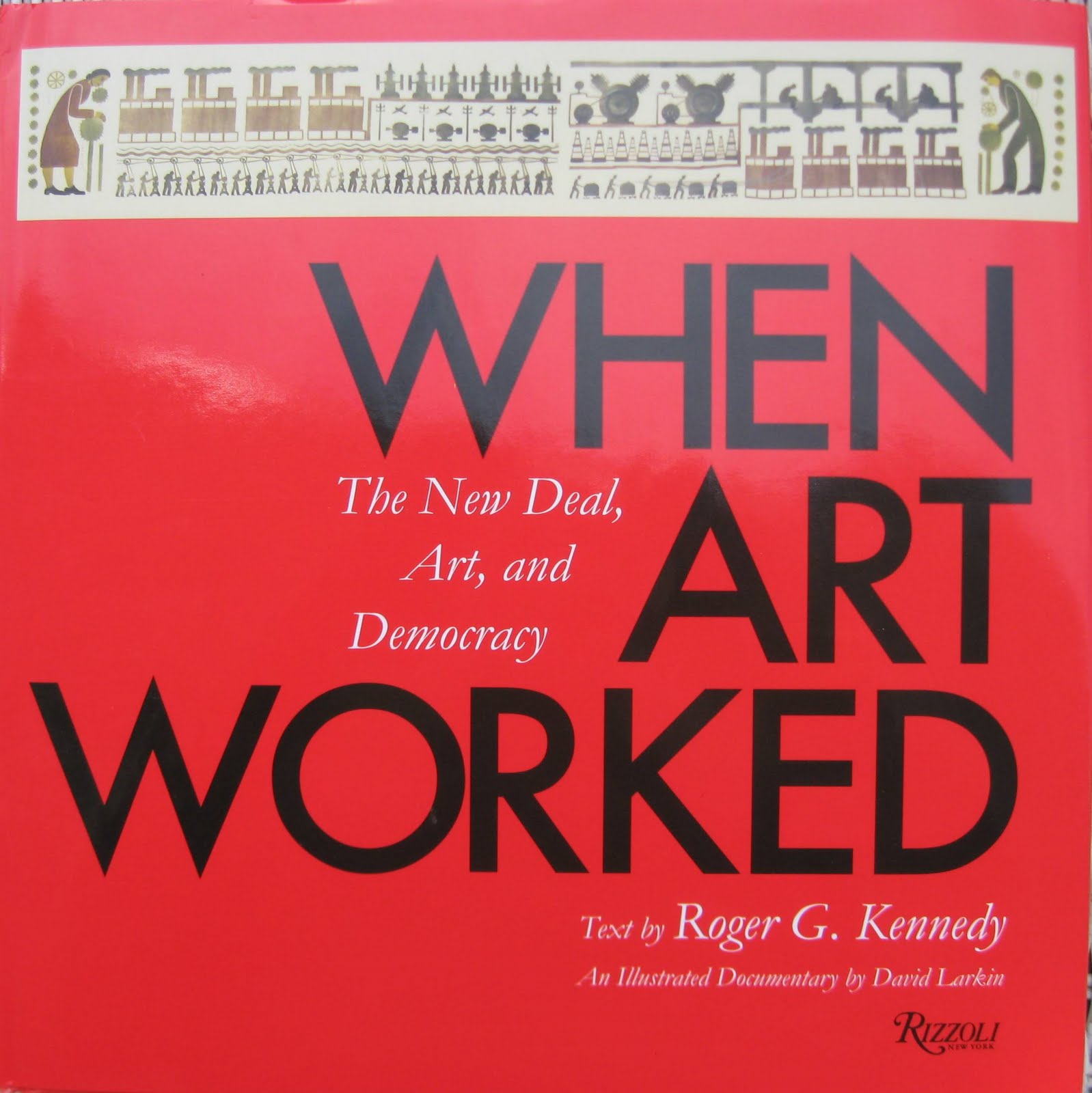
Resuming the earlier discussion, as other evidence I'd cite two exceptional books published in late 2009, Dancing in the Dark: A Cultural History of the Great Depression by Morris Dickstein (from Norton) and When Art Worked: The New Deal, Art, and Democracy by Roger G. Kennedy and David Larkin (from Rizzoli).

The two complement each other perfectly, with Dickstein writing at length on fiction, film, and social history, and with a brief look at Art Deco--covering the lively arts, one might say--while the coffee table book provides a splendid sampling of the government-sponsored public arts of the Depression (sculpture and painting, posters and photography, architecture and public works), created by and for the WPA, CCC, TVA, FAP, and Roosevelt's other "alphabet soup" organizations.

With deft yet erudite critical acumen, Dickstein analyzes in fascinating, enriching detail (and at 550-page length) an astonishing array of cultural touchstones: Steinbeck's beloved Grapes of Wrath and Roth's fitfully remembered Call It Sleep; Wright's violent Native Son and Hurston's rediscovered Their Eyes Were Watching God; the once-scorned novels of Nathaniel West and the misinterpreted films of Busby Berkeley; Left-sympathizing fiction (and non-, including Agee's fever-dream text) compared to the hard-reality photos of WPA regulars Ben Shahn, Walker Evans, and Dorothea Lange; Odets and Blitzstein and the Federal Theater Project shut down while Pare Lorenz's documentaries triumphed; challenged conservative poets like Frost and Stevens versus the freeform sophistication of Hollywood's "screwball" comedies; Welles' Kane following on the heels of Capra's Mr. Smith; Thirties Populist music ranging from Gershwin to Woody Guthrie, from Copland to the Duke; and so on, ad glorium.

Basically, if it happened, if an artist registered on the public consciousness at all, then s/he's here. But Dickstein's critiques extend as well to historical moments and sociological matters. I won't try to summarize or synthesize all the brilliance on display, but I will cite just two of the hundreds of secondary references and quotations he draws on. First, President Roosevelt himself, taken from the Second Inaugural Address:

I see millions of families trying to live on incomes so meager that the pall of family disaster hangs over them day by day.

I see millions whose daily lives in city and on farm continue under conditions labeled indecent by a so-called polite society half a century ago.

I see millions denied education, recreation, and the opportunity to better their lot and the lot of their children.

I see millions lacking the means to buy the products of farm and factory and by their poverty denying work and productiveness to many other millions.

I see one-third of a nation ill-housed, ill-clad, ill-nourished.


(And today FDR would see many millions more, with two-thirds of the farms and factories taken over and sold off, and the manufac-turing and service economy jobs outsourced overseas by stock-worshipping true-believers and bottomline bottom-feeders.)

For a more personal depiction, Dickstein quotes from T.H. Watkins' fairly recent, instant-classic text The Great Depression: America in the 1930s--written in the early Nineties, but now sounding prescient, tragically apt again:

Fear was the great leveller of the Great Depression. It haunted the dreams of the African-American sharecropper in the South who held a fistful of barren dust in his hand and wondered what the system would do now to cheat him and his family of life. It stalked the middle-class white merchant in Idaho who had seen decades of work destroyed when his once-friendly banker coldly forced him into bankruptcy. It whispered terror into the ear of the Mexican-American foundry worker in Detroit who had put his future in the hands of the coyote who brought him north from Mexico into this strange cold place and who now found his job had vanished. Fear shattered all the fine Anglo-Saxon certitudes of the Great Plains farm wife who watched black clouds of dust roll up on the edge of the horizon and knew that her dreams would soon be sucked up into that boiling mass.

(Whew. Factual writing that elegant, no matter how emotional, in itself justifies the study of history!)

The text of When Art Worked, on the other hand, is somewhat less compelling, more dryly factual, full of obscure details about the Roosevelt administration and all the capital-letter works divisions and arts czars (Morgenthau, Hopkins, Ickes, and others) vying for influence. Skim it to get the political gist, I'd say, and focus instead on the artist personalities and the embarrassment of visual riches, most pieces never seen outside the Library of Congress or other government storehouses. (Except for Walker Evans' shot of his friend Agee, all the visuals I've chosen as pictorial support come from the Rizzoli book.)

Courtesy of writer Kennedy and designer Larkin, not only do we enjoy posters and paintings and photographs both famous and unknown, but we also experience major road works, bridge repairs, construction of buildings and monuments, rural electrification projects, farmlands regenerated, neglected National Parks revitalized; plus the remarkable (and readable) series of state and regional guidebooks created by then-struggling writers like Steinbeck and Nelson Algren, Ralph Ellison and Jim Thompson; plus wallsful of murals both interior and ex-, music events "for the People," and not-so-radical Populist theater, heroic attempts to document the whole spectrum of peoples and sub-cultures across America... and, dare I say, more?

FDR promised a New Deal for economically devastated America. In varying degrees he delivered, thanks to the hard work of willing-to-believe millions (and a World War to rev our economic engines). He also said something else pertinent to these two books: "One hundred years from now my administration will be known for its art, not for its relief."

Will our current President accomplish even half as much? He talks a good fight, but so far only the wealthy and powerful are enjoying any tangible benefits.

Where are the jobs and economic assistance for workers and the hurting middle class? Where are the CCCs and WPAs for this Grim Regression?

Tuesday, April 6, 2010

Bill Evans, Not Kurt Cobain


When cocksure young bassist Scott LaFaro died in a car accident in July of 1961, it sent Bill Evans into a tailspin.

The trio of Bill the ever-lyrical pianist, Scott the take-charge innovator, and drummer-perpetual Paul Motian had been together off and on for two years: touring, recording sparely, gradually probing more deeply and more freely, eventually merging and emerging as three brilliant musicians soloing together simultaneously, each following his own extemporaneous thread that somehow stayed interwoven with the others. The Evans Trio's special magic set a new standard for small-group jazz; musicians, critics, and hip listeners were all paying attention... Portrait in Jazz, issued in 1960; then Explorations (still my favorite, recorded in 1961 on my birthday, February 2); and the three had just completed recording of the live and soon-to-be-famous Village Vanguard dates.

Then Scott drove into a tree, and Bill fell from giddy heights to floundering depths in little more than a week. He closed down and stayed mum, morale devastated, supposedly not even touching a keyboard. Months went by. Meanwhile, the two Vanguard albums were released one by one to great acclaim.

About then, another young bassman that Bill had casually admired some years before suddenly popped up in New York. Chuck Israels had been playing around Europe, but had decided it was time to return to the States. I don't know who or what brought Bill and Chuck into contact, but by the beginning of December the two plus Motian were testing the waters, trying to work out the differences among them that were immediately apparent. Bill took his time--cannily wouldn't consider recording this new threesome (though he needed the money) until it was musically clear that they belonged together.

So the debut album(s) by the new, second Bill Evans Trio was(were) recorded in mid-May 1962, a number of sessions that producer Orrin Keepnews organized to create two records rather than one, the ballad set soon called Moon Beams and the up-tempo numbers gathered later as How My Heart Sings! (And both scored well with the critics.)

But wait...

In fact Bill, Chuck, and Paul had already appeared together on another album, recorded in December 1961 and early May of '62, the Herbie Mann disc titled Nirvana--which then sat on the shelf for nearly three years before Atlantic got around to releasing it--with the three tentative trio-mates circling cautiously around each other, providing decidedly, maybe desperately, quiet back-up to Mann's mournful flute. The six tunes put on tape were slow ballads for the most part, ranging from the Impressionistic title tune, to one of Satie's Gymnopedies, to "Lover Man." Static and subdued, adrift and idly modal after the new fashion shaped by Miles and Coltrane--and Bill--back around 1959 during the Kind of Blue sessions.

Nothing in this "Nirvana" to suggest the raucous grunge rockers determined to explode into the public consciousness three decades later, and very little even to suggest the peaceful, Om-niscience of some Eastern mystic contemplating Paradise. The truth is, Mann's album is pretty boring--or maybe pretty and boring. Just too quiet and too unfinished, too disparate and too dispirited. The decision to shelve it for years seems wise in retrospect.

I freely confess I'm not much for flute, whether Jazz or Classical or pennywhistled Folk. But it's not Mann who falters on Nirvana. Evans manages a few lyrical runs, but Israels and Motian sound isolated and indifferent. Compared to the artistic merger of the original three, these guys might just as well have phoned it in. Maybe the baffles were too high (a baffling development?). Maybe the drugs--Evans was struggling with heroin--didn't get them high enough. Maybe someone's higher power wasn't listening. Luckily the disjointed three ignored addictions, omens, and Mann-made obstacles, and kept at it over the winter and spring of '62 until the nascent new Trio began to get things right.

And so the History of Jazz avoided the loss of a subsequent, substantive chapter: the Bill Evans Trio (Mach 2) and the joy and gladness that Bill and Chuck and Paul--or Bill, Chuck, and Larry Bunker; or Bill, Paul, and Gary Peacock; or some other temporary variation--would contribute to live music for several years to come.

Sometimes three's a crowd. Sometimes it's the minimum number for democracy. The first Trio was Jacksonian and pushy, the second more Jeffersonian and cool--with Chuck much less demanding than Scott, Paul (or Larry, soon) powering on, and Bill having to take charge... Not three of a mind like the first Trio, but still three of a kind.

Saturday, March 27, 2010

Listening to Lange...


Hip-deep in some recent books relating to the Great Depression--the first one, I mean, not our on-going "Grim Regression"--I am offering here for the moment my own slight tribute to the astonishing, hauntingly beautiful, era-defining b&w photos taken by those artists working for the W.P.A. in the early Thirties: Ben Shahn, Walker Evans, Marion Post Wolcott, Arthur Rothstein and, of course, Dorothea Lange.

So: an encore presentation of my Lange dramatic monologue/ballad poem... but this time I'm adding photos that should enhance it a lot:


Ballad for Dorothea

I saw the plow that broke the Plains
break on dust and “drouth.”
That’s what the people called it,
a word as dry in the mouth

as a farmer’s thirst. Or his curse.
That damnable dearth of rain
dried up the land, growing
crops of nothing--but a harvest of shame


when bankers foreclosed on families
who’d seeded the earth with their bones,
raising up an army of the homeless
I held in the lens

of my eye long enough
to let the pure
light within them burn this country
a way to a truer future.


I couldn’t think of them as migrants,
or Okies, like some, because I’d
seen the dusters come rolling and boiling,
blotting out the sky,

till a one’s hair and tongue and dreams
were all the same dark smudge.
To me they were refugees,
even the ones that held on and didn’t budge.


Those black blizzards ate the sun,
and I traveled through the towns,
the tent camps and Hoovervilles,
seeking with my lens

to tell the folks’ hard stories
without leaching their pride.
That was my strength: I could look
and not seem to be looking; I could


see the split-seconds that would
document lives—that bitter old man
with his cup, turned away
from the breadline; one

lone worker, his wheelbarrow dumped over,
head down and back against the wall… Yet
truth to tell, I suppose
I never quite caught


those broken farms on film.
How I envied Rothstein his glorious
shot of the man and his sons
leaning into the dust

storm! I was better focused
close on people: mothers and children
in tarpaper shacks, towns
fly-specked with aimless men,


whole families packing the roads.
Displaced persons everywhere I looked,
their faces streaked
with the dust they couldn’t lose. The Joads

were just folks I’d met;
I as much as snapped the photos
for John’s novel. Still, I don’t know
what they thought.


Times we’d talk, they weren’t what
you’d call articulate. Uneducated,
most of them, and shy.
But with hearts that could reach the sky

above the Great Plains. I
never knew a one of them to grovel,
or even ask for pity.
I loved them all


the only way I could—
I hugged them with the camera.
But I don’t see as how
my caring made any difference.

So many years now,
and the moneyed are still in control,
the homeless still search for cover.
I’ve come to believe we’re all,


poor and rich, wandering in ignorance;
refugees, on a road the dust blows over.

Thursday, March 18, 2010

Tom Russell: Darkness Visible


Lately I've been listening to more folk/ roots music than anything else, and I've found four artists who speak more directly to me than the popular, maybe better-known performers do. I suppose it's partly a matter of age, because these four songwriters are closer to my 67 years than, say, Ben Harper or Ani Defranco or Whosit. All four are well-regarded here in the U.S. and highly praised in Europe. I've already written (here) about Dave Alvin, ex- of the great roots rock band the Blasters; and another of the four needs no publicity from me (hard-living, late- and still-lamented Townes Van Zandt), so I'll focus some attention on the remaining two, stubborn Westerner Tom Russell in this post and New Orleans r&b guitar master Chris Smither (sometime soon).

Russell has been at it since the mid-Sixties. In fact, a recent post on his personal blog talks about having an encounter with Bob Dylan back in '62 or so, and knowing then and there what he wanted to do with his life. His success came slowly, but by the early Eighties other performers were recording Tom's songs--Joe Ely, Nancy Griffith, Jimmie Dale Gilmore, Dave Alvin, Tom Paxton, and Johnny Cash all discovered his music. In the meantime he was recording for Philo and then Hightone, and nearly every album from those three decades is a gem. But a trio of his most recent releases provide a good summation and intro: Veteran's Day: The Tom Russell Anthology, a 2CD set on Shout Factory, sampling his best songs from those two defunct labels; One to the Heart, One to the Head, by Gretchen Peters, with Russell duetting and producing, on Scarlet Letter/Frontera Records (in 2008); and Tom's latest, 2009's Blood and Candle Smoke, also on Shout Factory.

There's a well-known Northwest poet named David Wagoner, who in his heyday seemed to find poems in everything: old shoes, getting lost in the woods, baseball games, croaking frogs... you name it and he'd write it. Russell has some of that world-embracing, eclectic, encyclopedic intelligence; his storytelling songs draw on the cowboy past and the confused present, historic happenstance and misterioso modern moments alike. So in the two-set you find wonderful originals devoted to Japanese-Americans interned at Manzanar, the sad death of Bill Haley, Vietnam veterans, pre-Katrina Mississippi floods, careless horsethieves caught and hung, Little Willie John's cellmate, a handy Navajo rug, Mickey Mantle, fighting cocks in Mexico, Charles Bukowski, a border patrolman in California's unexpected snow, a statue in Lyon, France... and that's just a third of the 37 tracks on Veteran's Day.

Tom's fondness for high-energy folk-rock and chiming guitars (mostly courtesy of longtime pal Andrew Hardin), mariachi and Tex-Mex backgrounds, memorable images and muscular language, are all well represented, his past as amateur boxer, carney roustabout, sometime cowpuncher, and semi-pro adherent to the stripped-down style of Hemingway and Raymond Carver subtly present too. Listen to this 2CD set, and I'll bet you want more.

Gretchen Peters is a Nashville-based country singer/songwriter, but she grew up out in Colorado and a few years back she and Tom linked up somewhere, with Peters providing background vocals on some Russell tracks. And Tom was immediately convinced she should cut a modern Western album, which is how One to the Heart got recorded. The two put their heads together and assembled a terrific array of new and old Western songs with a suitably autumnal feeling and arrangements favoring piano, accordion, and cello more than guitars--Mary McCaslin's beautiful "Prairie in the Sky" and Rosalie Sorrels' proud farewell titled "My Last Go Round," the cowboy tune "Old Paint" and Dylan's border-flavored "Billy 4" (from his soundtrack for Pat Garrett and Billy the Kid), Ian Tyson's sad and lonely "Blue Mountains of Mexico" and Nan O'Byrne's comically rowdy, not-precisely-cowboy original called "Sweet and Shiny Eyes."

Three others elevate the album beyond excellence to secure classic. Townes Van Zandt's "Snowin' on Raton" receives a gorgeously simple guitar-and-piano arrangement, with Gretchen and Tom trading verses and harmonizing a slightly lengthened chorus, repeating the simple, hypnotic lines "Snowin' on Raton, Come mornin' I'll be through these hills and gone." Meanwhile, the puzzling title of Peters' album comes from a number (written by several women) which addresses directly and angrily male abuse of women; its title "If I Had a Gun" tells you that the later line "One to the heart, one to the head" comes with a snarl and a promise of violent revenge. A cowboy song? No, but a modern "murder ballad" for sure.

Finally, Russell provided a new song for Gretchen and himself to share, the wonderful, spirit-comforting original called "Guadalupe," depicting the Virgin of Guadalupe shrine and miracle story of Juan Diego seen anew through the eyes of a troubled penitent, and sung first-person as if truly being experienced by Gretchen (or Tom, in harmony). The lines are haunting, questing, amazing. Here's a sample:

There are ghosts out in the rain tonight
High up in those ancient trees
And I have given up without a fight
Another blind fool on her knees...

She is reaching out her arms tonight
And, yes, my poverty is real
I pray roses shall rain down again
From Guadalupe on her hill

And who am I to doubt these mysteries?
Cured in centuries of blood and candle smoke?
I am the least of all your pilgrims here
But I am most in need of hope...


I have to admit that this beautiful song strikes a chord in me, the first time I've ever been made curious about Catholicism and saints and miracles. And the performance anchored Gretchen's CD so remarkably that when Tom released his own Blood and Candle Smoke a year later, he revisited their duet and picked an alternate track or shaped a different mix putting himself in the lead (making it the album's title source too). With Russell's wounded baritone throughout, a later verse takes on new meaning:

So here I am, your ragged disbeliever
Old doubting Thomas drowned in tears
As I watch your church sink through the earth
Like a heart worn down through fear...


But the earlier duet was a musical miracle not to be supplanted by his own doubt and guilt, however heartfelt.

Russell's songs are quite literate, even literary, sometimes more like short stories or spoken word recordings, as he cites in passing--or builds whole songs around--Mother Jones, Nina Simone, Hank Williams, Joseph Conrad, J.D. Salinger, Graham Greene, Picasso and John Donne and Tennessee Williams. But this is not just namedropping; the references are usually surprising but apropos and add welcome depth--until his later CDs have come to seem chapters in some grand Encyclopedia of America, evoking Nature despoiled ("Santa Ana Wind" and "Mississippi River Runnin' Backwards"), his own wild past in Nigeria and Canada and Mexico as some strange code for U.S. meddling around the world ("Criminology" and "East of Woodstock, West of Viet Nam"), and carnival craziness as greater metaphysical exemplar, found in "Darkness Visible" and "Don't Look Down," the latter including this packed verse:

Oh, the rhymes of the ranges,
And the kindness of strangers
I have run all the changes
Of the Chickasaw waltz
Tasted lipstick and nylons,
Seen your mental asylums
Turned my back on that violence,
Before I turned into salt...


Even the music this time roams farther, offering not just folk guitars and Tex-Mex excitement, but odd percussion and drifting arrangements involving members of the musical cooperative Calexico/Giant Sand (Joey Burns, John Covertino, and others) and ex-Box Top keyboards whiz Barry Walsh. Gretchen Peters adds harmonies as well.

I could blather on for several more paragraphs, but I'll skip to the chase--the remarkable track titled "American Rivers," which pretty much includes all the points about Russell's songs I tried to make earlier: personal remembrance, history and politics, pollution of Nature, satirical references, surprising tenderness. Let Tom's own words suggest his role in roots music:

In an old Chinese Graveyard, I slept in the weeds
When a song and a story were all a kid needs
Yeah, the rhymes and the rattle of those runaway trains
And the songs of the cowboys, and the sound of the rain

And it's mama I miss you, I woke up and screamed
American rivers roll deep through my dreams...

With their jigsawed old arteries so clogged and defiled
No open-heart miracle will turn 'em back wild
Past towns gone to bankers; past fields gone to seed
All cut up and carved out; so divided by greed

And old grandfather Cat Fish with whiskers so long
And his life in a struggle, 'cause the oxygen's gone
Oh, mama I miss you, I woke up and I screamed
The American rivers, they've poisoned my dreams

Colorado, Allegheny
Shenandoah, Sus-qua-hay-nee
And the Wabash, the Hudson, the brave Rio Grande
I was a kid there, asleep in the sand, near your Waters...

Sunday, March 7, 2010

Of Bootlegs and Blogging


I'm lucky to have lived through the birth and early growth of Rock Music's bootleg records--1967 to 1980, approximately--back when the Mafia hadn't yet muscled in to press counterfeit copies of real albums, and the artists themselves were often amazed and flattered and happy to cooperate somewhat in the release of such collectable stuff.

Back then, it was understood that any bootleg collector was also a big fan who'd buy anything the artist recorded, whether released as an industry product or a private label swipe. The records were pressed in limited numbers and sold openly in certain alternative-style, hippie-driven stores, and there weren't that many releases at first.

If we ignore the Forties/Fifties tradition of beyond-legal (re)issues of unavailable Early Jazz discs (at first still as 78s, then later gathered on 12" LPs), the first Rock era bootleg was a two-record set issued in 1969 in a plain white jacket completely devoid of text, with blank white labels as well. The set was loosely identified as Great White Wonder, and playing it revealed four sides of previously unissued tracks and unknown songs by Bob Dylan: a variety of studio outtakes, hotel room tapes, live-in-club performances, and demos of tunes offered to other artists, two dozen numbers ranging from "Dink's Song" and "Ramblin' Around" to "Tears of Rage" and "The Mighty Quinn." The tracks weren't uniformly excellent, and sound quality varied widely, but to have them issued at all was both feat and treat, offering splendid fare for collectors and Dylan fans.

I guess the set must have sold well because soon other (and better) Dylan albums appeared, and then other artists showed up too--the Beatles, the Stones, Led Zeppelin--and in no time the levees were breached and the floodgates broken wide: live concert tapes and obscurities galore by the Who, Neil Young, David Bowie, the Dead, and other Sixties faves, followed soon by a whole new branch devoted to Bruce Springsteen alone, and then Jackson Browne, Frank Zappa, Elvis Costello, the new Fleetwood Mac, the Clash and the Sex Pistols, on and on.

There were a couple of excellent underground companies like "Trademark of Quality" (with its pig symbol and jacket covers featuring artwork by brilliant comics artist William Stout); but there were also crappy fly-by-nighters who just bootlegged, poorly, other labels' boots, and--still later--legitimate above-ground industry careers for one or two of the ever-anonymous master 'leggers!

Several major artists actually climbed on board, allowing high-quality tapes to slip out to the "fans," and a few even issued their own official boots. (Decades later came the legal Dylan series that continues today on CDs.) Bootleg album packaging kept getting fancier and fancier, until a buyer could easily be fooled into thinking s/he was purchasing a legitimate release.

But, really, what had begun as a service to fans, and a relatively harmless promotion for the performers, somehow had grown immense and become a giant sub rosa industry involving a few thousand different albums and hundreds of thousands of dollars--worrisome revenue totals not going to the bypassed record labels and original artists. Investigations were launched, warehouses and pressing plants raided, serious fines and jail terms slapped on anyone caught selling any sort of bootleg. (Elvis Presley, meaning Colonel Parker, and RCA were especially virulent and aggressive; one bigtime bootlegger, based in Florida as I recall, got 20 years.)

The fun went out of the game. Too much grief awaiting buyers and sellers. Too much shoddy product. Too many choices with no open discussion possible to help determine which discs were worth owning.

Like many others I stopped buying... until CDs came along and revived the whole thing all over again, resulting in new high-quality discs, more serious collector material unearthed, and many stores again selling them almost openly--for example, major stuff appeared from the always-indefatigable Dylan, including a five- or six-CD set offering the complete Basement Tapes of Bob and the Band, which shamed Columbia's mid-Seventies two-record sampling... I've succumbed to a few of these new-era issues, but I'm cautious.

Who wants the hassle? Let the younger fans track down boots of Nirvana and Pearl Jam, Throbbing Gristle and REM or whoever. The collector fun's pretty much gone for me. I guess I'll just stick with the now-historical gems I was able to accumulate 40 years ago--samples of which are illustrating this very pictorial post.

Friday, March 5, 2010

Delray Beach, Sort Of


Spaceholder this week...

Just back from Florida, from the Shults family gathering--with Ludwiczaks too, and extended-family Maxwells and Stalneckers--convened around father Richard's lamented passing (see post below). But he got a grand send-off indeed, from Funeral Mass at the favored Catholic Church, to official Reception at a posh Holiday Inn restaurant, to several reunion parties with all ten kids (well, all of them are aging adults now), and spouses, and some of their children present too, ranging from 23-year-old blonde bartender Ashleigh down to six-months-old, new-kid-on-the-block Blake.

West Palm Beach, Highland Beach, Delray Beach... wind and rain, sand and sun, we roamed the Southeast Florida retirement/vacation strip. And a great good time was had by all, even widow and proud matriarch Peg.

So the sad occasion became serendipitous and magical, brimful of love and joy. Glad I got to go along as daughter Sandra's happy partner (albeit worse half).