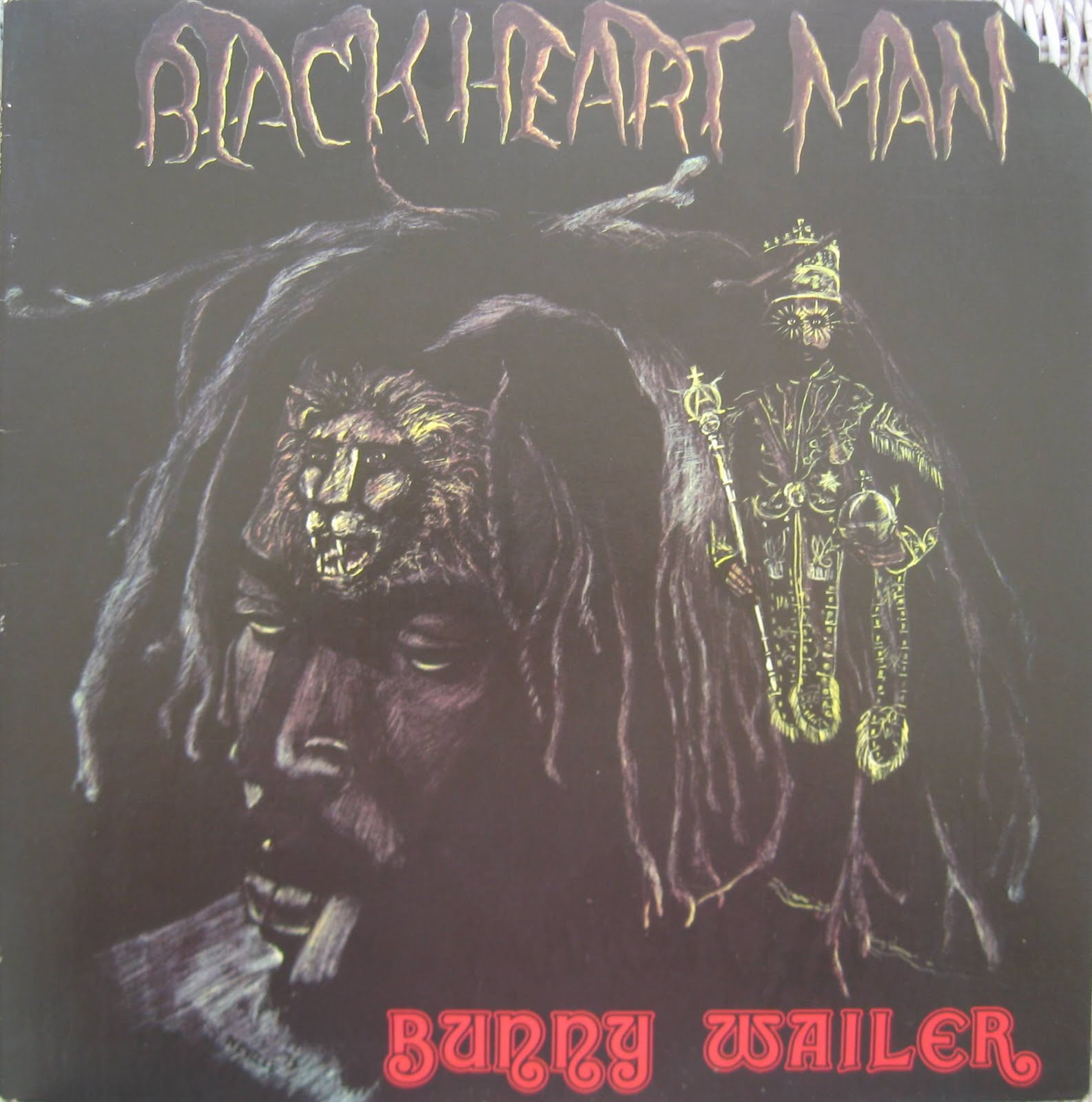
Yah mon, seen? Righteous Reggae music make me wanna holler, "Rasta far I!"--and I don't even know what it means.
Some say the "I" thrown in to sentences, or added as a prefix or suffix to certain words, is a self-effacing Rastafarian way of offhandedly--avoiding "me" and "we"--referring to oneself. Well maybe, but the varied, freeform usages are just confusing to... I? I-man? I and I? Kiddus-I? I-dren? Irie? Ital? Ites?
Similarly, original early-Seventies Reggae had what's called a "one drop" rhythm (in Jamaican patois, "riddim"), which means a four-four beat where the snare and bass drums hit the third beat of every measure, but not the one (it's dropped), while rhythm guitar keeps solid two and four.
 But these days one-drop can also mean whole CD albums offering multiple versions of a single riddim pattern and tune, or two or three different riddims with several performances each, and all with different vocalists/lyrics/instrumental flourishes/mixes for each individual performance or interpretation. This can get pretty boring when the rhythm doesn't please the ear much or the melody isn't catchy, but a few one-drop CDs are brilliant--sort of variations on a theme, Jamaica style.
The island has actually been a musical phenomenon for 50 years, with more 7" singles sold there per capita than anywhere else in the world. Consider that again: a tiny poverty-stricken island (where a drug war like Mexico's, but on a smaller scale, is raging just at this moment) whose "herbal loving" populace buys more records than ganja spliffs... with Bob Marley and the Wailers (and others following after)
 turning the whole world onto the stuttering beat patterns and deep spirituality of certain styles of Reggae (basically Roots Rasta vs. sexy, secular Dancehall).
And then the instrumental versions of songs re-mixed by inspired engineers like King Tubby (because the record producers were cheapskates and wanted to recycle existing tunes and tapes) with echo, electronic tricks, and minimalist vocals dropping in and out to create Dub Music, at first used as the B-sides of singles and then as significant releases in their own right--which gave Sound System deejays (who ruled over deafeningly loud outdoor dances) a musical bed to talk and chant over.
 And these two newer variations of Reggae then swept the world too, in the Eighties mostly, leaving Rap, Hip-Hop, Trance, Electronica, and umpteen other sub-genres bobbing up in their wake ever since.
Meanwhile, back on Jamaica, you had 40 years of massive gun violence, continued poverty, governments failing, and dancehall behaviour turning--let's be blunt--exceedingly lewd and lascivious, this "slackness" acted out over music made tinny and insubstantial by a switch from real musicians to digital gadgets. Yet still the discs sold, and still the tourists came to laze and glaze and gawk.
 (A recent, perfect expression of the grim side of Jamaica is "Nothing to Smile About," the bitter and beautiful hit by vocal group Morgan Heritage; see more below.)
And eventually there came a spiritual awakening, a return to "conscious" roots and reality, as the Rastafarian belief system began to dominate the lyrics and message of the music once more. (Briefly, that would signify a belief in Jah--God, more or less--with Emperor Haile Selassie of Ethiopia
 as the Jesus figure who'll save his followers from the hellish Babylon they, and we, all live in. Plus gentle pacifism, strict vegetar-ianism, hair grown to an uncut thickness and length known as "dreadlocks," and the consumption of astonishing quantities of ganja.) The basic rhythm tracks--and each newly invented riddim--reverted too to real musicians again, but now playing in tandem with the banks of digital drums and electronic gear.
But I want to focus on one-drop albums a bit more. Reggae experts and record companies have taken to referring to each individual riddim as a "one-drop anthem." Sounds impressive, right? After all, many familiar rhythms/tunes have been in use, and recycled, since the old Studio One days, meaning the late Sixties.
 But others are as new as yesterday, and suggesting classic status for most of those just flies in the face of historical judgment. Also, the anthems are frequently not identified by name, leaving it up to clueless ignoramuses like me to puzzle things out somehow. I swear there are no hints hidden in the credits or minimalist liner notes; I guess true fans are expected to have memorized all 300 or 3000 or however many riddims there are! (Among the variety of riddim names, by the way: Zion and New Jerusalem, Gully Gully and Wadada, Caribbean Party and Stop That Train, No Vacancy and Drop It.)
One-drop albums so designated have been appearing since 2006 or so. (Older compilations identified themselves as single-riddim or "riddim rider" or some such, but included a given name.)
 The first one I bought, Strictly One Drop Volume 1 (on Cousins Records), didn't impress much; the CD has a total of 20 tracks, but the base riddims and performances are pretty ho-hum--more "weed" songs, recycled American r&b, dancehall shakers, and prayers to Jah. Plenty of good voices (Luciano, Frankie Paul, Lukie D, and George Nooks leading the way), and two tracks by Morgan Heritage (who basically can do no wrong), but mostly the inspiration is as washed-out as the tan-brown packaging. Where's all that resonant red, green, and gold?
Well, maybe the label had the same thought because Volumes 2
 (with the best one-drop releases of 2007) and 3 (2008) do revive the Rasta color(s) and sound-clash excitement; 40 tracks in 2CD sets, each one, and three-quarters of them are killah! And I believe their powerful impact is largely due to one person, young turk producer Kemar "Flava" McGregor, who proved himself the hottest Conscious Roots creator of the mid-decade, shaping new riddims or re-arrangements for almost every major singer or chanter, and young newcomers too.
McGregor is behind 12 of the 40 tracks on Volume 2, and while the remaining 28 offer some excellent tunes and performances, they are often updates of familiar riddims; I'm hearing versions of Marley's "Easy Skanking," the ultimate Roots tune "Satta Massagana," and favorites from Burning Spear, the Mighty Diamonds, and the bass-lines of Leroy Sibbles--the Reggae past, in other words (and openly celebrated in Earl Sixteen's "Cassava Piece" and "Sweet Reggae Music" by George Nooks).
 McGregor instead makes it new: lyrics, riddims, odd percussion, Dub-influenced effects, even some mechanical trickery with two of the vocal performances by ace vocalists Gyptian and Lukie D, both of whom have beautifully expressive voices with convincing falsettos, plus the ability to slip in and out of proper English and Caribbean patois as needed.
The producer's hot riddim known as Trumpet (for no reason that's apparent) figures in half of the dozen tracks chosen, but he has others represented too, all with his inventive touches (toy piano, anyone?);
 and if one listen to Gyptian's "My Head" and "What Are You Fighting For," or "Jah Jah" by Natural Black, "Is This Love" by Lutan Fyah, or Lukie D's "Father," don't make a convert of you, well, you should have stopped reading a while ago! (I won't even mention Natural Black's "No Cry Cry Smile" and Lukie D's unforgettable "So Long" and Lloyd Brown's "Leave the Guns Alone" and Gyptian's big hit "Higher"--all from other producers.)
By 2008 and Volume 3, either Flava and his No Count label had already fallen from favor,
 or maybe his re-lease price shot up too precipitously, but in the event he has only three tracks--albeit hot, uptempo, and prestigeous: Alborosie with the Tamlins, Gyptian with Barrington Levy, Richie Spice with some sort of bass-deep jaw's harp! So other producers--Byron Murray, Christopher Hart--have taken up the slack as well as some of McGregor's innovations. Several tracks, for example, have Santana-ish guitar singing in and out of the mix; Ginjah's vast and magical "Na Go a Jail" adds burbling organ too, Turbulence lives up to his name and ascends into unexpected beauty in "Do You Remember the King" (brought back 'round by Natural Black seeking "Close Friends"),
 and Lutan Fyah surges like a tsunami through "Genesis," then returns later to chant-sing "Jah Is My Deliverer" accompanied by cool alto sax.
But let's move on, to the best of the new, The Biggest Reggae One-Drop Anthems 2008, from a separate series issued by Greensleeves Records for a few years now. (The 2005 and 2007 selections didn't compel me, but I did buy a just-arrived, not-yet-played copy of the 2006 anthology, with another 40 cuts waiting to be absorbed!)
 This latest set has only one CD of 18 tracks, but--ites green and gold!--what an array: Luciano trods out in Sizzla's crucial time, Romain Virgo caan sleep and Gyptian feels his pain, Jamelody is love crazy but Terry Linen has no time to linger, and Queen Ifrica and Jr.Kelly together agree it's too late anyway. Meanwhile the bonus DVD with six music vids and two documentaries is most excellently irie.
The variety of riddims and accompanying instruments demonstrates the richness of Reggae today---Nyabinghi drums, Jackie Mittoo-styled organ, something like a Hardanger fiddle, nods to Memphis's Stax/Volt horns and Van Morrison's "Crazy Love," inspired borrowings from Ska and Rock Steady as well as Studio One Reggae.
 It seems that in this brave old world of drops, anything goes, from any era of the music, kettle drums to bubbling synths. And we fans of Reggae and all its shoots and Roots are the richer for it.
But I can't end this without giving a shoutout to the two most remarkable and emotionally moving performances, heard as hits and seen as videos too: newcomer Duane Stephenson's trip back in time to "August Town," where the singer confronts youth violence and lost opportunities;
 and Morgan Heritage's amazing "Nothing to Smile About" (a piece de resistance for producer McGregor, by the way), which expands the tragic rollcall of shame from some immediate locale to larger regions and indeed the whole of Jamaica when a white tourist asks the singer:
"How come Jamaica full of so much screwface?"
Same time mi lift mi head to di sky
And a tear drop fall from mi eye
Me say, My youth, come we go out fi a drive
Mek mi show you why mi cry
Look 'pon di gully side
Do you see anyt'ing fi smile 'bout?
Look at that hungry child deh
Do you see anyt'ing to smile 'bout?
Look at di school weh deh youth dem go fi get dem education
Do you see anyt'ing to smile 'bout?
Look at di conditions of our police stations
Do you see anyt'ing to smile 'bout?
And the list goes on, particularly effective in the video's images of Kingston slums and sad faces.
 There is no happy ending, only the darkness gathering--in Jamaica, yes, but all across the Mexican border too, along the oil-fouled Gulf Coast, everywhere that Palestinians and Israelis cross paths, in the madrasas and angry hearts of Islam.
And thus the dancehall craziness and sexual escape, the clouds of ganja smoke and the Rastafarian message as Jamaicans seek salvation or forgetfulness. All us Jamaicans of the wider world.