Tuesday, September 3, 2013

June Tabor and Martin Simpson in Edinburgh Too

Sooner? Later? Oh, what’s a little timeslip among friends? I approach each post with high hopes and low... self-esteem? expectations? moral standards? Or maybe the hint should be... "Lowlands away, my son.”

Meanwhile--per spatial definition, if not exacting temporal terminology--in another part of the city, somewhere between the rocky valley of downtown commerce, and higher education climes where colleges rule... between the high culture of historic Edinburgh, and low comedy of the anarchic Fringe... between high hopes of an upper-crust caste tucked safe high in the Castle, and low
expectations of commoner folk, lost in the city’s unmapped underground of alley and tunnel and dead-end close... yes, between the high C’s of a coloratura soprano adrift in the storms of Britten's Peter Grimes, and the lowering, unearthly tumult of Tibetan tuva voices, or the up-from-the-earth, Jamaican Reggae thud, plucked by Robbie the Shakespeare of bass...

For in the end, but before it all, you surely are between a rock and a hard place--between the high seat of learning, looking, and listening, the top-of-the-rock, plein-air parkland called “Arthur’s Seat”--and the stony-eyed, hard-hearted, less-than-Festive ticket-mongers, before whom you can spend many a futile hour trying to upgrade your seats!

But I jest. Yes, folks, I’m just riffing--“thriving on a riff,” is how Charlie Parker put it--and I promise you that without wearing uniforms the Festival folk are uniformly cheerful and helpful... insofar as they can be... and often do go farther, regardless.

“It seems hopeless, but let’s try this anyway,” the young woman said to me. Then, while I read brochures and walked around whistling tunelessly, she spent a solid half hour calling ‘round, talking to other ticket folk, and finally tracking down the single unclaimed will-call ticket--which got me a seat at the concert that now occupies the fifth spot on my list of
unforgettable Festival events...

5) If you think of the spectrum of Scots folk music as a balance scale registering opposing weights, rugged Dick Gaughan would hold down the fiery, straining-for-independence, always political tray, while jaunty Jean Redpath--beloved, exalted, equally serious--would rise higher and higher on-board the gleaming silver tray inscribed with her name. Dick would make do with his guitar and commanding voice, while Jean’s pure vocals, mellow, often acapella, always musical, would skip lightly and blithely about, dance playfully around each mesmer’ed listener, and then be wafted
aloft by some airy combination of flute and Scottish harp, cello and Classical guitar, to drift among the sparkling chandeliers and high-ceiling’ed elegance of the Festival’s music rooms. He’d sing the ballads and old Border songs and mix-in some modern-day equivalents; she’d carefully work through a cannily concertized program mixing Haydn’s semi-Scottish songs; Robbie Burns numbers ranging from “Scots Wha Hae” to some erotically charged love-lyric; the English-translation words to a pair
of lighthearted Gaelic tunes (but no jigging about, please!); and simply lovely “guid auld ones” like “The Mill o’ Tifty’s Annie.” It was a grand concert and I admired the presentation, but a single visit to that Empire Salon scene has sufficed.

6) I was going through changes then--nearing 40 with divorce pending, learning la vida bachelor while maintaining the house and maturing kids, restless in a waning ad-producer job, traveling for fun at first but then as prelude to a planned two-year, ‘round-the-world escape. I’d also decided that a solo adult needed to know
some Classical Music, and I’d fallen hard for Gustav Mahler’s all-or-nothing approach: “the World as Symphony, Symphony as the World.” Picking tickets pre-Festival 1980, I knew only that a Mahler concert by the London Philharmonic should be worth attending, even if I’d never heard his Symphony #7, or heard of the conductor... And so: the elegant musicians ambled on stage and slowly settled into place, and then, tall and angular, moving herky-jerk, all elbows and knees like a grasshopper (a “grace-hoper” says
Finnegan’s Wake) or a puppet with strings dangling, came this Ichabod Crane-ish fellow... yes, the conductor... Klaus Tennstedt. We hushed, he eyed the lot of them... and launched. Suddenly, right before our ears and eyes, the wounded-insect mantle was shed--and awkward grace-hoper became winged cicada, hieing and pitting his swarming sections, expending his Full-Harmonic minions against the maleficent Mahlerian BeHeMoth... “Not always smoothly paced, but always emotively wrought and emotionally right”: such was the judgment that emerged from the happy bedlam later that night and became the critical take on Tennstedt, with that Edinburgh revelation entering the history books as a wondrous moment and inarguable peak performance in the lives of conductor, orchestra, and festival.

(About six years ago, the BBC discovered archived tapes of that legendary Seventh; some engineers had been testing new gear on location and serendipitously had captured the entire performance... but promptly filed it away with other "test
results.” Three decades on, the impeccably recorded tapes delivered an astonishing sound picture of the Philharmonic’s bracing performance for the ages. Hear for yourself what we experienced that August night--Tennstedt and the LPO taming Mahler’s unruly Seventh, available for the present on BBC Legends 2CD set BBCL 4224-2... and in a roundabout fashion that brings us to the seventh Festival event, the one that has meant the most to me over the years.)

7) English folk-rock, from trad. sources at least, began about 1966 with the advent of Fairport Convention and then Steeleye Span. The premier guitarist and songwriter to emerge from that scene was Richard Thompson--four decades later
quite clearly still in his prime, still crafting songs to match his serio-comic reputation as the “Master of Doom and Gloom.” The foremost interpreter of his songs, her versions often more immediately compelling than Richard's, is folksinger June Tabor--who was first praised for her Silly Sisters duets with Maddie Prior of Steeleye. June's husky, haunting voice and steely spirit immediately made her the perfect vocalist for British Isles traditional music, yet her repertoire in fact ranges from Border balladry to modern ballads, from sea chanteys to French chansons, from klezmer music to moody Jazz --a depth and breadth as complex as her deep alto sound.

RT has shown up as guest guitar on several of June’s sessions over the years, but her primary picker accompanist for the Eighties and early Nineties was Martin Simpson. And when Martin eventually, inevitably, went out on his own, even moving to America for a decade or more, their mutual magic was attenuated but not lost; he has remained on-call-available, playing a special concert, or the two guesting on each other’s solo albums, or doing a few tour dates where he opens, she takes over for a set backed by her long-faithful crew (more brilliant players!), and then Martin joins in for a couple of closing numbers--a fairly standard stage-sharing, of course, but never better than when in the hands and voices of Tabor and Simpson.

When I saw them for the first time in Edinburgh (a Festival around 1980), it was a slightly chilly night, an outdoor concert set up inside a huge tent. June warmed us right up with a perfect mix of beautifully sung/played versions of British Isles traditional songs (replete with mysterious images and soul-deep emotions); an occasional modern-folk tune by Thompson or John Tams or the Watersons; and an unexpected comical stage presence as she got us laughing uproariously, her pauses becoming ribald anecdotes, song-source stories, even self-mockery regarding the whole “Doom and Gloom” thing.

New albums by both June and Martin have appeared in the past few weeks, which got me thinking about the old days and Edinburgh. Hers sounds as rich and strange as ever, a stripped-down but gorgeous, and Jazzish, trio experiment (voice, piano and saxes only) called Quercus and available on ECM 2276. (Oddly, it was recorded in 2006; held back, picked up from another source, silently reissued? They aren’t saying.) Martin’s latest, Vagrant Stanzas on English Topic TXCD589, is a kind of career summation, offering Simpson’s usual bright and brisk, or sleek and slow, or generous and gingerly reinterpretive arrangements of songs
from a host of traditions: Scottish, English, and Appalachian; cowboys, steel workers, and banjo entertainers; Old Timey string bands and African percussion, New Orleans r&b and British rock; church hymn-tunes and the American Civil War, Bobby Zimmerman in his guises and disguises and, leave us not forget, most excellent originals courtesy of M. Simpson himself!

So enough with the Leim-blather. It’s ta’en us an intolerable unconscionable length of time and pace to get here where the song at last will be sung. No more adjectival jivin’ from me; on with the concert instead. I’ve
assembled a selection of video-taped, maybe digi-talented (oops) performances by Martin and June--lovely or lively, lived-in and loved long--each of them without... not her (his) better half exactly, but his (her) completing other... plus sum of the two as one. As once.

Please just follow the links one at a time, in the order suggested. (You can shape your own hits-list later.)

Here is the first
. (Strum that Martin!)

Here the second. (Sound the Tabor!)

Now the third. (Bless Edinburgh’s Festive best.}

Here is the last. (Doom and Gloom and Beauty still.)

(As encores let me suggest Martin's astonishing reinvention of newly minted classic "Killing the Blues," then June with England's Oyster Band, adrift off "Finisterre," dreaming of an ending.)

Friday, August 30, 2013

Belabored

There's the labor of baby deliveries;
The heavy labor on seaport docks
(Softer in science laboratories,
Harder, time and labor, where convicts pound rocks);

The "Long Labor Day Weekend" when you can't
Quite decide if it's the season's final getaway,
Or last chance at Summer's work, that's meant...
Ant or Grasshopper? Well, either way,

On the day that follows Labor Day,
I'm delivering a labor of love, the erst-
While "Edinburgh Fest, Parta Due"--
Read it and (I hope) hear it here first.

Thursday, July 18, 2013

Depressions

Yeah, there are Depressions enough to go around.

The hopeful words I used to end the previous post are mocking me now. I’m late, as usual... caught up in something we could call "life"... filing a substitute piece once again.

Yet, since last I wrote, the family and I have added to our list of woes a horrid case of shingles that each night leaves daughter Kris frustrated and
crying; a mean collision of car and iron pipe (no one hurt, though Driver Ed may need a brush-up course), the only damage to my self-esteem (unaccountable) and my oft-cursed car ($2700 and counting); and a sudden and scary partial collapse of the links between my right eyeball and its natural fluid protection, so the eye now sees gunk and dangling ganglia and tiny black spots--"I Witness" indeed.

Rather than a simple rough patch, I’d say we’re going through hell’s half-acreage... except that, of course, there are millions of persons on this earth who have it considerably worse. So, since the Depressions go on, within families, in whole
communities, and world-wide, I offer these reminders:

The Great Depression was actually the beginning of the rising to America’s peak years (now lost) of greatness; read and see what I mean by that, here.

President Roosevelt believed that America's people needed the Arts as well as Sciences to thrive, and the “three letter” government agencies he called forth helped secure just such a state: from Copland’s sky-bootin’ cowboys and President-
setting un-common sense (I guess it takes a Lincoln to keep us thinkin'), to parched-farm mid-Americana dances, choreographed by Graham and deMille; from off-Broadway agit-prop theater Blitzed by Weill and Welles, to off-the-grid Agee-less scripts and black-and-white photo plays, Rothstein to Evans to Lange; from hard-time Dust Bowl documentaries, to cheap electricity for all.
I invite you to review some of the best W.P.A. photos--stark but strangely comforting too--posted as part of my tribute to Lange and the others (find them here). Then come back to this paragraph for... well, just take my word for it. You are in for a treat.

* * * * *

We don’t associate color photography with the federal government’s Depression era policies and planning, projects to create or improve the inadequate
infrastructure of the U.S. (it all comes ‘round again, doesn’t it?), as well as the publicized efforts to catalog America--the regions, the astonishing sub-cultures, and “the People, yes” (as Carl Sandburg put it), our many mini-nations of immigrants.

This time there is something, not new but not known, or perhaps forgotten, under the sun.

Think two Depressions: Then and Now. Imagine some surprises from back Then that we Now still might find enlightening and colorful.

Step through the portal.

Saturday, June 15, 2013

Edinburgh: Heights and Highlights

It’s been nearly 35 years now, but the concert's still live in my mind, and in my bone-marrow memory of music and sound...

I had ridden a train from London north to Scotland’s capital city; I’d been reading for some years about the glorious madness of the Edinburgh Festival that commandeers the whole of the city and nearby surrounds every August for a month of Music and the Arts.

Each day for 18 hours or more, amateur and professional performers--actors and orchestras, buskers and ballerinas, jugglers and jazzmen, painters and poets, string quartets and one-person shows, magicians and filmmakers and maddening mimes-- take over the parks and basements, the alleyways and streetcorners and every possible regular venue, whether theatre or concert hall, dance studio or music room,
dingy club or raised tent--and I was determined to take-in every available mystical, musical, magical, maniacal moment.

And I did. That exhilarating, exhausting fortnight--plus two subsequent August weeks when I flew back for more--gave me scores of blurry scenes and forgettable brief entertainments (main Festival, Fringe, and beyond the Fringe alike); both personal embarrassments (like wooing a sweet schoolteacher and then losing her when I let the local lads buy me too many single-malt Scotches) and small triumphs (climbing to the top of the high hill called "Arthur’s Seat" just in time to see the dank clouds part and a liquid, angled-light sunset scald the crags and roofs and stones of grey “Auld Reekie” Edinburgh to molten gold); along with the crucial big events, of course, burnished and possibly brighter in memory and nostalgic conversation than in fact.

But look at the list:

1) Yo Yo Ma, Emanuel Ax, and a young violinist whose name I've forgotten, doin’ the dumkas for Dvorak’s danciful Dumky Trio (in E Minor, Op. 90)--ranging wide and far, from majestic to genial, from foot-stomping folk to a fire-breathing frenzy. Ma smiled and smiled, and I swear his eyes twinkled too... riding the dust-devils raised, already bestriding his silk road to worldwide acclaim.

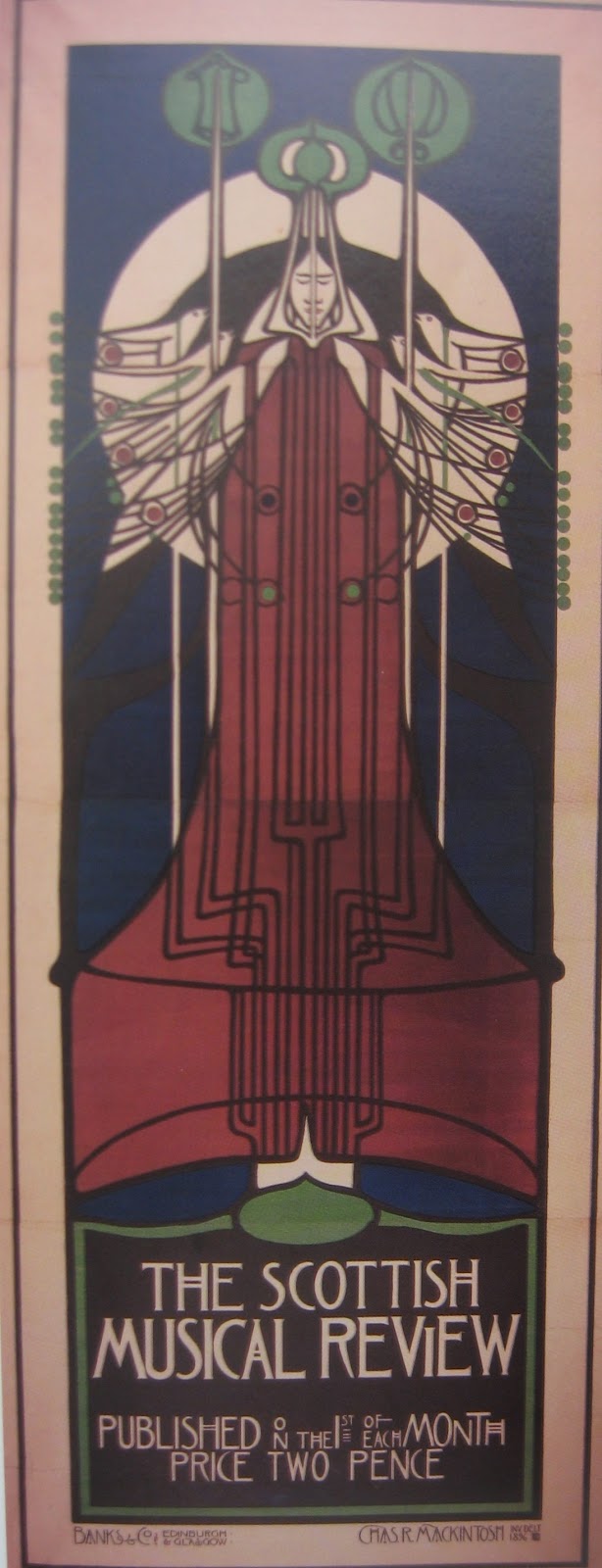
2) A beautiful exhibition titled something like “Charles Rennie Mackintosh and the Vienna Secession” opened the eyes of my soul ever after to the
aspects and links among Art Nouveau, Gustav Klimt and Egon Schiele, the Arts and Crafts Movement, artist and architect Mackintosh, and by extension the Prairie School and Frank Lloyd Wright and all the ways that merged again at last for the Art in excelsis: Deco.

3) Item, the concert by Scots socialist, staunch union man, master of finger-pick guitar, and voice-of-the-folk extraordinaire, which add up to one man only: Dick Gaughan (pronounced Gaa-kin)--brusque and rugged,
a take-no-prisoners, suffer-no-fools, but friend-to-all sort of a fella known to bust the fourth wall and reticent union halls wide open!

4) Great Swedish film director Ingmar Bergman staged more and more classical theatre productions as he aged, including the brilliant, partly reimagined (for example, adding several servants who’d pop in and out, silently mocking and mimicking the main characters), still heartbreaking version of August Strindberg’s
Miss Julie that he brought to Edinburgh for two or three performances only, just before that production toured the world, welcomed everywhere as a Bergman masterpiece like his then-current television film Fanny and Alexander. But for the Festival crowd that evening it was performed in the original Swedish, without translation, and we of the audience, we mesmerized fans and canny Scots alike, didn’t mind a bit. We were “in the moment.” We laughed; we cried. It was Strindberg, it was Bergman... it was Strindbergman... and it was perfect.

(Let that be our place to pause. Take a break while I finish up Part 2, “June and Martin Gone Festive.” You may have noticed that the sizing and integrating tools are working again, at last! I'm keeping my fingers crossed...

Back soon, I hope.)

Tuesday, May 21, 2013

Dog Daze of May

Like a big dog, Life picks us up by the scruff of the neck and shakes us silly. ("Surly" might be closer to it.) Cursed by cars, consumed by computers, sold out by our cells--whether cancer in the flesh or the camera's red-eye flash--working our selves deeper into cosmic, economic, and social-medium debt (neither rare nor well done), belaboring all.

I'm currently trapped by tasks I'm too slow for, and tricked by this tripwired hard-drive. Waiting in the wings, my newest piece can't be posted until I learn how to convert a stubborn pdf file into some more-malleable format. (Suggestions are not only welcome; they are sought!)

In the meantime, read some of the most excellent of other blogs and sites: for Jazz, check Doug Ramsey's wise and measured Rifftides, Jazz Profiles by the inexhaustible Steve Cerra, ever-quirky Brilliant Corners, VillesVille for elegant Ellingtonia, and the inelegant Bill Evans mainstay; for Rock/Rootsier material, try allmusic, BeesWeb (i.e., Richard Thompson and related), extensive Early Blues, and the Guthrie descendants' homage to Woody. I also recommend the amazing Samuel Beckett site and (less active now but good stuff in his archives) War Poetry for... well, take a guess. (And if you are desperate for some culture a la Shakespeare, there's always this droll curiosity.)

I hope to get with it soon--blogging actively again, I mean. Till then, drive safely and defensively, and cool it with the phone-cell photography. In the immortal words of Ray Davies of the Kinks, "People take pictures of each other, Just to prove that they really have been there." You could be a model of restraint instead.

Sunday, April 28, 2013

When Les Was MOR

My first wife was not a forgiving woman. (She still hasn’t forgiven me for being whatever lesser man I was in my callow 20’s.) When the slightly older, laid-back-hippieish filmmaker Les Blank--actually working on his fifth or sixth documentary, and by 1968 already on the verge of greatness--would cadge a meal and a couch to sleep on, then drink too much and inevitably hug and paw the hostess... well, that was about her limit.

So when heavy smoker Les also carelessly charred a gouge in her favorite coffee table, it was “Blank you, Les, and Sayonara... no more freebies at the Leimbachers.” But he and I kept in touch--for who wouldn’t and didn’t marvel at his bracing, embracing portraits of crazed, crooked-teeth Cajuns and little-known Bluesmen like Mance Lipscomb, Les's quirky camera eye meandering on and on from there for almost 50 years, finding some bizarre character or strange old music and culture to film (Asian green tea, women with gaps in their teeth, the Savoy family of Eunice, LA, even director Werner Herzog going crazy in South America).

I couldn’t keep up with his casual gypsy lifestyle, but I did borrow his shed-turned-house, hideaway-in-Hollywood when I went to the other L.A. trying to sell my Robert Johnson screenplay in 1970 or ’71. But I immediately caught some virulent flu bug that kept me feverish and flat on my back in 90-degree heat without air conditioning, trapped in that one-room garden shack, it seemed forever, crawling out to find water and a dollop of sherbet once a day for nearly a week.

We went our separate ways. He continued the ascent to an eccentric fame, while I couldn’t give my Hellhound script away. (Blaxploitation movies had not yet made their mark. No way was “a downer Bluesman who dies at the end” the prescription for a hit movie!)
Les Blank died a couple of weeks ago. Age 77, he had lived long enough to win acclaim and honors; but even though he’d quit the habit years before, the cancer-sticks got to him after all. He was working on a couple of new films (according to the obit I read) but to finish them someone will have to step into his oversize Madison shoes!

Way back when, Blank was for several years loosely linked to the Arhoolie record label (see previous post below), creating brief and brilliant portrait-films--20 or 30 minutes in length--of musicians Arhoolie was promoting: The Blues According to Lightnin’ Hopkins, A Well-Spent Life (his film on Lipscomb), and a longer piece on Zydeco accordion great Clifton Chenier. These persuaded owner Chris Strachwitz actually to partner with Les for three other films, most notably J’ai Ete au Bal, a terrific study of the differences and similarities between the “twins separated at birth,” South Louisiana musics casually identified as Country-ish white Cajun and Rhythm’n’Bluesy black Creole Zydeco.

But sharing the lead didn’t last long; the principals’ work habits and social skills were just too divergent, with take-charge, get-it-done, Roots-music-loving entrepreneur Chris bumping up against--and sometimes stumbling over--mellow Les, full-size Ferdinand the Bull, sniffing the flowers and smoking their green leaves, too hippie to be hip, yet so lazily laid-back that he could settle into almost any scene, absorb it, and then slyly film it.

Blank’s production company occupied space in the Arhoolie headquarters building for many years after the partnership was dissolved, and he managed to take part, quietly, in the label’s big 50th anniversary celebration. His final year saw brief upticks around the honors accorded him, but a quiet letting-go was evident as well...

Regardless, his mortal coil now shuffled off, the wonder-filled lives and works will amble on, all those firmly fixed documents of oddities and crudities, madcap musicians and molarless meals, mescal and Mason jars, shrimp gumbo and “snap beans ain’t salty,” holidays on horseback, booze and the Blues, and earthy dancers, always.

* * * * *
Was it ironic or perfectly right that I learned of Blank’s death thus: an email from Arhoolie arrived to announce the release of an album that sounded promising, so I clicked on the link, and the first thing I saw, heading the home page, was Arhoolie’s lament for his passing. Then, below that, the announcement for Jumps, Boogies & Wobbles, major label debut (on both CD and LP) of juke joint-styled Blues trio HowellDevine, consisting of Joshua Howell on harmonica, Hill Country slide guitar, and vocals; mighty rhythm man Pete Devine (machined to sit tight and fit right); plus, takin’ up any slap bass slack... whoever’s made the gig.

I listened to a couple of sample tracks, then rode the link to their home page. And when I found THIS engine of regress, I knew I had to buy the album. (Hitch a ride on the Yella Dog and hear for yourself!)

Meanwhile, I also realized that this confluence represents the passing of the baton, from venerable bearded oldtimer to up-and-coming young whippersnappers. Les began with the Blues and certainly structured some of his best films around those vital elder “musicianers.” I believe he would have taken to HowellDevine immediately. (In fact, might have done so already.)

Chris Strachwitz launched Arhoolie the same way: Mance, Mississippi Fred McDowell, Big Joe Williams, the Black Ace, John Jackson, Lightnin’ the wry and worldly wise. After 25 years or more of them “away,” working well and apart, and in other genres, for the two men to come back to their Blues/Roots Music base--even if only figuratively--and then face a definite permanent parting, well... I guess, as a scuffling musician might say (irony included): “It’s all good.”

R.I.P., Les... Keep on it, Chris... P.I.R., HowellDevine. (Yeah, play it right.)

Wednesday, April 3, 2013

4 by 4

 That title is not meant to suggest a Jeep or Ram truck or any other “four-wheel-drive” vehicle, nor does it indicate the “four on the floor” beat of disco music. It’s not some doubled-up 2x4 construction beam; and I have no idea if Jimmy Rushing, “Mr. Five by Five” in the flesh, so to speak, ever went on a crash diet!
No, it’s that the other day I was remembering how LP records back in the Fifties and early Sixties still nearly always were issued singly. A two-record set was as uncommon as, say, a Blues 78 in Mint condition. So Dylan’s Blonde on Blonde of 1967 was a bigger deal than we knew, one more challenge to the cultural hegemony of the Arts Establishment--upstart disposable Pop Music, call it, versus the supposed high culture of Opera, where three and even four “LongPlay” vinyl platters were needed to encapsulate a Rigoletto or La Boheme. The gates were pried open, creaking and groaning, and squeezing through came major double sets by the Beatles and Taj Mahal, the Dead and the Who, C.T.A. and CSNY: bootlegs and hits packages and an Exile on Main Street.

Two, then three, then... well, whatever number of records an artist’s fans would bear and buy--meaning more and more as lightweight compact discs supplanted bigger, heavier vinyl. Now some Classical box sets house hundreds of discs presenting the complete works of Bach or Mozart. Now the voluminous record sessions and live performances of Miles on Columbia or the Duke on RCA can come to you in a replica Davis trumpet case, a miniature steamer trunk of Ellingtonian elegance, in fact practically anything a record label’s Marketing and Art Departments can dream up.

Now a multi-talented performer like country great Vince Gill with 43 of his own new songs pent up and wanting to pour out can persuade his label to issue them all at once, filling four CDs with Vince’s genial, Jim Dandy vocals, electrifying eclectic guitars, Bluegrass-style harmonies, big-star pals dropping by, and so on, the four released in a quietly tasteful box with inner sleeves that differentiate each disc by style or substance, and the whole package offered at a bargain price, approximately what a single CD used to cost!

Actually four-disc sets pretty much became the standard for any comprehensive look back--whether a single artist’s career and hits, an important period in a genre’s development, or the different chops and sound from one tenor sax man to the next--as a result of looser copyright laws in Great Britain. In the late Nineties or ‘Oughts as fifty-year protection ended on major figures across the recording industry, new reissue labels like JSF and Proper began flooding the shops in Britain and subsequently the US (as import goods not otherwise available) with amazing and often quite desirable four-CD anthologies rich in discographical information and housed in small-is-better packaging.

... Which brings us circling back to that post title given up top: within a six-week stretch just ahead of and mostly after New Year’s 2013, four divergent four-disc box sets were released, all of them historically important (three not previously available), and all well worth your hard-earned cash. (I’m giving shout-outs here rather than full reviews, but think Five Stars for each set.)

The collection youngest in years that yet reaches farthest back in the story of Roots Music in America is They All Played for US: Arhoolie Records 50th Anniversary Celebration, honoring that great label and shoestring operation, which driven by founder Chris Strachwitz discovered (or rediscovered) and recorded many splendid Roots Music figures--and so became the unheralded major repository for nearly all the musics (plural) of North America, post-1960: Blues, Gospel, some Jazz, Old Time Country, casual Bay Area Folk; obscure Cajun counterbalanced by the genre-defining Zydeco of Clifton Chenier, plus slightly West, a dozen different sub-versions of Tex-Mex/Frontera/Norteno/Border Music; brass bands, merengue players, polka dancers Old World and New; Mance Lipscomb and Lightnin’ Hopkins, Big Mama and Rose Maddox, Whistlin’ Alex and Miss’ippi Fred, Memphis Minnie and Lydia Mendoza, Robert Pete Williams and Sonny Boy 2...

But many musicians passed on over the 50 years of Arhoolie, so the three-day party featured “younger” stars, more-recent Strachwitz discoveries, and cheerful friends of the label: Taj Mahal and the Creole Belles, Ry Cooder and Country Joe McDonald, Any Old Time String Band and Treme Brass Band, Barbara Dane with some local Trad Jazzers, Peter Rowan with accordion master Santiago Jimenez Jr., and three groups alone worth the price of this 200-page, horizontal folio-sized hardback book with terrific reminiscences, commentary, and color photos (by Mike Mednyk).

The picks that really clicked: a multi-generation, La Raza-style group of political-activist singers called Los Cenzontles; the amazing Sacred Steel group The Campbell Brothers (a special interest project for Strachwitz for a decade now); and one of my own lifetime faves, the ever-driven, always-effervescent, Louisiana-hot-spiced Savoy-Doucet threesome, with two of the brightest stalwarts of the Cajun Music revival (fiddler extraordinaire Michael Doucet and squeezebox-maker/mentor Marc Savoy) challenging each other and Miz Ann Savoy, rhythm guitarist and nonpareil scholar of Cajun music and mores. These three will enliven your life.

In 1975, during the brief union of Jazz label Artist House and Pop megalith A&M, guitarist Jim Hall, a great melodist and nervy soloist, received mildly favorable notices when his Live! album appeared (distilled from a week’s performances at a club in Toronto). A low-key, retiring sort of chap, Jim was back then a hidden commodity, indifferent to public acclaim, but in fact the sought-after equal of his peers--notably Rollins (never having played on the Bridge, Hall yet played on The Bridge), Giuffre, Farmer, Desmond (Jim’s Nova sparks striking Bossa Paul), several classic duet albums with Ron Carter or Bill Evans (Jim’s solos comfortably occupying the space between Evans and earth).

These days when octogenarian Hall is feeling his oats he’ll go play with one of “the kids,” whether that younger duetist bears the years of Metheny, or Frisell, or Geoff Keezer. A match whatever the moment, Jim can still pick mighty quick, strum with aplomb, or extoll a droll solo. For example: “Stuck in his strum, Jim pulled out a plum, and got right back in the pocket.” (All right, I agree... no more puns.)

Remember that Live! album? In the four decades since, guitarists and others have discovered it, loved its beauty and wit and immaculate sound and completely inventive playing, studied it note by note by note, and now adjudge it one of the supreme Jazz albums of the 20th century. Much credit belongs to the Canadian sidemen, bassist and crafty sound recorder Don Thompson and drummer Terry Clarke, both playing at the top of their game, both simultaneously supporting and challenging Hall. Still mesmerized after many listens, many a listener has wondered what the rest of that astonishing week could have sounded like...

Wonder no more! The canny, fan-funded ArtistShare label has worked with Hall and Thompson to assemble and, late last year, issue Live Vol.2-4 (4CD set ASO116, maybe available from the ArtistShare website only)--21 performances of melodic standards and excellent originals, three hours and seven minutes of gorgeous, perfect guitar-trio Jazz. These occupy three of the CDs; the fourth is a CDR offering High Res 24bit/48K Audio Files of the music for your computer or other sound-system device. And all housed in an inch-thick, extra-sturdy, 5”x6” album-book with essays, photos, drawings, news clippings, et al. I can only add... BUY IT! NOW!

Four-set number 3 comes from a trumpeter you would not think to call under-recorded. But elegant little album-book Columbia/Legacy 88725418532, Live in Europe 1969: The Bootleg Series Vol.2, presents the only known recordings (and live ones at that) of Miles Davis’s so-called “lost band,” the transitional quintet he had in 1969 between the splintering of his long-lived “second quintet” (Miles + Shorter, Hancock, Carter, Williams) and the several changeable, gauntlet-thrown-down, Fusion bands of the Seventies.

“Lost band” is actually an unfortunate appellation, because to my aging ears that’s what I’m hearing in too many places: musicians who are lost and struggling to find a way--forward or back they don’t care, so long as there’s movement. Well, with a rhythm section as speed-ready and stamina-sure as Chick Corea, Dave Holland, and Jack deJohnette, the trick for Miles and Wayne Shorter is either to keep up, to ride those tigers--or to rein them in. And that’s the fractious and fractured para-Jazz we hear taking up too much aural space: grooves few, swing absent; the sounds unsettled, falling between two stools; neither the Miles that was--whether soft and sensuous, or shattered blue glass--nor the Fusion that would be... something... something not yet defined.

So discs 1 and 2 document summer festival dates, with Miles alternately sputtering fire and squeaking futilely, and Shorter exploding all cylinders, as frenzied-fast and angry as Coltrane on a bad-karma day. The third CD is more transitional. Early fall in Stockholm finds the music clearly on a course for Fusion, Corea trinkling a real piano and the “tunes” now tumbling roughly into place...

And suddenly it’s disc 4, a spectacular color DVD with the band fully “found” at last, five powerhouse players concertizing in-the-round, their in-Fused notes like imperious fists pounding and resounding throughout the Berlin Philharmonic’s shuddering foundations. Roll over, von Karajan, and tell Furtwangler the news: the barbarians are at the gates, ‘Gate. And that Fusion rift? Man, it’s da Bomb!

If I’m lyin’, I’m tryin’. Czech it... Miles has dedicated the concert to Duke Ellington. (Huh? See the Aryans whispering, “Is that the Duke of Hohenzollern?”) Our five NeuMuziKnights confront Deutsche dragon ComplaZenSie, and snicker-snak... behold, from the entrails of the beast drift partial visions of players yet unknown: Zawinul to Jarrett, Mahavishnu to Bartz, a massive Jack Johnson rope-a-doppelganging, and Miles-to-be going before he sleeps. (Mistah KunFused--he live...)

But the capper, the last laugh, the final geste and gesture... in a placid farewell to his past, Miles ends this brilliant set, this irony of the moment and augury of things to come, with a near-solo stroll across “I Fall in Love Too Easily” (plus, band back, a sign-off whisp of “Sanctuary”)--spirited and dispirited, fragmented and fragile, broken and bereft, brazen and beautiful. It’s Berlin all over again, an un-Sally’d Joel Grey and goodbye-to-all-that cabaret, a cock in the snoot to good-German kunst and the rusticals of the Wall, and--above all--a five-band of brothers in a divided city, about to divide the whole world of Jazz.
* * * * *
Rather than keep over-writing, I think I should wrap things up. The fourth set (ordered but not in hand when I began this meant-to-be-light essay) turned out to bring mixed results--100 Hits Legends: The Everly Brothers (set LEGENDS019), takes five CDs, 20 cuts per CD, to deliver most (but not all) of the Cadence and Warner Bros. hits and best other tracks... but only 80 or so in this selection are really worth reissuing. (Hands up if you think you need to hear the Brothers whipsaw through “My Mammy,” “Mention My Name in Sheboygan,” or “O Mein Papa.”) But even the bad songs still have the gorgeous, soaring, brothers-in-arms harmonies pretty much patented by the Everlys.

I was fooled too by the widespread publicity; I guess the 2010 not-new set was instead being dumped on the market at a ridiculously low price, so the good news is you can probably find one at Half-Price Books or on the Internet for about $10. As some song our Daddy taught us might say:

If you write for no money,
Put on a free show,
You got to be ready...
Sometimes it’s no go.


Yet in this case,

At a dime a song
For those harmonies,
You can’t go wrong
With the Everlys...