No illustrations this time. Please absorb the words and supply your own mental images. Lord knows the news has shown us enough.
When I traveled around the world in 1986-87, I missed visiting Japan. The hellacious events there now, the terrible destruction, lives lost, radiation clouds drifting unchecked, are a dreadful reminder (and, yes, I am full of dread) of our place in the Pacific Rim's "Ring of Fire." Violent earthquakes in Chile, New Zealand, and Indonesia, the horrific, beyond-imagining pictures from Japan, even the minor aftershock in Alaska, warn those of us living on the West Coast to prepare now for the worst.
But the trip years ago did allow me to wander the two main islands of New Zealand, with a few days spent in South Island's then-lovely city of Christchurch--whose venerable Cathedral was destroyed, portions razed to the ground, in the 2011 quake just weeks ago. With Easter approaching now, and in remembrance of the earthquake and tsunami dead, in Japan and elsewhere, I offer this slight, reluctantly religious poem started in New Zealand long ago, intending to express a small bit of the angst and doubt--and irrational hope--most humans experience along the troubled way... where the worst natural disasters are still outnumbered by human ones.
Easter in Christchurch
The man on the dark tree
died into mystery;
his gaunt corpse disappeared
and all of history veered...
Like every other youth,
I hungered after truth
but slipped away, as most
of the agnostic host
that sees the world its way.
But this is Easter Day,
and I am in Christchurch--
another man in search
of something, Jaysus wept,
some message to accept.
The Cathedral stands fair,
a monument to prayer
and song--a Schubert mass
this day as I walk past.
The voices rise to heaven;
their lives have been forgiven,
their errors purified.
I listen from outside.
Easter is autumn here,
the down-turn of the year:
leaves withering on trees,
systems in entropy's
grip... In this dying season
how can a soul be risen?
I pace out in the rain
and ponder the world's pain,
the blood shed in hatred,
anguish of quick and dead,
absence of brotherhood.
Christsake, where is the good?
If race survives, still man
does worse than he began.
If this be God's behest,
I will remain a guest.
From all that's sanctified,
stone of ages, I would hide.
Yet the cold rain compels
me in, where belief dwells...
I come in doubt, but stay
to listen and half-pray.
Nothing waits me out there,
and I must be somewhere
this day of Resurrection.
I brood on his rejection.
At cock-crow, in first light,
I still could rise. I might.
Sunday, March 27, 2011


Monday, March 21, 2011
Sound the Tabor

British Isles folksinger June Tabor is very much the doyenne among rival claimants, and that's because she is blessed with one of the most haunting, mood-driven voices in the entire world of recorded music. (A tabor with great pipes, say.) There are splendid older and younger singers across the Pond, of course, from Norma Waterson and her daughter Liza Carthy, to Maddy Prior and Kate Rusby; but for us fans of June, the release of a new Tabor CD is a cause for curiosity, suspense and then, most often, wonder and celebration.
The question every time is: Has she cut an album of traditional songs and the English/Scottish ballads,
 creating another of her "doom and gloom" masterworks like 2003's Border ballads set, An Echo of Hooves, grandly sung tales steeped in bloody revenge and desperate love? (Yea, verily, cry "Hughie Graeme" and "Young Johnstone" and "Sir Patrick Spens," grimly rendered all.) Or has she taken a sidestep and produced an album of slowed-down standards or modern folksongs or a mixed potpourri organized around some general theme perhaps? Such queries matter just now because Ms. Tabor has a brand-new release simply titled Ashore--which is where
 we'll get eventually.
Over the course of her 40-year career, June has worked most effectively with a somewhat narrow cast of musicians--whole albums with Maddy Prior (as "the Silly Sisters"), brilliant folk guitarist Martin Simpson, and genius side men ranging from Nic Jones and Andrew Cronshaw to the current core four of Andy Cutting, Tim Harries, Mark Emerson, and Huw Warren--but on a few experimental occasions the results seemed attenuated if not misguided (comedy with Les Barker, new age-y songs by harpist Savourna Stevenson, even a high profile tour with electric folkrockers the Oyster Band). June can sing anything, really;
 even an old British Bell phone book would sound throaty, a bit mysterious, wounded (though not a victim), worldly wise, her ringing tones never flat but at times slipping deeper into darkness.
In her early 60's now, she has sung with the same maturity, quiet power, and husky contralto beauty all along, but her interpretations have deepened and slowed, the finest now enfolding the listener in roses and brambles, the green earth and the darkening sea, hypnotic tunes and heraldic words--like Morgan le Fay ensnaring Merlin, or Mother Nature wrapping her arms around Ophelia.
Think I'm waxing past poetry into silliness? Well, June is also known for mocking her own seriousness and the severe look she adopts in photos. In live performance she can be witty and charming,
 happily breaking up all the tales of doomed lovers. I witnessed that first-hand when I attended a Tabor-Simpson concert during the 1980 or maybe '81 Edinburgh Festival--vast and varied, as always, with events eccentric to elegant. I saw bizarre Fringe plays, young and exciting cellist Yo Yo Ma, Scots vocalist Jean Redpath, a glorious performance of Mahler's Fourth Symphony, a concert by brusque and brilliant Dick Gaughan, a Strindberg play (Miss Julie, as I remember it 30 years later) presented in the original Swedish and directed by Ingmar Bergman, and much much more--but THE highlight of those weeks, and one of the very best live concerts I've ever attended, was June and Martin duetting simply and powerfully for 90 minutes,
 a great singer and a great guitar master both still in the flush of youth but at the top of their game, a definitive experience of that "doom and gloom" leavened, indeed laughed at, by the camaraderie of the duo at play(ing).
Simpson backed her for a few years, then moved on to pursue a solo career (he still drops by for the odd tune occasionally), and June settled on a repertoire and pattern of arrangements centered on the four remarkable musicians mentioned earlier: agile diatonic accordionist Andy Cutting, bottomland double-bassist Tim Harries, master of folk fiddling Mark Emerson (on violin, viola, and piano too when needed), and regular pianist, the lilting, subtle, single-note-runs specialist Huw Warren, with one or some or all four on nearly every track she has cut for maybe 20 years now. And it's fascinating how June's voice becomes a fifth instrument--a cello, say--added to the arrangements.
 Or maybe I should say... the central instrument around which the others circle and entwine--for traditional ballads, modern folk tunes and, more rarely, caberet-ish songs in French or Yiddish, unexpected Jazz compositions, even Music Hall numbers.
I said June can make almost anything hauntingly beautiful, and I stick by that judgment, but sometimes she and the guys just pick a wrong 'un and/or dress it in strange attire. At the Wood's Heart, for example, includes misfit versions of "Heart Like a Wheel" (over-dramatized, even with Simpson's guitar answering, and also unnecessary given the simpler, defining performances by the McGarrigle Sisters and Linda Ronstadt) and Ellington's "Do Nothing Till You Hear from Me" (with Ducal, anti-folk rhythm and soprano sax wailing).
 The album Rosa Mundi sinks into sentimentality too often, its single "roses" theme forcing the selection of some lesser songs and schmaltzy stacked strings. Similarly, A Quiet Eye functions as a folk big-band album with oddball choices like "The Making of Tipperary/It's a Long Way to Tipperary" and then World War II's "I'll Be Seeing You," and brass brashly in excess elsewhere, overwhelming some fragile folk melodies.
Yet that last CD also soars with splendid performances as simple as "I Will Put My Ship in Order" and as monumental as "A Place Called England," as lovely as "The Water Is Wide" and as angry as Richard Thompson's "Pharoah." (June has gravitated to Thompson songs on several occasions,
 most memorably for a mesmerizing version of "The Great Valerio" on the CD titled Aleyn.) Whether mixed bag or themed array, every album has a few perfect Tabor treats, right from her 1976 solo debut, Airs and Graces ("Reynardine," "The Band Played Waltzing Matilda," "Pull Down Lads") through 1988's potent and eccentric Aqaba (with trad. "The Banks of Red Roses," klezmer-sourced "Mayn Rue Plats," and the bio-in-song title track, tracing the life of Lawrence of Arabia!) to the several CDs of her major resurgence in the 'Nineties and 'Oughts. Aleyn, to pick just one, ranges far and farther, with eerie arrangements on love songs "Go from My Window" and "I Wonder What's Keeping My True Love Tonight"; a trad.-adapted, beautifully sad rejection of false lads, "April Morning";
 a Jewish immigrants lament titled "Di Nakht"; a charming remembrance of a neighborhood character observed to be "A Proper Sort of Gardener"; and closing the album transformatively, a gorgeous, slowed-down sea-shanty called "Shallow Brown."
I've raved sufficiently. June's excellent and lighter 2007 CD, Apples, starts with "The Dancing," moves through "The Rigs of Rye" to find that "My Love Came to Dublin," and ends gently with another at-sea wonder, "Send Us a Quiet Night," peacefully drifting away; and I like to imagine that the last one lodged in June's heart and mind and slowly persuaded her to make an entire album of gone-to-sea, missing-the-sea, tired-of-the-sea jigs and songs and laments--which became the just-released Ashore,
 with every track a winner. But let me mention first in passing that once again June--as on four-fifths of her near-20 albums; look back over the ones I've mentioned--has selected an album title beginning with the letter A; and I think this chosen word, and image, were lifted from two songs in particular...
Because for this CD she has actually gone back 20 and 35 years to reclaim splendid songs she first recorded on shared albums, "Finisterre" from her collaboration with the Oyster Band, and "The Grey Funnel Line" from her earlier duets with Maddy Prior--and in both cases June has crafted new, personally definitive versions. "Finisterre" has eighty-sixed the rock drums and gained an air of mystery; just the way she says the name "Santander" in the repeating chorus will give you goosebumps. Ex-seaman Cyril Tawney's "Grey Funnel Line" seems slower, sadder, somehow conveying both grief and relief as the sailor contemplates leaving the service and
 going ashore for the last time. (The idea of being ashore is strong in this lyric though the word is not used, but "The Bream Lament" says it several times, related to drowned sailors washing up, being buried--the dead man's body or his boots only--below the tideline, ashore forever.)
Tawney has another quiet lament for a love lost and an era passed by, in the oddly titled "Oggie Man" (a dockside seller of pasties displaced by the vans of "progress"), and June's singing makes it relevant, important, even heart-breaking. Whether a slip-jig or morris dance allowing Cutting and Emerson to strut their stuff while she lays out ("Jamaica" and "Vidlin Voe"), or a Post-Mod take on families in the "Shipbuilding" trade (written by Elvis Costello), or a superb, dare-you-to-top-this rendition of "The Great Selkie of Sule Skerry,"
 the fantastic Child ballad (#113) of love and death among a girl upon the land, her mer-seal lover, and their wee grey bairn... all things are glorious.
And then slowly, slowly, like the tide encroaching on a broad flat sand, the album sails West, "Across the Wide Ocean" to America, carrying thousands of proud and angry Scots displaced by the ruthless "Clearances" of the Highlands & Islands. It's a 12-minute epic telling that June and the band take up and carry--seamlessly, easily, commandingly--like sails holding the wind, onward all the way to the new land and the unanticipated resentment of immigrants that was shameful in the past and is surely stupid today. June and the song relate that unending tale.
Ignoring man's inhumanity and greed, "Nothing lasts," she says matter-of-factly, "not the old ways, not love."
 Still, she does... June Tabor in her Navy greatcoat, stalking the shoreline, searching for survivors, their songs old and new--Gallipoli to Auschwitz, Good King Richard to Bonnie Prince Charlie, lovers' skirmishes to Border Wars, demons of hell to the green fields of England... signaling goodbye to Santander, singing the great selkie home.
Sunday, March 13, 2011
Works of Magic

On many lists as one of the Top 10 greatest Chicago Blues--even General Blues--albums of all time is the Delmark LP (and CD ever after) titled West Side Soul, presenting guitarist Magic Sam Maghett--recorded in late 1967, released early in '68, and pretty much available in some form ever since. West Side was a perfect time capsule of that era of soul-influenced electric Blues, as well as the relocation/expansion west of Chicago's South Side Blues clubs, and it was an immediate success, acclaimed by critics and Blues fans as a modern classic. Magic Sam followed it up a year later with an excellent encore titled Black Magic,
 but then died unexpectedly--a brilliant young Bluesman with a tragically weak heart--before a third album could be completed.
Delmark has issued some concert tapes and collections of session outtakes over the years since, eager to "Magicmize" record company profits, but none of the posthumous CDs is really essential. To be specific, the live albums suffer from poor sound, no matter how sharp and energetic Sam's performances. So, while the 2002 release Rockin' Wild in Chicago has a very apt title, Sam really working his magic on the cheering crowds, too much of both volume and nuance has been lost.
 The Magic Sam Legacy, on the other hand, is all studio outtakes and alternates, and Sam and his band play with fire and feeling, but any serious fan knows a few other versions of nearly all of these songs already. I admit to still wanting to hear the Delmark CD titled Give Me Time, which consists of informal at-home tapes, just Sam and his guitar, noodling around, trying out other performers' songs, working up a few new ones of his own. But fans and critics alike complain that the small tapedeck Sam used was not really up to the challenge.
And that brings us back to West Side Soul, the original LP having an absolute killer first side and a damn fine second, just eleven numbers total but nary a one you'd want to omit, from the high-test opener, a career-defining Maghett original called "That's All I Need," to the closer,
 Sam's houserocking (homewrecking) version of J.B. Lenoir's slip-shufflin' hit, "Mama Talk to Your Daughter." (The later-issues addition of a twelfth track, an alternate take of "Don't Want No Woman," proved largely superfluous.) It's likely that all the digital mastering and remastering, changing formats and reissues streaming forth over three-plus decades caused deterioration to the original album master, though Delmark doesn't mention it specifically. The company does proudly boast that this 2011 issue has gone back to recording session engineer Stu Black's original tapes and mixes to create a new analog master. Well, it was definitely worth it, the music not just catchy but compulsory now--crisp, clean, loud, and proud of it.
On the plus side too is the new and improved, tri-fold "digipak" presentation.
 Brief new-info liner notes along with the first LP's biographical ones; a half-dozen added photos of Sam and related club-appearance ephemera; and a tasteful color version of the original cover photo, which was printed early on in a sickly green-and-white, to match the other psychedelic colors of some art director's concept. Now, rather than a fledgling record company's garish attention-grabber jacket, the West Side Soul package sports a somewhat more studied and steady look--one befitting a Blues genre release that history has deemed a classic.
But greatness is in the grooves. Ably aided by a quartet of Blues pros (the personnel fluctuating a bit), including guitarist Mighty Joe Young and the Odie Paynes (father/son drummers), Sam updates the Chess/Checker Chicago standard, chuckling quietly as he speeds and aerates-some the heavy, Delta-drenched sound favored by Muddy Waters and Howlin' Wolf. Though the young guitarist had come up the river from Mississippi too,
 his heart was lighter and his fingers faster, so the tempos set and solos sent forth tend to be upbeat, whether the tunes be as soul-specked as "Feelin' Good" and "Don't Want No Woman" (both lifted from Duke Records and reworked, Sam grinnin' in your face), or as sturdy and locally subsidized as "My Love Will Never Die" and "Sweet Home Chicago."
The back of the Rockin' Wild CD offers a sound assessment of Sam's technique (written by the album's liner notes writer Dick Shurman): "His finger-plucked fleet-fingered long lines, screaming bends and squeezed chords, hand vibrato, driving rhythms, dynamics, and trademark tremolo added up to an explosive package.... The quavering melisma in his voice and its counterpart guitar tremolo combined to give his music an ethereal undulating quality.
 Nobody rocked the blues any wilder..."
At the time of his Delmark debut, after years of apprenticing in the clubs and on indie-label 45s for Cobra and Chief, Magic Sam in late 1967 was poised like the nation, though we didn't know it yet, on the brink of major change--Stax Records was at its peak; the Black Power and Vietnam anti-war movements were seething and setting the pace, the lives of Civil Rights workers and Dr. King himself continued to be threatened across the South... Murders and riots, drugs and disenchantment, lay ahead. On that momentary cusp Sam Maghett seemed to embody the momentous excitement and optimism, the growth and strength of Soul and Rock music, the reworking of older Blues into something newer, still Black, still deep and true. West Side Soul hit the music scene like Bob Dylan's second album a few years earlier, and then Sam's own second LP secured the field.
 Maybe all things were still possible...
The forces of repression made sure they weren't. King and Kennedy were cut down. Nixon and new greed carried the day. Turning-on and dropping-out took over. And Sam died suddenly in 1969.
But for a time there was Magic.
Sunday, March 6, 2011
Deep Song

The "bluesiest," most sombre sounds of flamenco and Spanish gypsy (gitano) music are called cante jondo (or hondo), translated as "deep song," and equating to an awareness of death and the limits of reason: dark despairing emotions expressed in proud, percussive song and dance, and in the darker chords and notes played on a chiming and resonant, ringing-out guitar. According to Spanish poet Federico Garcia Lorca you can hear Death sing in it. (The mysterious term duende--meaning something like an unyielding, unruly spirit--also figures in this bleak expression of the Moorish/Sephardic/gypsy-Andalusian folkloric soul.)
For comparison, let's say that Billie Holiday singing "Strange Fruit" and maybe "Gloomy Sunday," or Bobby Bland working through a "Stormy Monday" week, or any performance by always-sorrowing James Carr, would be deep song equivalents from America's Black populace--and, in fact, some critics have designated such music as "Deep Soul," presumably borrowing the flamenco terminology.
 But there are lighter forms of flamenco as well, both old-style dances like alegrias and gypsy tangos and some bulerias, and the current craze for too-cheerfully-upbeat flamenco nuevo.
Jazz has its deep song too. Think of Charlie Haden playing practically anything, his bass thudding like the earth's heartbeat. Certainly one can play "deep" on a smaller stringed instrument with a higher range, from Ron Carter's piccolo bass to an electric guitar in the hands of Kenny Burrell or Grant Green or even Bill Frisell at times, to the swirling dance of violinists Michael White and Regina Carter. (I'm exempting piano strings from this discussion.)
 Especially compelling are the great string duos of Jazz history, whether Eddie Lang duetting with Lonnie Johnson or Joe Venuti, Carl Kress duelling George Barnes, Herb Ellis on the road with Joe Pass, or Jim Hall teamed with Ron Carter, Bill Frisell, and others. (One's impulse is to add Django Reinhardt and Stephane Grappelli to that select list, but it was rare for the two of them to play minus the rest of the Hot Club.)
 More recent examples from the wider world could include Philip Catherine and various guitarists; Haden cloistered with Pat Metheny (a match made in Missouri and heaven too); the flamenco-fusion duo of Paco de Lucia and John McLaughlin; the Assads, Brazilian brothers who began with Classical guitar, sidled into Jazz via sambas and bossas and such, and have now recorded a stunning two-guitar, complete Rhapsody in Blue; and the sunny, South-of-France, Midi-Mediterranean swing of Sylvain Luc and Alsace gypsy Birelli Lagrene.
Still and all, the bass has a certain built-in advantage in the deepness stakes--from Jimmy Blanton to Milt Hinton and Ray Brown, from Paul Chambers and Charles Mingus to George Mraz.
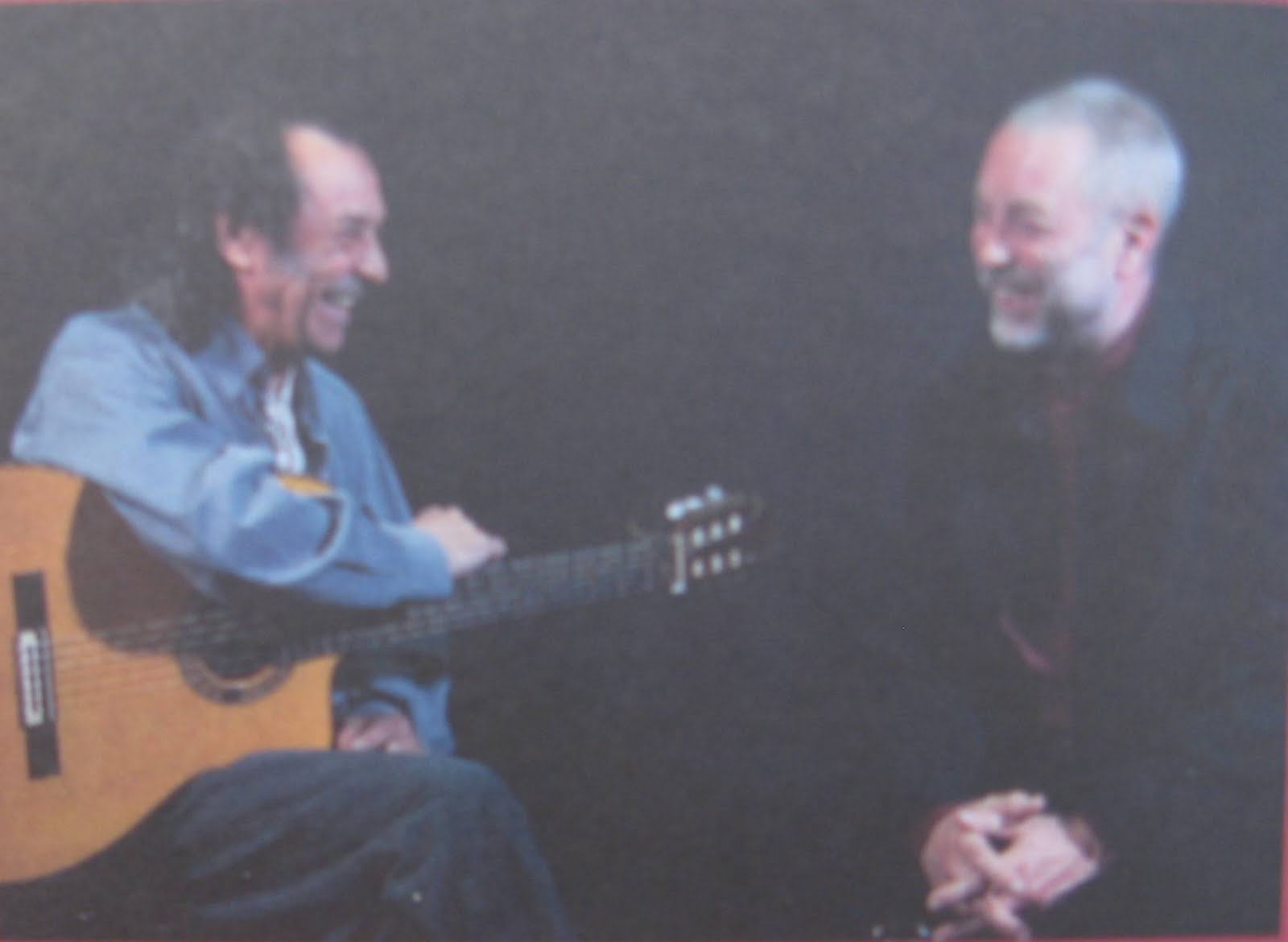
 And, in the right hands--left and right--miracles may yet be wrought. The 2010 album co-led by bassist Dave Holland, precisely titled Hands, in both nature and name exemplifies many things: humans reaching out to one another, the unexpected connections possible in world music, the parts of the body which help create melodic sounds, the yes-vote critical response the CD has already achieved, and of course the real hands of the real players involved in this, Holland's Jazz-meets-gypsy project with flamenco guitarist Pepe Habichuela and musician members of his clan family.
The first thing to notice is the disc's incredible sound--light and lively, crisp and clear, powerfully percussive, bright or dark as needed, and deep; deep; deeper still. Steel and cypress wood, the strings ringing, chords singing, los instrumentos cantan y cantan mas. Next consider the participants: Pepe Luis of the clan/family mostly known as Habichuela but some bearing last name Carmona instead (including the backing musicians here),
 with master Pepe a fourth generation flamenco guitarist happily streaming string duets with distinguished all-around bassist Dave Holland, who effortlessly plays free, avant garde, melodic, world, and whatever else seems interesting.
But for Hands Dave immersed himself in flamenco for parts of three years--no casual tourist he--before venturing to record the fine-honed ensemble. The two, four, six players (changing line-ups) perform eight tunes based on traditional flamenco forms plus two Holland originals; and from either orientation, Dave joining Pepe's tradition or Pepe shifting to a Jazzier style, the soloing duo works a wonder. His bass notes leap and linger, thump and shudder, drive and dance, while Pepe and his kin let flow a cascade of clicks and plucks, sudden flicking and striking, surging strums and thrums, joy unleashed in a mellifluous melee of percussing strings and singing cajon drums.
The rhythms are often way too complex for me to count out or critique for accuracy; suffice to say that the ten tracks ebb and flow
 like a flamenco-through-the-ages suite (even Dave's tunes
"Joyride" and "The Whirling Dervish" are taken up and, not tamed, but transmuted), a magic carpet ride back in time, from the beaches at Malaga and the majesty of Madrid, to the glories of Moorish Granada and el gran senor savior El Cid. Some standout moments/melodies/match-ups include the title tune where a hint of bossa nova leads straight into a traditional fandango de huelva; "Camaron," identified as a taranta, but sounding like a moody ballad, with Pepe and Dave trading call-and-response licks, Dave's bass much like a giant guitar within the flamenco framework; a gorgeous gone-from-Cuba rhumba tune called "El Ritmo Me Lleva," which means, approximately, "The rhythm takes me away" (an accurate description indeed); "Puente Quebrao" (buleria) and "My Friend Dave" (Pepe's solo solea),
 two deep-song cries echoing down the years; and the all-powerful, nine-minute "Bailaor" (seguiriya cabal), which allows both string masters minutes to strut their most serious stuff, both a tiempo and drifting out-of-time.
If anyone hasn't noticed, I love this album. It stands head-and-hands above other Jazz-flamenco attempts... so I won't resist the pun that's been lurking between the notes and lines all along... With Pepe and Dave you're definitely in good Hands.
Saturday, February 26, 2011
Whose Land?

"Feb. 23, 1940"--that's the date Woody Guthrie penned at the bottom of his single-page, original handwritten draft of the song eventually to become known as "This Land Is Your Land." As can be seen in the photo of that momentous sheet of paper (posted at www.woodyguthrie.org recently), the original title and repeating refrain was "God Blessed America" completed by "... for me." But Woody crossed out all the God lines, and though there was no replacement refrain added, up top he did scribble a new title: "This Land Was Made For You & Me."
I wonder what Woody would make of the current on-going crisis crippling our nation, as the Supreme Court declares that corporations are "citizens," so the richest corporate thugs (American demi-oligarchs like the Koch Brothers)
 by their huge contributions now can buy state governors and state congressmen and our national Congress too; and the banksters and Streetists steal the wealth of investors big and small; and the rich folks and corporate rulers escape paying taxes altogether but still outsource as many manufacturing jobs as they can, while regular folks get taxed and taxed again--but even so, there's no money for all the physical and social infrastructure repairs and improvements desperately needed in 2011. And thus the Right Wing Repugnants proceed on several fronts with their longterm plan to dismantle unions and collective bargaining, workers' pension plans and Social Security and any other safety net program for ordinary citizens in need... and so destroy the working middle class of these dis-United States, land of the service fee and home of the minimum wage slave.
Folk-country musician and singer Steve Earle has a great political song called "Christmas in Washington" that touches on this, and part of his lyrics are a request:
So come back Woody Guthrie come back to us now

Tear your eyes from Paradise and rise again somehow
If you run into Jesus maybe He can help you out
Come back Woodie Guthrie to us now...
There's foxes in the henhouse, cows out in the corn
The unions have been busted their proud red banners torn
To listen to the radio you'd think that all was well
But you and me and Cisco know it's goin' straight to hell.
Woody's own signature song, 71 years young, is often put forward as a strong (and actually singable) replacement for our increasingly obscure, seldom-sung National Anthem; and Guthrie's lovely, stirring images of redwood forests and Gulf Stream waters, diamond deserts and wheatfields waving amid ribbons of highway--his heartfelt, heartworn love song to this wonderful and shameful country--certainly would be a step up from the martial manipulation that blats like an amateur's trombone for "the twilight's last gleaming," "the perilous fight," and that yet-waving "star-spangled banner."
 But my own favorite stanza of "This Land" hints at some slight civil disobedience, a minor version of what the infamous I.W.W. "Wobblies" of the Northwest woods and Montana mines called "blackcatting"-- which meant to interrupt the efficient flow of things by a work slowdown (sometimes by tossing a real monkey wrench into the machinery!) rather than a complete stoppage or walk-off-the-job strike. Woody's rarely sung words, with his punctuation:
Was a big high wall there that tried to stop me
A sign was painted said: Private Property.
But on the back side it didn't say nothing--
...which was polished a bit later and a fourth line added, by Guthrie or friend Pete Seegar or maybe Woody's son Arlo: That side was meant for you and me.
 The two-part question for Americans now is simple:
Whose land is this?
Which side are you on?
(I have another Guthrie post to write soon, but for now let this stand as my tribute to the threatened teachers and police and firemen and other unionized workers, in New Jersey, Ohio, Indiana, and too many other Right Wing-infested states, but especially Wisconsin, whose valiant 14 state senators are fighting the good fight even if from a distance. And a tip of the hat to radio/TV host/talker/commentator Ed Schulz for spreading the word first, and then far and wide. And I ask with others, Where the hell is the President, our smooth-talking, nothing-doing, sadly corporate-centrist Democrat in all this? He should be marching and speaking out. Shame, Mr. Obama!)
Tuesday, February 22, 2011
Devil Take the Hindmost

When I wrote about Cajun albums a few weeks ago, there was an unplanned but handy connecting thread. Each CD included a version of the tune "Les Flammes d'Enfer"--yes, "The Flames of Hell," a potent image for such a lively piece of dance music--which must be some sort of remnant of Catholicism's hold on early Acadien settlers and New Orleans Creoles. But since then I've been instead pondering the disappearance of the Devil from our culture. With so many Christian fundamentalists, so many followers of the Rapture and the "Taken Away" books, so much hellfire-and-brimstone talk, what's happened to Satan himself? ("Satan is real," sang the Louvin Brothers in 1958, "You can see him and hear him each day.")
The answer I've come up with is this: since we now ("we" meaning large chunks of the American populace) are rapidly and rabidly demonizing swarthy Arabs, Mexican immigrants,
 union workers and collective bargaining, women's-choice physicians, election opponents and rival political parties, Supreme Court (un)justices, and even the President himself... well, there's just no need for some master Lucifer to be manipulating the citizenry, because we're doing just fine by ourselves--we've already gone to the Devil--violence and vituperation outyelling and outselling mere outmoded venality and vice. Do banksters and Wall Street criminals escape with a slap on the wrist and a fine? Do the wealthy and undeserving get a pass on taxes while the Middle Class gets beaten down into the dirt? Do our stupid celebrities spend more time in rehab centers than they do in shopping malls? Oh, they're just so lovable and watchable and forgivable, all these victims of disfunctional or abusive families, troubled by their demons within.
 No one would ask, "What the Devil got into you?" now because no one's to blame. No Devil need apply.
I miss Old Scratch, that surly bastard and shadowy fallen angel, poet John Milton's not-very-secret hero. Robert Johnson believed, singing, "Hello, Satan, I believe it's time to go" (his "Me and the Devil Blues"). So did Peetie Wheatstraw, who billed himself as "the Devil's Son-in-Law." Those good old country boys, the Louvins put out a whole Satan Is Real album, with an infamous cover photo truer than expected, because the Satan photo set caught fire and so nearly did the Louvins. Speaking of such, I've found versions of "Les Flammes" not only by Mamou and Richard Thompson per the earlier post, but also by Austin Pitre, Jo-El Sonnier, the Balfa Brothers (great one! but why "Flemmes"?), BeauSoleil, Steve Riley and the Mamou Playboys, Zachary Richard, et quelques autres. The chorus says "Priez pour moi, Sauvez mon ame, Je suis condamne Aux flammes d'enfer." (In simple English, "Pray for me, Save my soul, I'm condemned To the flames of hell.")

Who was it first sang "Old Devil Moon," and who had "that old devil look in her eyes"? Was it Mitch Ryder who recognized the "Devil with a Blue Dress On"? (And comedian Flip Wilson who'd often wear one? "The Devil made me do it!" he'd comically claim.) Now add "Devil or Angel," "Devil Doll," and "Devil Woman" (two songs by that title), and a pattern of misogyny emerges, summed up by the sleazy '50s paperback titled Satan in Satin. But Lucifer isn't a woman all that often; think instead of "Sympathy for the Devil," "Friend of the Devil," and the banjopickers' anthem "Devil's Dream."
There are plenty of period songs from the folk and gospel traditions involving demonic possession, satanic acts, and devilish trickery. But I'm more interested in cueing up a few particular songs that demonstrate (watch out for the first two syllables there; the Devil's in the details!) how widespread belief in Beelzebub used to be.
 Yes, Satan was once commonly found in country and Cajun, blues and r&b, Jazz and pop, even Classical music--Mephistopheles in operas by Gounod and Boito, Mozart's third act Don Juan in Hell, the Mephisto waltzes, "Devil's trills" among violinists, Paganini and Liszt themselves--and Devil take the hindmost.
If Old Scratch found his way to Southwest Louisiana first, it was fiddler Charlie Daniels who finagled him to fame further east: "The Devil went down to Georgia, He was lookin' for a soul to steal; He was in a bind, He was way behind, He was willin' to make a deal." But this time he gets outsmarted--or, rather, outplayed--by a kid whose fiddle is smokin' hot.
 Daniels performs both parts, with amazing crazed dissonance for the Devil's still-musical sawing (a violint assault, so to speak), answered by powerhouse chicken-pluckin' and gut-struck, soul-saver bowin' from young musician Johnny. And the track became an unlikely yet huge hit on both country and rock charts. (Yes, bow down, Satan--you met your match!)
Forty years earlier, eccentric Bentonia, Mississippi bluesman Skip James recorded "Devil Got My Woman," which sounds definitely ominous, but turns out to be not so bad after all. James could play free-style piano, beautiful guitar, and sing ethereally; this cut, his debut on wax, has Skip on guitar, resentful but resigned, and pitching his voice up high, "I'd rather be the Devil than be that woman's man (Repeats), 'Cause nothin' but the Devil change my baby's mind." (In other words, not The War for Heaven and Earth, but the daily war between the sexes.) More significant are Skip's stylish picking and general text,
 both of which turn up a few years later when young Robert Johnson gets his chance in a studio, indicating some sort of influence, James to Johnson, whether via records, actual close contact, or a third party.
Jumping forward a couple of decades, another Miss'ippi lad sang an upbeat paean to another irksome, ever-fascinating woman. Tupelo's Elvis Aaron Presley (just a country boy, hunh) identified her, "You're the Devil in Disguise," exercising his vocal cords when exorcising her might have been more salubrious: "You look like an angel, Walk like an angel, Talk like an angel--But I got wise, You're the Devil in disguise, Oh yes you are..." Still, those simple repeating lyrics and the quick, swirling-rhythms arrangement produced a major Sixties hit for Electrifying El';
 good thing he missed noticing "the Devil in her eyes" early on. (But what should we make of "Elvis" rearranging to become "Evils" and "Veils" as well as "Lives"?)
Finally, taking another cue from the Louvins' album, I offer "Satan's Jeweled Crown," sung spectacularly in 1975 instead by the then-littleknown Emmylou Harris. If there's another 40-year mistress of rock and country more worth sinning for, more worthy of risking one's starry crown over... well, I sure can't name her. Gingerly and tenderly supported by her friends, resonator-guitar ace Mike Auldridge and D.C. area Bluegrass vocalists John and Fayssoux Starling, Emmylou reaches for the heavens, turning an old-style gospel hymn/sermon into something rich and strange:
If I could be queen and ruler of nations,
Wear jewels and diamonds profound,
I'd rather know that I have salvation
Than to know my reward is Satan's jeweled crown...
Satan's jeweled crown, I've worn it so long
But God for my soul has reached down;

His love set me free, He made me his own,
And helped me cast off Satan's jeweled crown.
The lovely Emmylou is jewel-crowned queen of country harmony vocals, and will remain such long past her active performing years. Any belated attempt by Beelzebub to alter that set-in-stone fact will just fall flat.
Better the Devil you know than... what? Start talking about Lucifer, open those floodgates wide, and you might suddenly have a devil of a time getting the demon back in the box. At the geologic level there's Devil's Canyon, Devil's Tower, Devil's Island, Devil's Cauldron, and more than one Devil's Anvil. Cast a wider net, and you find From Hell to Texas, Duel at Diablo, The Demon Seed, and a spectrum of notions ranging from The Screwtape Letters to Their Satanic Majesties Request, from Hell Is for Heroes and Sartre's Existential play No Exit ("L'Enfer--c'est les autres") to Spielberg's early, eerie TV movie Something Evil.
Go to the Devil, then--get back to the original creature again--with "The Devil's Right Hand," "The Devil Came from Kansas," and The Devil Walks at Midnight... and that's probably because he's starved for deviled eggs, devil's food cake, and a ration of demon rum.
 The increased number of the Beast must be 666 at least!
Clearly I need to stop obsessing over the many-named Mephisto ("Get thee behind me, Satan!") and focus my mind on healthier, happier matters. Hmm, maybe some Ellington on the CD player... "Satan Doll," perhaps...
Tuesday, February 15, 2011
Shearing

George Shearing has died at age 91, and though I can't pretend to have listened to more than a dozen of his, what, hundred albums, I always heard something to admire, whether he was playing solo or in numerous duet and trio settings; backing some vocalist, or leading his early, ever-fluid, boplight quintet (George with his so-called "locked hands" approach, his sidemen on vibes and guitar each doubling a hand); recording with too many strings attached, or simply larking about--as was his wont occasionally--as jovial emcee and NonZensical blind master of all he surveyed (using some sort of uncanny radar). I felt particularly inept when I realized I'd omitted him from the "oldsters riding high" post I wrote a couple of months back.
George was funny and droll, skillful and quietly proud, sometimes reticent and yet always friendly, or so it seemed.
 Over the many many years, he famously backed Peggy Lee, Nancy Wilson, Nat Cole, Dakota Staton, Mel Torme, and no doubt more; introduced Cal Tjader, Toots Thielemans, Gary Burton, Brian Torff maybe, plus several Latin percussionists of note; and shared the stage (and/or album sessions) with Marian McPartland, the Montgomery Brothers, Hank Jones, Red Norvo, Ray Brown, and others I'm forgetting.
Of certain, sure-swinging interest was his too-brief quintet with both young Gary Burton and brilliant New Orleans-born drummer Vernel Fournier. That fine five (completed by guitarist John Gray and bassman Bill Yancey) in 1963 laid down at least one terrific LP, the classic live set simply titled Jazz Concert, offering great solos and interaction on "Walkin'," "Love Walked In," and a Ray Bryant original, "Bel Aire."
 With the album's total six tunes lasting just 40 minutes, now I'm wondering if there might not be more tracks from that concert worth hearing, still languishing in the Capitol vaults. George's passing might just lead to some intelligent reassessing and reissuing.
Specifically, Capitol, Concord, and MGM control the lion's share (so to speak) of his best recordings, and Capitol the worst of the plentiful, M.O.R. supperclub albums with strings. I suppose Shearing thought of himself as, not strictly a Bop/Jazz pianist, but a more rounded "entertainer" in both the English concert hall and Fats Waller/sui generis manner, and maybe a bit of an interloper as an immigrant-Brit, blind white man working to claim his niche in the world of mostly Black Jazzmen. But if for nothing else, he'll always be remembered for composing "Lullaby of Birdland." (It might be a fair observation that even his choice of the word "lullaby" suggests those Bop-made-beautiful piano stylings.
 Anyway, I can't name another Shearing original even though he composed a few hundred!)
Death has been thinning the Jazz herd a little too assiduously of late---Hank Jones, James Moody, Abbey Lincoln, Bud Shank, Billy Taylor, Lena Horne, Buddy Collette... We might have been spared this Shearing.
Thursday, February 10, 2011
All-Star Game

On Super Bowl Sunday, Steve Provizer of the "Brilliant Corners" blog gave readers a brief respite from the day's football excess. He compiled a list of composers' sheet-music terms and selected a Jazz great to exemplify each word--for example, Andante character-ized Benny Carter and Prestissimo pointed to Bird. It was amusing but possibly mistimed--that is, Steve offered up a list that could run at any time, with absolutely no connection to football. Moreover, selecting each defining player in "speed" terms and nothing else didn't leave any room for argument. You could name some other musician as equally Moderato, but that wouldn't contest Steve's choice of Red Garland.
Then it occurred to me that one might take the positions available on a typical football roster and fill each with a familiar name "player" (of improvised music, that is), creating a team of Jazz All-Stars, with the placement of each musician definitely a matter subject to debate.
 Who would make the best Quarterback or the best Left Guard? (If I knew what a Nose Guard did, maybe I could think of a suitable candidate, other than Jimmy Durante!)
If this were a contest, the logical reasons for each placement might be important. But I'm frankly too lazy and too disconnected from the NFL today to mount those arguments. Instead, I'll just offer my roster and let anyone amused by the whole idea respond with his or her better choices or suggestions for more pertinent positions out on the gridiron. (Do football fans still use that word?)
 I looked at the Offense only, but I'll bet someone can offer persuasive reasons for choosing, say, Mighty Joe Young to take Mean Joe Greene's Defensive Tackle slot. (And who would be the Corner Backs of Jazz?)
Here's my half-fast selection:
Left End--"Lincolnesque" Lester Young
Left Tackle--Thelonious "The Mad" Monk
Left Guard--Max "Imum-Time" Roach
Center--"Sunshine" Ray Brown

Right Guard--Shelly "The Main" Manne
Right Tackle--Coleman "On-'Em-Like-a-Hawk" Hawkins
Right End--Bill "Plu-Perfect" Evans
Kicking Specialist--Count "ToeSwinger" Basie
Tailback (rotating plays in from bench)--Louis "Full Satchel" Armstrong/Clifford "The Kid" Brown
 Halfback/Wide Receiver--Charles "High-Flying" Parker
Fullback/Tight End (rotating with Fullback/Blocking Back)--John "Nigh'Trane" Coltrane/ Charles "Fingers" Mingus
Quarterback--Dizzy "The Fox" Gillespie
Trainer--Adolphus "Take-Two-and-Call-Me-Doc" Cheatham
Offensive Coach--Art "Bop 'Em Harder" Blakey
Assistant Coach--"Indomitable" Dave Brubeck
Head Coach--Edward "Duke of Wails" Ellington

And holding down the Front Office, Stan "White Bred" Kenton (Acting General Manager) and Woody "New Math" Herman (Chief Accountant).
(But where are Miles, Getz, Rollins... all our other favorites?)
Okay, fine. Fantasy trades are encouraged.
Subscribe to:
Posts (Atom)