If that punning headline bearly escapes being a self-defeating prophecy, I’m pretty sure some readers will consider it, not oxymoronic, but beary moronic indeed.
Undaunted, still I come, not to beary, but to praise author-illustrator D.B. Johnson who has created five incombearable works of wonder, a real handful, literally and figuratively, of picture books designed to please young readers, that are also wowing parents, librarians, kids’ book critics, and other adult readers—a nearly unbearalleled feat!
Who knew that Henry David Thoreau could be so much fun--aside from Johnson, that is. Intelligent and cranky? Yes. Confident to the point of arrogance? Sure. Full of Yankee ingenuity, yet uncannily attuned to the natural world? Goes without saying.
But a big, no-nonsense brown bear not so much roly-poly as brusque and solid, and still chockablock with dry wit, and folk wisdom, and expansive imagination? (Coulda fooled Emerson, I bet.) As the central conceit for a series of children’s books, Thoreau the Bear works well, and Johnson has a great knack for ferretting out a few sentences or a single paragraph from Walden that he can expand visually, to present some aspect of the man’s social conscience or scientific method or Nature aesthetic—while also portraying Henry’s quiet, usually solitary discovery of beauty or connectivity or wonder.
Like many college students, there was a time when I was fascinated by Walden and its author, imagining that his hard-headed innocence—his native curiosity and cussed stubbornness--spoke to me directly. In fact, one year I worked as a gate guard, manning a lonely outpost on the University of Washington campus—specifically, the gatehouse and (then) dead-end road leading to parking areas down behind the University Hospital and Health Sciences complex. Undisturbed for half-hours at a time, not only could I get classwork done, but I also scribbled a goofy journal of urban(e) observations--stealthily taking notes on the behavior of bearded doctors and chatty nurses, harried students and unhurried faculty, burly truck drivers and cadaverous cancer patients, and composing pithy philosophical dicta and witty remarks that such sightings inspired. Oh yes, I was convinced I was shaping a modern, city-wise Walden for bright, later 20th century minds… but of course after a few weeks my big plan faltered and fizzled and stopped.(Right, I lost interest.)
Lethargy and self-doubt may have overwhelmed me, but clearly D.B. Johnson is made of sterner stuff. His books’ simple titles pretty much tell the story: Henry Hikes to Fitchburg; Henry Builds a Cabin; Henry Climbs a Mountain; Henry Works; and Henry’s Night.
Ah, but what visual magic animates those words, appearing on every page of the telling! The medium Johnson works in blends radiant colorpencils and richly colored paint; and the full-page illustrations offer a fractured perspective--sometimes the false geometry of all-sides-at-once Cubism, sometimes the irregular shards of a faulty kaleidoscope. But these uncommonly intriguing elements plus the simplified Walden text together make one smile happily as each story proceeds.
Thoreau for young kids (and wise adults)? Hey, works for me… and likely would for you too. Consider the plots of my two favorites:
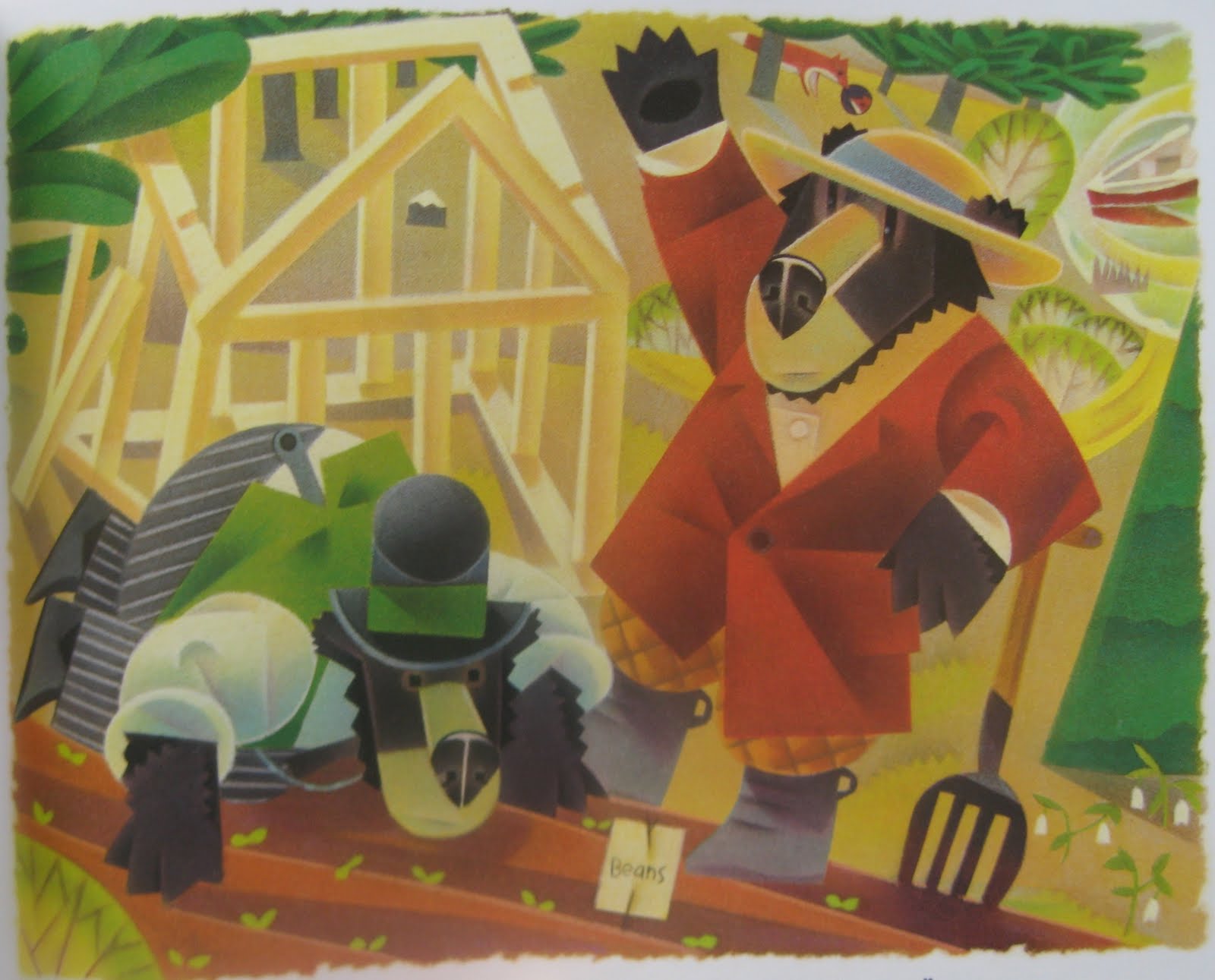
Henry Builds a Cabin has the frugal bear buying lumber from a torn-down shed, assembling tools and plans, and then as he does the piecemeal construction having to explain to neighbors “Emerson,” “Alcott,” and others how his “too small” cabin grows considerably more spacious when the bean patch serves as his dining room, a sun-and-shade nook next to his cabinbecomes the library, stone steps leading down to the creek magically ‘morph into a ballroom for dancing, and the entire cabin is his umbrella when it rains. (And rain in Johnson’s rural New England landscapes is a particular visual wonder!)
Book 3, Henry Climbs a Mountain, gradually becomes a game of “Can You Top This?” as the principled bear—wearing only one boot and having refused to pay the taxman--is escorted to the localhoosegow. (If the same famous incident, there is no visit by Emerson depicted, when he supposedly asked, “Henry, why are you in there?” and was answered, “Emerson, why are you out there?”)
Using crayons from his pocket, Henry first sketches his missing boot and then covers the walls and ceiling with drawings that carry him right out of the cell, over rocks and streams, and straight up a neighboring mountain where he views… a hawk gliding overhead, far-off terrain below, and a stranger walking toward him--who turns out to be anescaped slave “riding” the Underground Railroad, following the “Drinking Gourd” and Northern Star on up to Canada. He is (of course) bear foot and still has a slave shackle around one ankle.
The two bears enjoy their world for a while, then Henry gives the escapee his boots and stumbles hurriedly back down the mountain, “arriving” in his cell just in time for breakfast and the news that someone has paid his taxes. He’s free once more; how does that feel? “Like being on top of a very tall mountain.” And so Henry departs—to buy a new pair of shoes!
The passage in Walden reads thus: “One afternoon, near the end of the first summer, when I went to the village to get a shoe from the cobbler’s, I was seized and put into jail, because I did not pay a tax to, or recognize the authority of, the state which buys and sells men, women, and children, like cattle at the door of its senate-house.”
Using those words plus another quote, along with climbing experiences Thoreau wrote about, and a smidgin of magic realism, author-illustrator Johnson fashioned atale to remind us of that first Henry’s other important work, “Civil Disobedience,” the speech that gradually became a whole non-violent resistance doctrine, used so effectively by Gandhi, Martin Luther King Jr., and other proponents of peace and freedom around the world. The list now also includes this year’s citizen actions in the streets of Cairo, Tripoli, Damascus, Athens, and… New York, Chicago, Oakland, Madison, Montreal, and more.
As the first Henry almost wrote,"The most of men lead lives of quiet occupation"--except for the millions who are underemployed and trying to live through the world recession and the sham of modern global capitalism. And all those folks must occupy themselves in other ways and other places, to reclaim their dignity and their rights… including the right to be there, anywhere, and their right to be here, period.
I doff my high-hat to both Henrys, with thanks, and to those who have bravely and angrily and desperately taken to the streets, I say:
Happy Trespass. Happy Transgression. Happy Thanksgiving.
a politically progressive blog mixing pop culture, social commentary, personal history, and the odd relevant poem--with links to recommended sites below right-hand column of photos
Tuesday, November 22, 2011
Saturday, November 12, 2011
Mingus Misprized, Duke Reprised
I’ve been thinking about Duke Ellington’s four-year loose affiliation with Frank Sinatra’s Reprise Records. Sinatra signed him on as an artist, presumably with a contract for X number of albums; then he did something more radical and innovative (or maybe risky): he also gave Duke a title and sometime job as A&R man for the label’s Jazz interests.
I should have bought the Mosaic set back a decade ago that revisited Ellington’s own albums for Reprise, not only because I quite like a few of them (especially his treatment of tunes from Disney’s Mary Poppins, plus the Afro Bossa and Symphonic Ellington LPs), but also because I’d love to read and learn from Mosaic’s special essay/discography booklet—a highlight of every set; a treat and an education no matter who or what the subject.
For example, Duke was soon responsible for producing the debut albums, cut in Paris the same day in 1963, of pianist Dollar Brand (better known as Abdullah Ibrahim) and stylized beginner vocalist Bea Benjamin (soon to become Ibrahim’s wife, and add “Sathima” to her name). The Brand album merited some critical attention and praise, but Benjamin’s equally intriguing session was shelved by Sinatra and only released in the Nineties. (More about Bea’s forgotten album below.)
Ignoring A&R Duke’s other hits and misses (from Bud Powell to Alice Babs), I have sometimes wondered… What if Charles Mingus had been without a contract at the time (rather than recording piecemeal for Atlantic and RCA and Impulse)? The bassist/bandleader greatly admired Ellington--openly competed with him too--and his big band compositions paid homage to Duke’s elastic but painstakingly crafted approach, building his compositions around the particular talents of each Ellingtonian. It’s a major loss for Jazz that the two great leaders only ever got to record as “equals” on the prickly but remarkable, and occasionally brilliant, Money Jungle trio date with Max Roach. (Mingus threatened to quit midway through the session but Duke calmed him down--a bit ironic considering that Mingus was the only band member that Duke ever fired outright.)
But fiery Charles was definitely one who broke the mold, a volatile mix of sensitivity, creativity, and orneriness, of gospel soul, sophisticated vision, and impolitic pugnacity. Only the contra-bass was massive enough to match big, bullish, master musician Mingus; and that “contra-“ prefix suited him too since he measured himself against… well… not to put too fine a point on it, the world: white racists, Ellington, record labels, other bassists, players he hired who didn’t “burn” with the same “orange, then blue” flame (those three words the title of one of his best-known compositions). Like Walt Whitman, Mingus embraced multitudes.
I assume that all these elements will—like the artist himself—loom large in the new documentary titled Mingus on Mingus, directed by his grandson Kevin Ellington Mingus (interesting name) and currently in the midst of filming. Except, to be strictly correct, the crew is on hold at the moment because, from November 7 to December 18, the core backers and creators are seeking to raise an additional $45,000. (You can read all about the project at www.orangethenblue.com, and also watch a brief trailer here. Then give whatever financial support you can muster!)
At any rate, any later creative interaction between Duke and Mingus was away from public view, if such occurred. In fact Ellington’s A&R work soon fizzled; he didn’t submit (m)any more productions other than his own orchestra’s—and some of those, recorded between ‘63 and ’65, actually turned up on the Atlantic label. Was Duke miffed at the lukewarm reception several of his projects received? Did Sinatra have second thoughts, wanting material more pop/commercial in content? Or did the souring relations result from new parent company Warner Bros. getting involved?
Apparently given short shrift were the second half of some “Duke-revives-the-Big-Bands” sessions, and a fiddlers-three project recorded around the time of the (pending) Mr. and Mrs. Benjamin-Brand-Ibrahim’s day in the studio--a Jazz violinists' summit of Ray Nance, Stephane Grappelli, and Svend Asmussen plus Duke and a couple of sidemen.
Asmussen, in fact, was a major addition to Bea Benjamin’s recording session, with all 12 songs cut, as the album title says, in the course of A Morning in Paris. Featured on the dozen were 1) some subtly Africa-tinged drum-work by Makaya Ntshoko; 2) a regal trio of pianists (Duke, Ibrahim, and Billy Strayhorn) taking turns at the keyboard; 3) then-still-Ms. Benjamin’s kittenish and slightly husky voice; and 4) the unplanned, unexpected addition of Svend—but plucking his violin’s strings singly or percussively rather than bowing them.
Curious and often compelling was the sound of those four features blended together—excellent takes on “Darn That Dream,” “I Should Care,” “Lover Man,” and “A Nightingale Sang in Berkeley Square.” But there are some irritants too. For too many tracks—and this is hard to fathom--the three pianists are so subdued as to be basically phoning it in over a failing long-distance line. Instead, Asmussen’s pizzicato commentaries are allowed to take the lead. At first I thought his staggered plucks to be oddly akin to the “speaking voice” solos of reedsman Eric Dolphy (Mingus’s revered cohort around the same time), or even some sort of weak and thin version of a bass player’s freeform accompaniment. Then I came to my senses and realized it was all just a novelty, a misguided momentary lapse by the ever-curious, willing-to-risk-it Duke.
If Ellington had intended a stripped-down, maybe simple bass-and-guitar backing, he surely could have made that happen. From Wellman Braud and Jimmy Blanton to Aaron Bell and Ray Brown, Duke usually relied on top bassists only, and if he’d had Jimmy Woode or John Lamb (or Mingus!), say, to provide the backing for Benjamin, rather than inadequate Johnny Gertze (yes, there was a bass just barely present) or bizarre Svendisms, her debut album might have appeared on Reprise in ’63 or ’64 rather than vanishing into the vaults full of no-hopes and not-likelies.
Even though Bea went on to a vocal career still continuing in South Africa today, it was only in 1997 that A Morning in Paris ever “dawned,” when the original recording engineer was found to have kept his own copy of the tapes for 35 years! By then, her album seemed a quirky curiosity instead of a lost masterpiece.
Maybe if Ellington had put a little more thought and effort into prepping the fledgling singer and the pick-up session men, rather than relying on the moment’s happenstance (which he could do reliably with his Ellingtonians, and did for 45 years or so), the Benjamin story might have taken a different course, and Duke might have had a more lasting A&R career, earning a solid reputation as producer of other major Jazz artists—which might also have helped Reprise’s anemic bottom line.
Ellington might even have persuaded Sinatra to give misprized Charles Mingus a chance.
I should have bought the Mosaic set back a decade ago that revisited Ellington’s own albums for Reprise, not only because I quite like a few of them (especially his treatment of tunes from Disney’s Mary Poppins, plus the Afro Bossa and Symphonic Ellington LPs), but also because I’d love to read and learn from Mosaic’s special essay/discography booklet—a highlight of every set; a treat and an education no matter who or what the subject.
For example, Duke was soon responsible for producing the debut albums, cut in Paris the same day in 1963, of pianist Dollar Brand (better known as Abdullah Ibrahim) and stylized beginner vocalist Bea Benjamin (soon to become Ibrahim’s wife, and add “Sathima” to her name). The Brand album merited some critical attention and praise, but Benjamin’s equally intriguing session was shelved by Sinatra and only released in the Nineties. (More about Bea’s forgotten album below.)
Ignoring A&R Duke’s other hits and misses (from Bud Powell to Alice Babs), I have sometimes wondered… What if Charles Mingus had been without a contract at the time (rather than recording piecemeal for Atlantic and RCA and Impulse)? The bassist/bandleader greatly admired Ellington--openly competed with him too--and his big band compositions paid homage to Duke’s elastic but painstakingly crafted approach, building his compositions around the particular talents of each Ellingtonian. It’s a major loss for Jazz that the two great leaders only ever got to record as “equals” on the prickly but remarkable, and occasionally brilliant, Money Jungle trio date with Max Roach. (Mingus threatened to quit midway through the session but Duke calmed him down--a bit ironic considering that Mingus was the only band member that Duke ever fired outright.)
But fiery Charles was definitely one who broke the mold, a volatile mix of sensitivity, creativity, and orneriness, of gospel soul, sophisticated vision, and impolitic pugnacity. Only the contra-bass was massive enough to match big, bullish, master musician Mingus; and that “contra-“ prefix suited him too since he measured himself against… well… not to put too fine a point on it, the world: white racists, Ellington, record labels, other bassists, players he hired who didn’t “burn” with the same “orange, then blue” flame (those three words the title of one of his best-known compositions). Like Walt Whitman, Mingus embraced multitudes.
I assume that all these elements will—like the artist himself—loom large in the new documentary titled Mingus on Mingus, directed by his grandson Kevin Ellington Mingus (interesting name) and currently in the midst of filming. Except, to be strictly correct, the crew is on hold at the moment because, from November 7 to December 18, the core backers and creators are seeking to raise an additional $45,000. (You can read all about the project at www.orangethenblue.com, and also watch a brief trailer here. Then give whatever financial support you can muster!)
At any rate, any later creative interaction between Duke and Mingus was away from public view, if such occurred. In fact Ellington’s A&R work soon fizzled; he didn’t submit (m)any more productions other than his own orchestra’s—and some of those, recorded between ‘63 and ’65, actually turned up on the Atlantic label. Was Duke miffed at the lukewarm reception several of his projects received? Did Sinatra have second thoughts, wanting material more pop/commercial in content? Or did the souring relations result from new parent company Warner Bros. getting involved?
Apparently given short shrift were the second half of some “Duke-revives-the-Big-Bands” sessions, and a fiddlers-three project recorded around the time of the (pending) Mr. and Mrs. Benjamin-Brand-Ibrahim’s day in the studio--a Jazz violinists' summit of Ray Nance, Stephane Grappelli, and Svend Asmussen plus Duke and a couple of sidemen.
Asmussen, in fact, was a major addition to Bea Benjamin’s recording session, with all 12 songs cut, as the album title says, in the course of A Morning in Paris. Featured on the dozen were 1) some subtly Africa-tinged drum-work by Makaya Ntshoko; 2) a regal trio of pianists (Duke, Ibrahim, and Billy Strayhorn) taking turns at the keyboard; 3) then-still-Ms. Benjamin’s kittenish and slightly husky voice; and 4) the unplanned, unexpected addition of Svend—but plucking his violin’s strings singly or percussively rather than bowing them.
Curious and often compelling was the sound of those four features blended together—excellent takes on “Darn That Dream,” “I Should Care,” “Lover Man,” and “A Nightingale Sang in Berkeley Square.” But there are some irritants too. For too many tracks—and this is hard to fathom--the three pianists are so subdued as to be basically phoning it in over a failing long-distance line. Instead, Asmussen’s pizzicato commentaries are allowed to take the lead. At first I thought his staggered plucks to be oddly akin to the “speaking voice” solos of reedsman Eric Dolphy (Mingus’s revered cohort around the same time), or even some sort of weak and thin version of a bass player’s freeform accompaniment. Then I came to my senses and realized it was all just a novelty, a misguided momentary lapse by the ever-curious, willing-to-risk-it Duke.
If Ellington had intended a stripped-down, maybe simple bass-and-guitar backing, he surely could have made that happen. From Wellman Braud and Jimmy Blanton to Aaron Bell and Ray Brown, Duke usually relied on top bassists only, and if he’d had Jimmy Woode or John Lamb (or Mingus!), say, to provide the backing for Benjamin, rather than inadequate Johnny Gertze (yes, there was a bass just barely present) or bizarre Svendisms, her debut album might have appeared on Reprise in ’63 or ’64 rather than vanishing into the vaults full of no-hopes and not-likelies.
Even though Bea went on to a vocal career still continuing in South Africa today, it was only in 1997 that A Morning in Paris ever “dawned,” when the original recording engineer was found to have kept his own copy of the tapes for 35 years! By then, her album seemed a quirky curiosity instead of a lost masterpiece.
Maybe if Ellington had put a little more thought and effort into prepping the fledgling singer and the pick-up session men, rather than relying on the moment’s happenstance (which he could do reliably with his Ellingtonians, and did for 45 years or so), the Benjamin story might have taken a different course, and Duke might have had a more lasting A&R career, earning a solid reputation as producer of other major Jazz artists—which might also have helped Reprise’s anemic bottom line.
Ellington might even have persuaded Sinatra to give misprized Charles Mingus a chance.
Tuesday, November 1, 2011
Ill Wind
Autumn has hit the U.S. with a vengeance: early snows, more flooding, storms hurling the fall-color leaves away to some other part of the world… and El Nino, or La Nina, or the Pinta and Santa Maria, or all four, threatening to wash America back to Vespucci and Isabella.
Nor are we alone in facing nature’s wrath. Whether you place your bet on Global Warming or climate change or warped statistics or Mayan prophecy, the arriving winter of 2011-2012 looks to be a doozy…
It’s 25 years now since Sandra and I and various children spent a chilly fall and icy winter skirting the Mediterranean from Provence to Portugal’s Algarve in search of warmth. The “coldest European winter in decades” was foretold, even heralded, that year by a particularly fierce mistral wind sweeping down and across Provence.
(Perfectly apt: that raw and raucous wind from hell is also the surname of the great Nobel-prizewinning poet Frederic Mistral, champion of the Provencal language. My slight whisper of air to be read below would be quickly lost in the storm gales and summer zephyrs he unleashed.)
I seem to remember, from Lawrence Durrell’s South-of-France quintet of novels (less known and less important than his dazzling, and bedazzled, Alexandria Quartet), that a mistral sometimes blows hot air rather than cold.
But not in early November, 1986…
Le Mistral
Ice-hard and unyielding,the autumn whirlwind bruises,
pummels crisp clouds askew,
and shreds the huddling trees
of their sharp, shriveled leaves.
Rapacious, falcon-fierce,
le mistral grips Provence;
chill talons rake the Rhone
from Arles back to Avignon,
beating the soul to its knees
with all fall’s cold at once.
Now the late grapes vein bluelike Papist folk new-shriven,
and the last vineyards lose
their golden cypress shielding.
Now the blood-earth grieves
a troubadour’s song of years,
dry hectares crying woe
for the region’s tans and creams,
burnt reds, bright blues, driven
in hiding, gone to cover
in halls of bauxite bone:
a blanched rotogravure
the dull, vainglorious endof summer's sun-drenched dreams.
Le soleil’s ancient foe,
the bandit mistral wind
demands his droit du seigneur,
pillaging Aix to Vaucluse,
till stripped to dust and stone,
Provence arrests the reiver.
Nor are we alone in facing nature’s wrath. Whether you place your bet on Global Warming or climate change or warped statistics or Mayan prophecy, the arriving winter of 2011-2012 looks to be a doozy…
It’s 25 years now since Sandra and I and various children spent a chilly fall and icy winter skirting the Mediterranean from Provence to Portugal’s Algarve in search of warmth. The “coldest European winter in decades” was foretold, even heralded, that year by a particularly fierce mistral wind sweeping down and across Provence.
(Perfectly apt: that raw and raucous wind from hell is also the surname of the great Nobel-prizewinning poet Frederic Mistral, champion of the Provencal language. My slight whisper of air to be read below would be quickly lost in the storm gales and summer zephyrs he unleashed.)
I seem to remember, from Lawrence Durrell’s South-of-France quintet of novels (less known and less important than his dazzling, and bedazzled, Alexandria Quartet), that a mistral sometimes blows hot air rather than cold.
But not in early November, 1986…
Le Mistral
Ice-hard and unyielding,the autumn whirlwind bruises,
pummels crisp clouds askew,
and shreds the huddling trees
of their sharp, shriveled leaves.
Rapacious, falcon-fierce,
le mistral grips Provence;
chill talons rake the Rhone
from Arles back to Avignon,
beating the soul to its knees
with all fall’s cold at once.
Now the late grapes vein bluelike Papist folk new-shriven,
and the last vineyards lose
their golden cypress shielding.
Now the blood-earth grieves
a troubadour’s song of years,
dry hectares crying woe
for the region’s tans and creams,
burnt reds, bright blues, driven
in hiding, gone to cover
in halls of bauxite bone:
a blanched rotogravure
the dull, vainglorious endof summer's sun-drenched dreams.
Le soleil’s ancient foe,
the bandit mistral wind
demands his droit du seigneur,
pillaging Aix to Vaucluse,
till stripped to dust and stone,
Provence arrests the reiver.
Wednesday, October 26, 2011
Flash Gordon and Rocket Fresh Rainier
Rainier Beer celebrated its hundred-year anniversary in 1976... well, sort of "a hundred"; there was some discontinuity ignored, some no-beer years due to Prohibition and such.
My boss coined the word “Beercentennial” to mark the occasion verbally--America’s Bicentennial was still, er, Fresh in the minds of folks--and we dreamed up television ads that touched on the past, present, and (possible) future of the popular beer. (I was writer/producer for the firm that provided all creative work for the brewery.)
Rainier had a reputation for presenting strange and surprising, tongue-in-cheek and amusing, commercials back then--still a rarity back in those stolid Seventies. But the requisite seriousness of such a major benchmark for Rainier actually constrained our much-vaunted creativity. Blowing the frothy heads off a tray of poured beers was about as wild as we got... except for the "future" spot, which evolved gradually from a single sci-fi parody to a 30-second extravaganza that borrowed from the “hot” films 2001 and Star Wars, joined by the outmoded glory of newspaper-strip and movie-serial hero Flash Gordon.
Our commercial ended up inside the bizarre Star Wars bar, where the camera discovers a big reunion in progress for the Flash Gordon characters—Dr. Zarkov, the lovely Dale, Ming the Merciless, and so on, plus (renamed for ad purposes) “Fresh” himself. But this reunion is occurring many years later, with the characters showing their post-retirement age.
Most of the parts were taken by local actors, but we actually hired the original movie Flash, Buster Crabbe (famous as a handsome, virile Tarzan too), still showing serious star power at age 72 (as I recall). Crabbe was serendipitously the main guest that year at a nicely timed Seattle science fiction convention, and we were happy to use his accessibility to our advantage.
In those days we also created several beer posters each year, usually related to the TV spots that were appearing. But the brewery balked at a "Fresh Gordon" poster; we couldn’t convince them of the sudden craze for science fiction that was sweeping the country. But I was so certain of its viability that I got permission from Rainier to print and market the poster myself.
So a comics shop owner and I did just that, printed 2000 or so, and over the next year-and-some sold all of them, to sci-fi fanatics and Rainier collectors and specialty poster shops. Now, skip ahead 35 years. Searching through stuff recently, before wife Sandra and I left on vacation, I found the copy of “our” poster that I’d kept as a sample/souvenir.
I decided to write a blog post around it, and that’s what you’ve been reading. (Used to caption the poster, that tiny print you can’t make out in the lower right-hand corner was meant to sound like pulp magazine copy.)
Retro rockets firing, Fresh Gordon jockeyed his MFR-80 spaceship down onto the arid, dusty surface of planet Bungo.
Then, aided by his thirsty companions of so many years, Fresh broke through the belligerent throng of alien vizki and d’jin, forging a path straight to the barren world’s lone outpost of galactic civilization, the B’aarli Maltina. There the beerless company at last espied the liquid treasure for which they had quested so long--Mountain Fresh Rainier.
Even Bing the Brewless was overcome. “The Beer That Conquered the Galaxy” soon quenched five more parched throats.
Classy, huh? Oh yeah, I really thought I was hot stuff back in the day…
My boss coined the word “Beercentennial” to mark the occasion verbally--America’s Bicentennial was still, er, Fresh in the minds of folks--and we dreamed up television ads that touched on the past, present, and (possible) future of the popular beer. (I was writer/producer for the firm that provided all creative work for the brewery.)
Rainier had a reputation for presenting strange and surprising, tongue-in-cheek and amusing, commercials back then--still a rarity back in those stolid Seventies. But the requisite seriousness of such a major benchmark for Rainier actually constrained our much-vaunted creativity. Blowing the frothy heads off a tray of poured beers was about as wild as we got... except for the "future" spot, which evolved gradually from a single sci-fi parody to a 30-second extravaganza that borrowed from the “hot” films 2001 and Star Wars, joined by the outmoded glory of newspaper-strip and movie-serial hero Flash Gordon.
Our commercial ended up inside the bizarre Star Wars bar, where the camera discovers a big reunion in progress for the Flash Gordon characters—Dr. Zarkov, the lovely Dale, Ming the Merciless, and so on, plus (renamed for ad purposes) “Fresh” himself. But this reunion is occurring many years later, with the characters showing their post-retirement age.
Most of the parts were taken by local actors, but we actually hired the original movie Flash, Buster Crabbe (famous as a handsome, virile Tarzan too), still showing serious star power at age 72 (as I recall). Crabbe was serendipitously the main guest that year at a nicely timed Seattle science fiction convention, and we were happy to use his accessibility to our advantage.
In those days we also created several beer posters each year, usually related to the TV spots that were appearing. But the brewery balked at a "Fresh Gordon" poster; we couldn’t convince them of the sudden craze for science fiction that was sweeping the country. But I was so certain of its viability that I got permission from Rainier to print and market the poster myself.
So a comics shop owner and I did just that, printed 2000 or so, and over the next year-and-some sold all of them, to sci-fi fanatics and Rainier collectors and specialty poster shops. Now, skip ahead 35 years. Searching through stuff recently, before wife Sandra and I left on vacation, I found the copy of “our” poster that I’d kept as a sample/souvenir.
I decided to write a blog post around it, and that’s what you’ve been reading. (Used to caption the poster, that tiny print you can’t make out in the lower right-hand corner was meant to sound like pulp magazine copy.)
Retro rockets firing, Fresh Gordon jockeyed his MFR-80 spaceship down onto the arid, dusty surface of planet Bungo.
Then, aided by his thirsty companions of so many years, Fresh broke through the belligerent throng of alien vizki and d’jin, forging a path straight to the barren world’s lone outpost of galactic civilization, the B’aarli Maltina. There the beerless company at last espied the liquid treasure for which they had quested so long--Mountain Fresh Rainier.
Even Bing the Brewless was overcome. “The Beer That Conquered the Galaxy” soon quenched five more parched throats.
Classy, huh? Oh yeah, I really thought I was hot stuff back in the day…
Monday, October 10, 2011
Roots, Right Hooks, and Hits
Remember the Who’s hardnose heyday and Roger Daltry raging, “Hope I die before I get old”? Never imagined I’d ever have to admit such a sea-change, but the older I get, the farther I drift from Rock and the nearer I draw to Folk (or, in current terminology, Roots/Americana). Only the Guthrie/Dylan/Springsteen-styled Populist mergers keep me hangin' on and around the Rock scene at all. (Happy to admit I haven’t looked at a Rolling Stone issue in years!)
So here are a half-dozen Folk/Roots (&Beyond) CD releases, both new and older, that I’ve heard and enjoyed in recent weeks (and you can play spot-the-connections if you choose):
Purpose + Grace (Topic). Pride of place goes to our guest from across the Pond, Martin Simpson. Back in Old Blighty after several years’ residency in the U.S., Simpson plays a Blues-infused, Anglo-AND-American Folk now, his guitar work smooth and Root-solid, often surprising, occasionally sensational. His own vocals keep improving too, but for this eclectic set, he brought in some big guns: June Tabor, Dick Gaughan, Richard Thompson. And the tunes are terrific, ranging from antique (“The Sheffield Apprentice” and “Barbry Allen”) to Americana (great expanded versions of “In the Pines” and “Little Liza Jane”), from updated (“Bad Girl’s Lament” and “Jamie Foyers”) to current (“Brothers Under the Bridge” and “Strange Affair”). Still, the disc’s apex is reached--and the album’s title secured--when Martin and “Geordie” Gaughan team up for Depression-anthem-come-‘round-again “Brother Can You Spare a Dime.” Anthemic and--think English slang now--brilliant.
Pull Up Some Dust and Sit Down (Nonesuch). Ry Cooder’s new albumchannels Woody Guthrie to offer Ry’s trenchant musical response to the New Depression and never-ending political chicanery--played as only slide-master Cooder can so casually emulate—with angry laments against Wall Street, the wars abroad, old folks cheated, families splintered, returning veterans neglected, a modern Jesse James (Tex-Mex corrida style), and other on-going Populist complaints. It’s a wry Cooder keeper, blending Blues, Old Time Country, Gospel, Folk Ballads, and other Roots-in-Americana; and his National steel guitar might rightly sport a sticker updating the well-known phrase on Guthrie’s: “This machine crushes banksters and warmongering profiteers.”
Note of Hope (429 Records). Opening salvo in the big build-up to the 2012 Guthrie centennial. Unfortunately there’s less meat and more aimless motion in this collection of unknown Woody texts nesting in new musical settings. The whole first half of the CD just limps along, but then Kurt Elling’s boogie and Ani DiFranco’s mechanized “Voice” auger some better; Pete Seegar and Studs Terkel (the one prodded awake and the other resurrected via tape) rouse ‘n’ roll the bindle on down the line; and Chris Whitley (high and lonesome some weeks before he died) and Jackson Browne, rumblin’ and rattlin’ for a fanciful 14-minute “You Know the Night” (Woody busily courting his second wife)… well, de Gents and DiFrank Lady do just manage to take ‘er on home after all.
Wonder Wheel (Jewish Music Group). The Klezmatics had Guthrie Estate approval to adapt some of his Coney Island-era writings to klezmer music… not a totally off-kilter stretch since the folk-poet’s second wife Marjorie (mother of Arlo and Nora plus two) was Jewish. But the result, while sung splendidly and played with an ear attuned to stately (rather than spirited) dance, seems to me a waste of Woody. The klezmer arrangements just overwhelm the Okie from Okemah, rendering his posthumous contributions surprisingly unraucous. Klezmatics fans should sample “Mermaid’s Avenue” (the only Woody lyrics offering his usual evocative sense of place), “Gonna Get through This World,” “From Here On In,” and “Wheel of Life” (Rabbi Woody, would you believe?), while the goyisch Guthrie gang must settle for his less earthy, more spiritual writings: “Holy Ground,” “Orange Blossom Ring,” and “Heaven.”
World Musette (Paris Jazz Corner). Klezmer clarinets, saxes, and fiddles show up sometimes in the wonderful French music called musette—bluesy and triste (sad) but somehow lightly so--which more commonly features accordion and guitar (and violin bien sur). The ever-changing ensemble known as Les Primitifs du Futur took a broader approach for this disc, incorporating xylophone, Hawaiian steel guitar, trumpet, oud, and whatever else might be needed to create a many-nations, World Music version of musette. Present too for many of the tracks, adding banjo, mandolin, and some vocals (plus artwork for the elaborate CD booklet, itself worth the price of the disc), is U.S. expatriate Robert Crumb, better known as cartoonist R. Crumb, professional artist and amateur musician--as opposed to amateur artist and professional musician W. Guthrie, but both men shaped by the Depression (one way or another) and each eventually emblematic of his time. All that aside, this album is strangely effective, a potpourri of varied sounds and styles, China to America, that still links back to the Parisian clubs and Buenos Aires dives that musette evokes.
There’s More Pretty Girls Than One (Arhoolie). Both Crumb and fiddler Ian McCamy appeared on World Musette; now, a decade later, comes McCamy's Melody Sheiks, a cheery quartet of expats residing in Provence and gleefully making Old Timey music together—tight and in tune, but no threat to the master pickers on either side of the Atlantic. And so what? With this repertoire, all the Sheiks need is a suit and a smile:
“Drunken Hiccups” and “Goodbye Booze,” “Ragtime Annie” and “Old Molly Hare,” both the “Dill Pickle” and “Pig Ankle” rags, the “Quebec Quickstep” and “Saint Jobe’s Waltz,” “Take Me Back to Georgia” and “Home Sweet Home.” Hot times in the Old Country, thanks to Crumb’s great collection of Twenties 78s, and a hell of a ways from the "New Country" we know and leave, gladly, behind! So rise up, Billy, and walk along, John, and sail away, ladies, sail away...
Catch ya on the other side.
So here are a half-dozen Folk/Roots (&Beyond) CD releases, both new and older, that I’ve heard and enjoyed in recent weeks (and you can play spot-the-connections if you choose):
Purpose + Grace (Topic). Pride of place goes to our guest from across the Pond, Martin Simpson. Back in Old Blighty after several years’ residency in the U.S., Simpson plays a Blues-infused, Anglo-AND-American Folk now, his guitar work smooth and Root-solid, often surprising, occasionally sensational. His own vocals keep improving too, but for this eclectic set, he brought in some big guns: June Tabor, Dick Gaughan, Richard Thompson. And the tunes are terrific, ranging from antique (“The Sheffield Apprentice” and “Barbry Allen”) to Americana (great expanded versions of “In the Pines” and “Little Liza Jane”), from updated (“Bad Girl’s Lament” and “Jamie Foyers”) to current (“Brothers Under the Bridge” and “Strange Affair”). Still, the disc’s apex is reached--and the album’s title secured--when Martin and “Geordie” Gaughan team up for Depression-anthem-come-‘round-again “Brother Can You Spare a Dime.” Anthemic and--think English slang now--brilliant.
Pull Up Some Dust and Sit Down (Nonesuch). Ry Cooder’s new albumchannels Woody Guthrie to offer Ry’s trenchant musical response to the New Depression and never-ending political chicanery--played as only slide-master Cooder can so casually emulate—with angry laments against Wall Street, the wars abroad, old folks cheated, families splintered, returning veterans neglected, a modern Jesse James (Tex-Mex corrida style), and other on-going Populist complaints. It’s a wry Cooder keeper, blending Blues, Old Time Country, Gospel, Folk Ballads, and other Roots-in-Americana; and his National steel guitar might rightly sport a sticker updating the well-known phrase on Guthrie’s: “This machine crushes banksters and warmongering profiteers.”
Note of Hope (429 Records). Opening salvo in the big build-up to the 2012 Guthrie centennial. Unfortunately there’s less meat and more aimless motion in this collection of unknown Woody texts nesting in new musical settings. The whole first half of the CD just limps along, but then Kurt Elling’s boogie and Ani DiFranco’s mechanized “Voice” auger some better; Pete Seegar and Studs Terkel (the one prodded awake and the other resurrected via tape) rouse ‘n’ roll the bindle on down the line; and Chris Whitley (high and lonesome some weeks before he died) and Jackson Browne, rumblin’ and rattlin’ for a fanciful 14-minute “You Know the Night” (Woody busily courting his second wife)… well, de Gents and DiFrank Lady do just manage to take ‘er on home after all.
Wonder Wheel (Jewish Music Group). The Klezmatics had Guthrie Estate approval to adapt some of his Coney Island-era writings to klezmer music… not a totally off-kilter stretch since the folk-poet’s second wife Marjorie (mother of Arlo and Nora plus two) was Jewish. But the result, while sung splendidly and played with an ear attuned to stately (rather than spirited) dance, seems to me a waste of Woody. The klezmer arrangements just overwhelm the Okie from Okemah, rendering his posthumous contributions surprisingly unraucous. Klezmatics fans should sample “Mermaid’s Avenue” (the only Woody lyrics offering his usual evocative sense of place), “Gonna Get through This World,” “From Here On In,” and “Wheel of Life” (Rabbi Woody, would you believe?), while the goyisch Guthrie gang must settle for his less earthy, more spiritual writings: “Holy Ground,” “Orange Blossom Ring,” and “Heaven.”
World Musette (Paris Jazz Corner). Klezmer clarinets, saxes, and fiddles show up sometimes in the wonderful French music called musette—bluesy and triste (sad) but somehow lightly so--which more commonly features accordion and guitar (and violin bien sur). The ever-changing ensemble known as Les Primitifs du Futur took a broader approach for this disc, incorporating xylophone, Hawaiian steel guitar, trumpet, oud, and whatever else might be needed to create a many-nations, World Music version of musette. Present too for many of the tracks, adding banjo, mandolin, and some vocals (plus artwork for the elaborate CD booklet, itself worth the price of the disc), is U.S. expatriate Robert Crumb, better known as cartoonist R. Crumb, professional artist and amateur musician--as opposed to amateur artist and professional musician W. Guthrie, but both men shaped by the Depression (one way or another) and each eventually emblematic of his time. All that aside, this album is strangely effective, a potpourri of varied sounds and styles, China to America, that still links back to the Parisian clubs and Buenos Aires dives that musette evokes.
There’s More Pretty Girls Than One (Arhoolie). Both Crumb and fiddler Ian McCamy appeared on World Musette; now, a decade later, comes McCamy's Melody Sheiks, a cheery quartet of expats residing in Provence and gleefully making Old Timey music together—tight and in tune, but no threat to the master pickers on either side of the Atlantic. And so what? With this repertoire, all the Sheiks need is a suit and a smile:
“Drunken Hiccups” and “Goodbye Booze,” “Ragtime Annie” and “Old Molly Hare,” both the “Dill Pickle” and “Pig Ankle” rags, the “Quebec Quickstep” and “Saint Jobe’s Waltz,” “Take Me Back to Georgia” and “Home Sweet Home.” Hot times in the Old Country, thanks to Crumb’s great collection of Twenties 78s, and a hell of a ways from the "New Country" we know and leave, gladly, behind! So rise up, Billy, and walk along, John, and sail away, ladies, sail away...
Catch ya on the other side.
Wednesday, October 5, 2011
Re:Freshin' (and Rainier Beer)
After limping through the Weill marathon, my clumsy stumblings in pursuit of his Jazz connections exacerbated by a recalcitrant new computer that keeps refusing to follow orders, well, I’m just bone tired. I feel like the Incredible Shrinking Man’s cousin. Add-in real height loss resulting from Parkinson’s as well as collapsing vertebrae… and it’s no wonder I’ve been having this irritating Mad Men/Pan Am Fifties dream...
My wife and I are out for a walk, and we bump into somebody she knows from business.
“Hey, Jim,” she says to him, “I want you to meet the ‘little man.’ Don’t know what I’d do without him… gets me out the door in the morning and keeps me going. Keeps me on my toes too.”
Not really. These days Sandie can wear flats and still get above my paltry 5’8”. I’ve lost nearly four inches in height, which has all slid down to my waistline. That’s one definition of an “Adult,” of course… someone who’s stopped growing at both ends and started growing in the middle. (I qualify.)
At any rate, no more big essays for a while (a Weill?). In fact, we’ll be gone east to Pennsylvania, New York, and Montreal for part of October, so blogging will be minimal for a… no, won’t say it… for some weeks.
These bleary thoughts have reminded me that back when I wrote and produced Rainier Beer ads (usually working off the buzzword phrase “Mountain Fresh,” clinging to the real tall mountain’s coat-tails), somebody among us on the creative team came up with a two-word bumper snicker that I liked well enough to stick a sample on my own car:
“GONE FRESHIN’.”
This time it’s RE-freshin’ I need, because… as we might have said in some other Rainier ad (but didn’t), with the unused two-word text positioned below photo of an empty sixpack-bottles carton…
Right now I’m “FRESH OUT.”
* * * * *
Note: One more post coming in a few days, so there’ll be something to think about while we're gone.
My wife and I are out for a walk, and we bump into somebody she knows from business.
“Hey, Jim,” she says to him, “I want you to meet the ‘little man.’ Don’t know what I’d do without him… gets me out the door in the morning and keeps me going. Keeps me on my toes too.”
Not really. These days Sandie can wear flats and still get above my paltry 5’8”. I’ve lost nearly four inches in height, which has all slid down to my waistline. That’s one definition of an “Adult,” of course… someone who’s stopped growing at both ends and started growing in the middle. (I qualify.)
At any rate, no more big essays for a while (a Weill?). In fact, we’ll be gone east to Pennsylvania, New York, and Montreal for part of October, so blogging will be minimal for a… no, won’t say it… for some weeks.
These bleary thoughts have reminded me that back when I wrote and produced Rainier Beer ads (usually working off the buzzword phrase “Mountain Fresh,” clinging to the real tall mountain’s coat-tails), somebody among us on the creative team came up with a two-word bumper snicker that I liked well enough to stick a sample on my own car:
“GONE FRESHIN’.”
This time it’s RE-freshin’ I need, because… as we might have said in some other Rainier ad (but didn’t), with the unused two-word text positioned below photo of an empty sixpack-bottles carton…
Right now I’m “FRESH OUT.”
* * * * *
Note: One more post coming in a few days, so there’ll be something to think about while we're gone.
Subscribe to:
Posts (Atom)
